Pomegra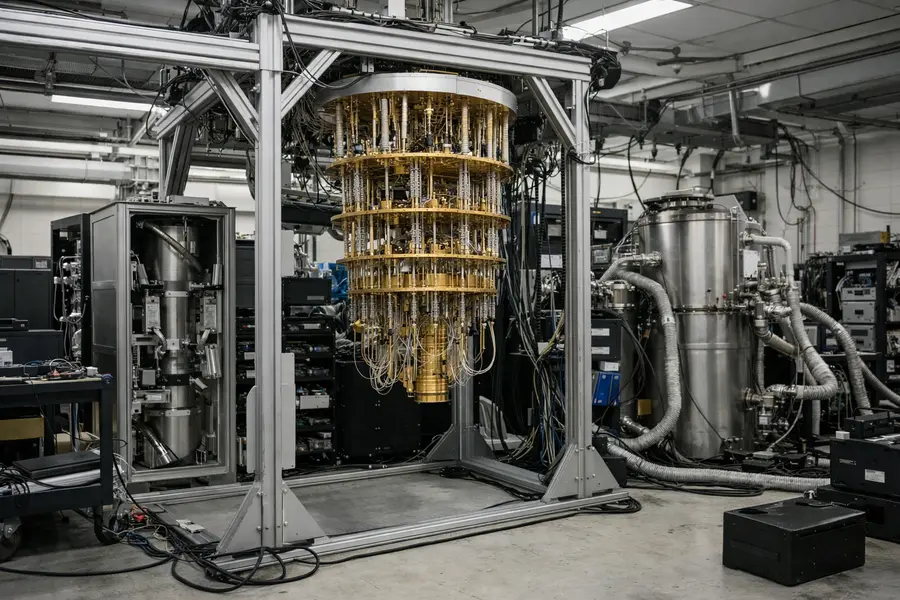
Google's Willow chip cut quantum errors 40-fold in a Science paper, reviving Bitcoin Q-Day fears, though no machine can break Bitcoin's encryption today.
- Google's Willow chip reached 99.99% logical fidelity using magic state cultivation, a roughly 40-fold error reduction.
- Willow has 105 qubits. Breaking Bitcoin's cryptography is estimated to need hundreds of thousands of physical qubits.
- About 6.04 million BTC sit in quantum-exposed addresses, keeping post-quantum upgrades on the Bitcoin agenda.
Lead
Alphabet (GOOG) unit Google Quantum AI said on Thursday, October 15, 2026, that it cut errors roughly 40-fold on its Willow processor. The results were published in the journal Science. The technique, called magic state cultivation, produced quantum states with 99.99% logical fidelity. The announcement renewed debate over "Q-Day", the point at which a quantum computer could break the elliptic-curve signatures that secure Bitcoin. The network itself is unaffected. Bitcoin traded near $81,249 on Friday, down about 1.5% on the day, within a weekly range of roughly $80,200 to $82,816.What Did Google Actually Achieve?
Google showed it can prepare the high-quality "magic states" that quantum computers need for complex programs at far lower cost. These states enable operations that error-corrected machines cannot otherwise perform, and producing them can consume up to 95% of a quantum computer's capacity.
The method starts with a rough, error-prone state, runs a series of checks and discards every failed attempt. What survives is a much cleaner state. The approach is selective: Willow retained only about 8% of preparation attempts. The team also moved states between two different error-correction schemes.
Google said further work is needed to scale the technique, but that it offers a path to reducing the hardware needed for fault-tolerant systems. The result builds on Willow's December 2024 demonstration of below-threshold error correction, in which error rates fell as qubit counts rose.
Does the Result Threaten Bitcoin Today?
No. Willow has 105 physical qubits, and breaking Bitcoin's 256-bit elliptic-curve cryptography requires a machine many orders of magnitude larger.
A March 2026 Google whitepaper put the requirement at fewer than 500,000 physical qubits. Published designs call for fewer than 1,200 to 1,450 error-corrected logical qubits and 70 million to 90 million Toffoli gates, a type of quantum logic operation. Attacking an RSA-2048 key is estimated to need error rates about a million times lower than the figure Google just demonstrated. Estimates of the qubit count needed for RSA-2048 have fallen from 20 million in 2019 to under 1 million in 2025.
The Science result addresses one bottleneck, the cost of magic states. It does not demonstrate the scale, speed or sustained operation a cryptanalytic machine would need.
How Far Away Is Q-Day?
Baseline forecasts cluster around 2033, with a range from 2030 to 2042. Each hardware or algorithmic advance tends to pull those estimates forward, which is why the Google result drew attention despite its limited immediate relevance.
Exposure is the practical concern. Glassnode data show about 6.04 million BTC in addresses whose public keys are already visible on-chain, including early coins in dormant wallets. These holdings would be the first targets for a capable quantum machine.
Why Does This Matter for Bitcoin's Roadmap?
The result strengthens the case for migrating to quantum-resistant signatures well before hardware arrives. Proposals under discussion in the developer community include introducing post-quantum signature schemes and freezing or restricting vulnerable coins, including dormant early wallets. Any change requires broad consensus across miners, node operators and holders, a process that has historically taken years.
Market reaction was muted. Bitcoin's decline on Friday was modest, and no market-wide repricing followed the paper. Alphabet shares showed no notable quantum-linked move in available reporting.
Outlook
Google's 40-fold error reduction marks progress toward fault-tolerant quantum computing but leaves Bitcoin's cryptography intact. The gap between a 105-qubit chip and a machine able to run Shor's algorithm against elliptic-curve keys remains large. The near-term agenda is a Bitcoin migration plan for exposed coins, while Google's next milestones will be scaling cultivation to larger error-corrected systems.