Pomegra
Alphabet (GOOGL) lost about $500 billion in value on its worst day ever as a revenue miss, negative free cash flow and $300 billion capex plan hit AI stocks.
- Alphabet fell about 13% on Thursday, its steepest one-day drop since its 2004 listing, erasing roughly $500B in market value.
- Q3 free cash flow was negative $9.07B against an expected positive $2.7B, the second negative quarter in a row.
- Capex is set to pass $200B in 2026 and rise to about $300B in 2027.
Lead
Alphabet (NASDAQ: GOOGL, GOOG) shares fell about 13% on Thursday, October 29, the largest single-day decline in the company's history. The drop wiped out roughly $500 billion in market capitalization. It also marked a sharp reversal for one of the best-known AI stocks. The sell-off followed third-quarter results that missed on revenue and earnings and showed the cost of the company's artificial intelligence build-out outrunning its cash generation. The previous record one-day decline, 11.63%, came in March 2020.What Did Alphabet Report for the Third Quarter?
Alphabet reported third-quarter revenue of $127.58 billion, up 24.7% from a year earlier but below the $128.20 billion that Wall Street had expected. Earnings per share came in at $2.12, well short of the $3.02 consensus.
The revenue miss was small in percentage terms. The earnings shortfall and the cash flow figures were what drew the sharpest reaction. Purchases of property and equipment reached $51.4 billion, more than double the $24.0 billion spent in the same quarter last year.
Why Did Alphabet Stock Fall So Sharply?
Alphabet stock fell because the results showed that heavier spending on AI infrastructure is not yet producing proportionate earnings or cash. Free cash flow, the cash left after operating costs and capital spending, was negative $9.07 billion. Consensus had pointed to a positive $2.7 billion. It was the second consecutive negative quarter for a company that once generated more than $70 billion in free cash flow a year.
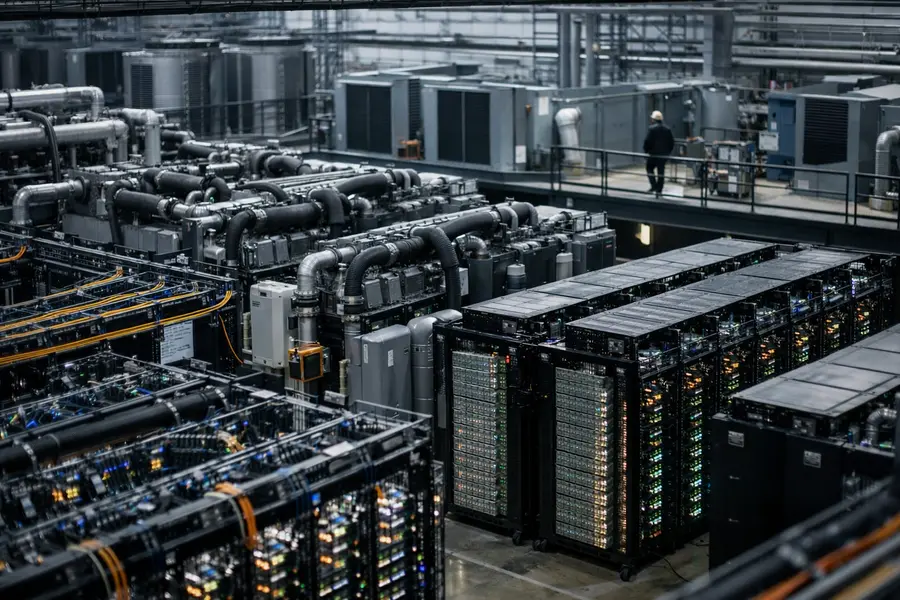
The company also indicated that capital expenditure will exceed $200 billion in 2026 and climb to about $300 billion in 2027. The spending covers data centers, custom chips and networking capacity for Google Cloud and its Gemini models. A 50% step-up in annual outlays, with no matching acceleration in revenue, shifted the debate from whether Alphabet can compete in AI to whether the returns justify the price.
Strategic Context: The Cost of Staying in the AI Race
Alphabet's spending plan reflects the competitive logic across large technology companies. Cloud customers want guaranteed access to computing capacity, and search and advertising face a changing product landscape as AI-generated answers reshape how users look for information. Under-investing risks losing share in both areas. Over-investing compresses margins and cash returns.
The scale of the 2027 figure matters. At about $300 billion, planned capex would exceed the entire annual revenue of most S&P 500 constituents. It also leaves less room for buybacks and dividends, which have been a pillar of the stock's appeal to institutional holders. Some investors have begun valuing the search franchise at a lower multiple than traditional energy producers, a sign of how far sentiment on the core business has shifted.
How Does This Affect AI Stocks and the Wider Nasdaq?
The sell-off raises questions across the sector, because Alphabet is among the companies most often cited as proof that AI spending can be financed from internal cash flow. When a business of this size turns cash-negative, the assumption weakens for peers that are also raising capex budgets, including Microsoft (MSFT), Amazon (AMZN) and Meta (META). Chip suppliers and data center vendors benefit from the spending, but the market reaction shows that investors are now scrutinizing the funding side of the cycle as closely as the demand side.
For investors looking to invest in AI, the episode is a reminder that infrastructure spenders and infrastructure suppliers can move in opposite directions when returns come into question.
What Comes Next for Alphabet?
The next test is whether cloud and search revenue growth accelerates enough in the coming quarters to absorb the depreciation from this investment wave. Key markers include cloud backlog, operating margin trends, and whether free cash flow turns positive again. Management's capex guidance for 2027 also leaves open the possibility of financing through debt, a shift that would change the company's long-standing balance sheet profile.
Outlook
Alphabet's record decline came from a combination of a revenue and earnings miss, negative free cash flow of $9.07 billion, and a capital spending plan above $200 billion this year and near $300 billion in 2027. The company's growth rate of 24.7% remains strong, but the market has moved to demanding evidence of returns. Until cash generation recovers, the stock and the broader group of AI-linked shares are likely to trade on the relationship between capex and reported cash flow.