Pomegra
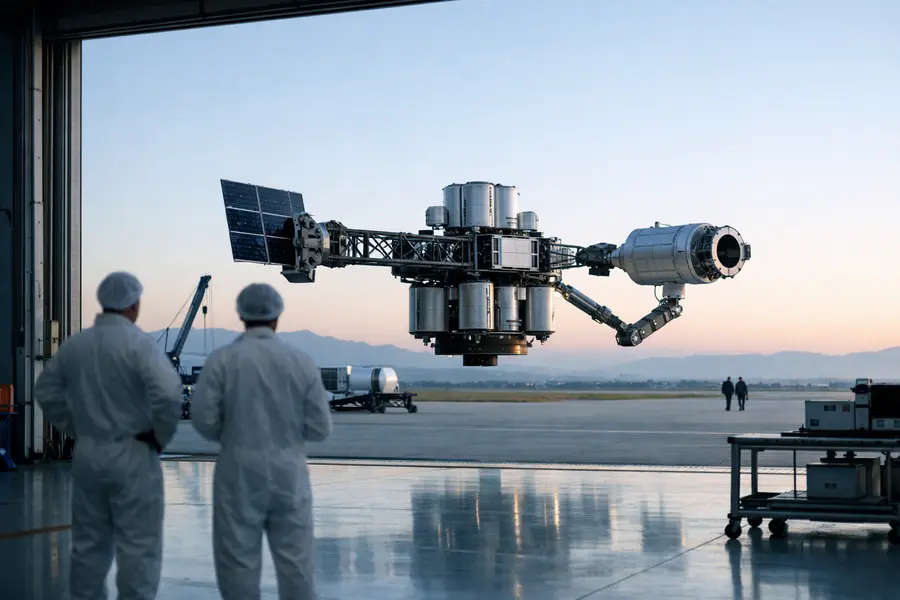
Colorado startup Rendezvous Robotics closed an oversubscribed $20M seed led by MaC Venture Capital and Toyota Ventures to build spacecraft that assemble themselves in orbit.
Key Takeaways
- Rendezvous Robotics announced a $20M seed round on Oct. 28, 2026, co-led by MaC Venture Capital and Toyota Ventures.
- Its hexagonal tiles, about 1m wide, connect in orbit with electromagnets. A 32-tile ISS test is set for December 2026.
- Valuation and prior funding went undisclosed. A seven-tile orbital demo is slated for April 2028 at the earliest.
Lead
Rendezvous Robotics, a Golden, Colorado startup, announced a $20M seed round on Oct. 28, 2026. MaC Venture Capital and Toyota Ventures co-led the oversubscribed financing, which the company describes as its first priced round. The company is building modular spacecraft from tiles that launch separately and then align and connect on their own in orbit.
The University of Michigan Endowment, Astera, Industrious Ventures, and existing backers Aurelia Foundry, ATX Venture Partners and Mana Ventures also took part. The company did not disclose a valuation or the size of any earlier funding.
What Does Rendezvous Robotics Actually Build?
Rendezvous builds hexagonal tiles roughly 1m (about 3 feet) across, each carrying sensors, onboard processing and electromagnets. The magnets let tiles latch together and also provide data and power connections between them. Instead of fitting a finished structure inside a rocket fairing, the company would launch flat, compact tiles and let them form the structure once in space.
The technology traces to TESSERAE, a self-assembly research program developed at MIT by co-founder Dr. Ariel Ekblaw, who is board chair. Joe Landon, the other co-founder, serves as CEO. The company came out of stealth last year.
Why Did the Company Shift Its Focus?
Rendezvous narrowed its target market from long-range ideas to near-term missions. Its earlier pitch covered phased array antennas, solar panels, in-space manufacturing sites and habitats. It now concentrates on commercial and government remote sensing and communications missions.
Landon has said large habitats and space stations remain part of the vision, but the company chose to focus on missions that meet present demand. The change makes commercial sense. Revenue from sensing and communications platforms can arrive years before anyone pays for an orbital habitat. It also ties the company to buyers who already have budgets.
What Milestones Does the Seed Money Fund?
The proceeds fund next-generation spacecraft development, flight demonstrations and team expansion. The company has scheduled three tests.
- November 2026: a parabolic flight campaign for microgravity testing.
- December 2026: 32 tiles aboard the International Space Station, assembling into a 3D structure.
- April 2028 or later: a low Earth orbit mission in which seven independent tiles join into one spacecraft, separate and reassemble in a different configuration.
The ISS test is the nearer proof point. It would show the assembly method working outside a lab, though in a controlled station environment. The 2028 mission is the one that matters commercially, because free-flying tiles must find each other, dock and share power without human help.
Why Does Investor Mix Matter Here?
The mix of lead investors points to two different bets. MaC Venture Capital is a generalist early-stage fund, while Toyota Ventures brings an automaker's interest in robotics and autonomy. Astera, co-founded by Jed McCaleb, and a university endowment add backers with long time horizons.
A $20M seed is large by historical standards, and it follows a stealth period of about a year. The round sets a high bar for an unflown product. Hardware that has yet to complete a free-flying mission carries technical risk that software seed rounds do not, and the stated schedule leaves roughly 18 months between the ISS test and the first orbital demo. Slips in either date would stretch the runway.
Strategic Context
Spacecraft size is bounded by rocket fairings, which cap what a single launch can carry. Modular assembly in orbit is one route around that limit. Rendezvous says the approach could support large power systems and large antenna apertures that no single launch could deliver. That claim remains unproven until tiles assemble and operate in space.
Customers were not named in the announcement. For a company selling to government and commercial operators, a first paying contract would carry more weight than further funding.
Outlook
Rendezvous has money, a technical lineage at MIT and a three-step test plan running from November 2026 to April 2028 at the earliest. The ISS result in December will give the first real evidence on whether magnetic self-assembly works beyond ground labs. A clean 32-tile demonstration would strengthen the case for a Series A, while a failed one would expose how much of the valuation rests on a single technique.