 Pomegra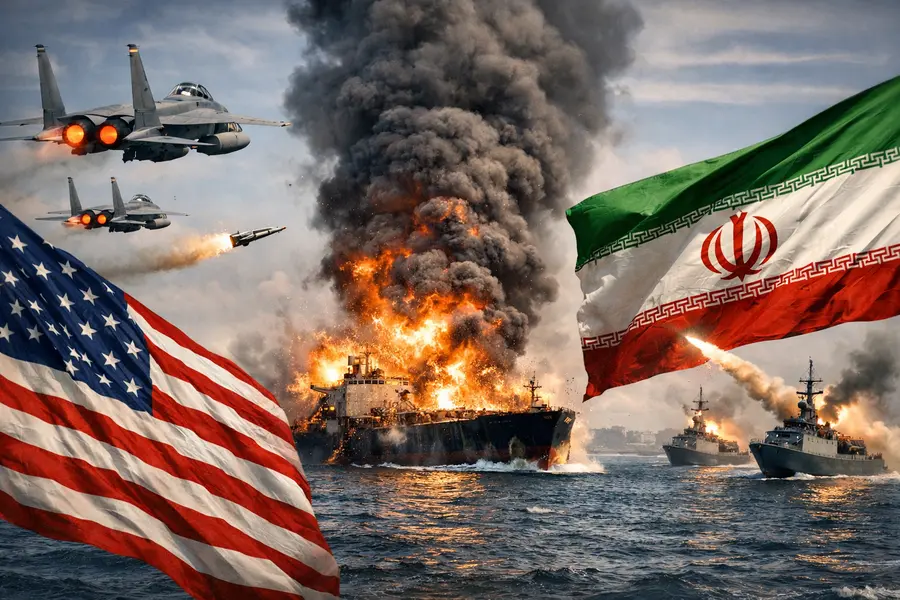
The US-Iran ceasefire has collapsed as Washington and Tehran trade Middle East missile strikes across Gulf states, driving Brent crude back toward $80.
- US CENTCOM hit over 140 Iranian military targets in its latest wave, deploying sea drones offensively for the first time.
- Iran's IRGC struck US assets in Gulf countries — Qatar, Bahrain, Kuwait, Jordan, UAE, and Oman — with ballistic missiles and drones in retaliation.
- Brent crude rose roughly 4% to near $79 a barrel as the Strait of Hormuz, transit route for approximately 20% of global energy exports, remains severely disrupted.
Lead
The US-Iran ceasefire collapse accelerated this week as US Central Command struck more than 140 Iranian military targets across multiple waves, while Iran's Islamic Revolutionary Guard Corps fired retaliatory ballistic missiles and drones at American military installations across Qatar, Bahrain, Kuwait, Jordan, the UAE, and Oman. Brent crude gained roughly 4% to around $79 a barrel on Monday, reversing a brief peace-premium decline, as the Strait of Hormuz — through which approximately 20% of global energy exports once transited freely — remained severely disrupted and contested.
What Happened
The collapse traces to competing interpretations of the Islamabad Memorandum, signed June 17 by President Donald Trump and Iranian counterparts, which had established a 60-day window to negotiate a final deal ending the conflict that began February 28. The central sticking point was the Strait of Hormuz: Tehran insisted on controlling which shipping lane vessels use near its coastline; Washington pressed for unconditional reopening, linking it directly to Trump's stated goal of lowering global energy prices.
On July 8, Iran struck multiple commercial vessels transiting the strait. US CENTCOM responded the same day with strikes on 90 Iranian military targets — air defense systems, coastal surveillance assets, and missile and drone storage facilities along Iran's coastline. Trump declared the ceasefire "over." A second US strike wave followed July 9. By July 12–13, CENTCOM had conducted its largest operation yet, hitting approximately 140 targets including missile and drone launch sites, naval assets, and ammunition depots — and for the first time deploying one-way attack sea drones alongside fighter aircraft and naval vessels.
Iran Retaliatory Attacks Target US Assets Across Gulf Countries
Iran's response has been simultaneous and geographically broad. The IRGC confirmed ballistic missile and drone strikes against the US Ali Al Salem Air Base in Kuwait and the US Fifth Fleet headquarters at Port Salman in Bahrain, where missile alerts sounded across the capital, Manama. In Qatar, the IRGC claimed strikes on Al-Udeid Air Base — the largest US military installation in the Middle East — stating a command center and aircraft maintenance facility were destroyed; Qatar's Ministry of Interior confirmed three civilian injuries from falling shrapnel. Iran fired 10 ballistic missiles at a US military base in northern Jordan, with the Jordanian government confirming Iranian missiles entered its airspace.
An offshore drilling platform in Kuwait was struck, marking the first direct hit on energy infrastructure in weeks. In Oman and the UAE, Iranian drones targeted radar installations and military support facilities. The IRGC warned after the July 12 salvo that "the time for restraint is over."
Strait of Hormuz: The Core Dispute
The Strait of Hormuz — roughly 21 miles at its narrowest navigable point — has sat at the center of the conflict since Iran declared it closed "until further notice," a declaration US CENTCOM formally rejected. The disruption has produced the largest single supply interruption in global oil market history, cascading into volatility across liquefied natural gas, fertilizer, aviation, and regional tourism. Trump stated the US would become "guardian" of the strait — "we're going to guard it, and we're going to get paid for guarding it" — language implying a long-term American naval presence independent of any ceasefire outcome.
Market Reaction
Brent crude reversed a two-session decline to trade near $79 a barrel, recovering roughly 4%, as the renewed Middle East missile strikes erased part of the price drop triggered by the June Islamabad Memorandum. Reports that both sides agreed to continue technical and diplomatic talks even while military exchanges persist provided partial support, tempering the most extreme pricing scenarios. Energy equities, shipping insurers, and Gulf-exposed financial institutions came under renewed pressure. Defense sector stocks in the United States advanced across the session.Outlook
The conflict has entered a phase in which battlefield escalation and residual diplomacy run in parallel — a dynamic that prolongs uncertainty without resolving the Hormuz dispute at its core. With the Islamabad Memorandum's 60-day negotiating window now in serious doubt following the US Iran ceasefire collapse, the path back to a durable agreement narrows considerably. Trump's "guardian" framing signals a potential long-term US naval posture in the strait rather than a negotiated sovereignty arrangement. Energy markets will continue to carry a structural risk premium until commercial shipping through the strait normalizes — a condition neither side has committed to delivering in the near term, and one that depends on resolving a territorial and strategic disagreement that predates the current conflict.
Mentioned tickers: XOM, CVX, COP, OXY, SLB, HAL, BKR, BP, SHEL, TTE, LMT, RTX, NOC, GD, BA, HII, INSW, STNG