Pomegra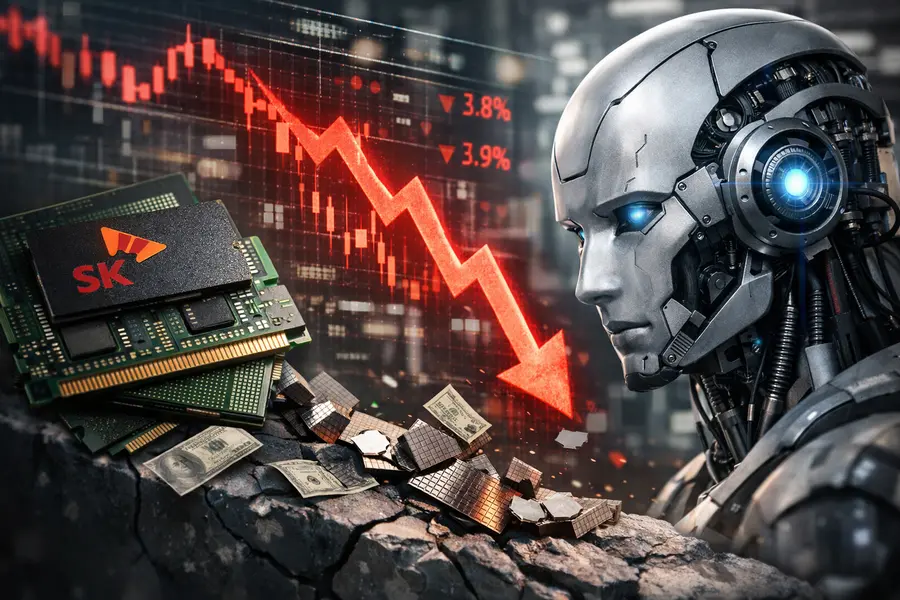
SK Hynix shares fell a record 15.37% on July 13, dragging South Korea's Kospi index into a circuit-breaker halt and spreading a global semiconductor selloff in the wake of its blockbuster Nasdaq debut.
- SK Hynix stock plunge of 15.37% marks the worst single-session loss in the company's history, triggering a Kospi-wide trading suspension.
- The South Korea AI stock selloff erased gains across the semiconductor sector, with Samsung Electronics falling nearly 11% on the same session.
- SKHY stock, listed on Nasdaq just three trading days earlier at $26.5 billion, fell as much as 9.3% in U.S. hours.
Lead
Seoul / New York — SK Hynix Inc. shares recorded their steepest single-day decline on Monday, shedding 15.37% on the Korea Exchange as investors reversed positions accumulated during a months-long AI-driven rally. The rout, which also took Samsung Electronics down nearly 11%, was severe enough to trigger South Korea's market-wide circuit breaker for the 35th time this year, halting all Kospi trading for 20 minutes. Foreign investors offloaded an estimated 1.7 trillion won ($1.1 billion) of Kospi-listed shares in the session, with sales concentrated in SK Hynix.What Happened
The SK Hynix stock plunge arrived just three trading days after the chipmaker's celebrated Wall Street debut. The company priced its American depositary receipts at $149 per share on July 10, raising $26.5 billion in a listing that valued it at a record for a Korean issuer. SKHY stock surged 13% on that first day, closing at $168.01 as U.S. investors competed for access to the dominant supplier of high-bandwidth memory chips used in Nvidia's AI accelerators.
On Monday, the dynamic reversed. Seoul-listed shares bore the brunt as profit-taking intersected with a negative earnings note from Korea Investment & Securities, which estimated SK Hynix's second-quarter operating profit could fall roughly 8% short of the market consensus. The bank cited slowing price appreciation in high-bandwidth memory (HBM) — the stacked chip architecture that underpins AI inference workloads — as the key pressure point. While HBM prices continue to rise, the pace has decelerated relative to earlier quarters, compressing the margin expansion that analysts had priced in.
Market Reaction
The South Korea AI stock selloff rippled outward with unusual speed. The Kospi index ended the session down approximately 9%, pulling it back into the 6,000-point range and triggering a 20-minute market-wide suspension under circuit-breaker rules. Samsung Electronics, South Korea's largest company by market capitalization, fell nearly 11%, amplifying the index-level damage.
The semiconductor contagion reached U.S. markets before the open. SKHY stock dropped as much as 9.3% in early New York trading, while Nvidia, Broadcom, and AMD all declined as the South Korea AI stock selloff stoked broader doubts about the durability of AI infrastructure spending. The session represented one of the sharpest single-day losses for the global chip complex since the AI investment cycle began accelerating in late 2023.
Strategic Context
SK Hynix controls approximately 60% of the global HBM market, giving it near-indispensable status in the AI supply chain. The company supplies Nvidia's flagship H100, H200, and Blackwell-generation accelerators with the memory bandwidth those chips require to perform at scale. In the first quarter of 2026, SK Hynix reported revenue exceeding 52 trillion won with an operating margin above 70%, driven almost entirely by AI-related memory demand.
That dominance, however, has also concentrated the stock's valuation in a single demand thesis: that hyperscale data-center operators — primarily in the United States — will sustain current rates of capital expenditure on AI infrastructure indefinitely. Monday's move reflected investors beginning to question that assumption more seriously than at any point in the current cycle.
AI and Technology Angle
The unease centers on a structural concern that has circulated since early 2025: whether AI infrastructure spending can generate returns commensurate with its scale. Major technology companies have deployed hundreds of billions of dollars in chip procurement and data-center construction, a buildout that has been the primary driver of HBM demand. Investors are now scrutinizing the timeline on which that spending translates into measurable revenue and productivity gains.
The deceleration in HBM price growth sharpens that concern. HBM is the highest-margin product in SK Hynix's portfolio, and its pricing trajectory had been treated by the market as a reliable leading indicator of sustained AI investment. A softer-than-expected pricing environment suggests either that supply is catching up with demand or that customers are exercising greater discipline — either of which would compress the earnings growth the stock's valuation implies.
SK Hynix's Q2 2026 earnings are scheduled for release on July 29, arriving just 16 trading days after the Nasdaq listing. That proximity makes the upcoming print an unusually high-stakes event: any shortfall relative to consensus will land while the ADR market is still establishing a pricing reference.
Geopolitical Dimension
Monday's selloff also reflected a broader risk-off environment. Escalating tensions in the Middle East pushed energy prices higher and reinforced the kind of macro caution that tends to hit high-multiple growth stocks disproportionately. Korean equities were additionally exposed to won weakness, which increases the local-currency cost of dollar-denominated debt service and complicates repatriation of overseas revenue for domestic conglomerates.
The circuit-breaker activation — the 35th of the year — underlines how the Kospi's concentration in semiconductor names has amplified its sensitivity to global AI sentiment swings, a dynamic that regulators and institutional investors have flagged as a structural vulnerability.
Outlook
The immediate test for SK Hynix is its July 29 earnings release. A result that meets or exceeds consensus would likely arrest the selloff and provide the first fundamental anchor for SKHY stock's U.S. valuation. A miss would validate the earnings caution that triggered Monday's decline and extend pressure on both the Seoul-listed shares and the ADR.
Longer-term, the company's 60% HBM market share and its entrenched position as Nvidia's primary memory supplier remain structural advantages that are difficult for rivals to replicate in the near term. The question the market is now asking is not whether AI demand exists, but whether the extraordinary pace of investment that has powered the semiconductor cycle since 2023 is sustainable — and at what point a more measured expansion phase begins to show up in order books.