Pomegra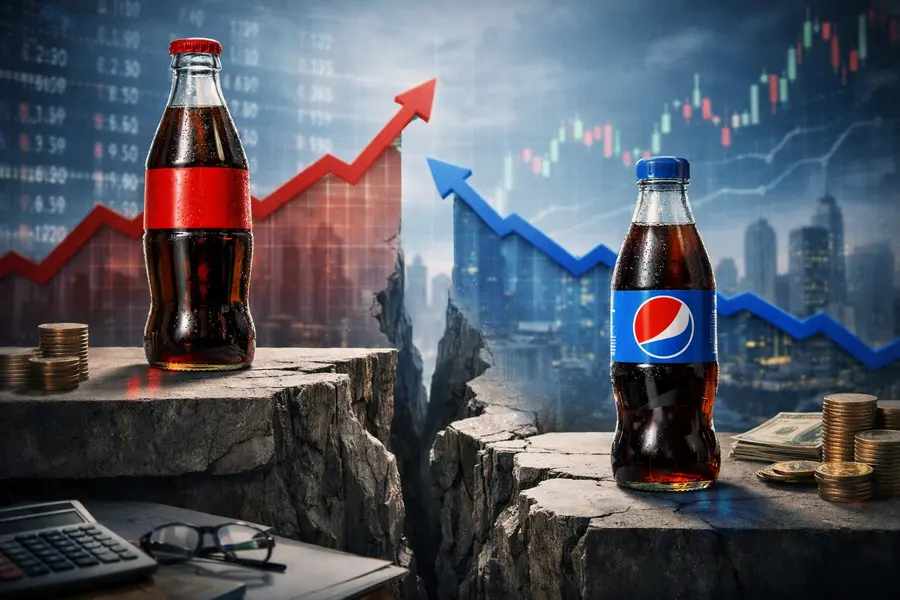
Coca-Cola trades at its steepest forward earnings premium to PepsiCo in years as diverging fundamentals and defensive sector rotation lift KO stock to record highs while PEP languishes near multi-year lows.
- KO's forward P/E of 25.3x is roughly 58% above PEP's 16x, the widest Coca-Cola vs Pepsi valuation gap in at least a decade, raising mean-reversion risk
- Coca-Cola's Q1 2026 organic revenue surged 10% as global unit case volume rose 3%; PepsiCo's North America beverage volume fell 4% in Q2
- PEP's 4.2% dividend yield versus KO's 2.5% reflects the market's sharply divergent confidence in each company's near-term growth trajectory
Lead
The valuation chasm between the two dominant names in global beverages has rarely been this pronounced. Coca-Cola (NYSE: KO) trades at 25.3 times forward earnings as of mid-July 2026, while PepsiCo (NASDAQ: PEP) has slumped to just 16 times — a gap of nearly 10 multiple points that marks the widest Coca-Cola vs Pepsi valuation spread in years and one that history suggests does not persist.
What Happened
KO stock hit an all-time intraday high of $85.68 on July 7, 2026, and has advanced approximately 19.4% year-to-date, lifting the company's market capitalization to roughly $357 billion. PEP, by contrast, has shed 4.2% over the same period, extending a five-year return of negative 8.1% — a striking reversal for a stock that spent most of the past decade trading at a comparable earnings multiple to Coca-Cola.The divergence has a clear fundamental catalyst. Coca-Cola reported first-quarter 2026 net revenue of $12.47 billion, up 12% year over year, with organic revenue advancing 10% — one of the company's strongest quarterly performances in recent memory. Comparable earnings per share reached $0.86, up 18% from the prior-year period and five cents above consensus. Management subsequently raised full-year EPS growth guidance to 8–9%, up from an earlier 7–8% target, while reaffirming organic revenue growth of 4–5%.
PepsiCo's trajectory has run in the opposite direction. Second-quarter 2026 net revenue of $24.18 billion grew 6.4% year over year and edged past estimates, but adjusted EPS of $2.20 narrowly missed the consensus of $2.21. More critically for investors, organic revenue grew just 2.4%, core operating margin contracted 40 basis points to 16.8%, and North America beverage volume fell 4%. Management maintained full-year guidance of 2–4% organic revenue growth and 4–6% core constant-currency EPS growth — a range that places PepsiCo's trajectory well below Coca-Cola's.
Strategic Context
The widening beverage industry stock divergence reflects structural differences that have sharpened since 2024. PepsiCo's diversified model — roughly half its revenue derived from convenient foods — has become a liability rather than a hedge. North American snack volumes have stagnated under the dual pressure of consumer budget fatigue and persistent demand concerns tied to the rise of GLP-1 weight-loss drugs. To arrest the decline, PepsiCo has cut prices on major snack brands by as much as 15%, a move that protects volume but compresses margins and signals fragile pricing power.
Market Reaction
Fundamental outperformance has been amplified by rotation dynamics within equity markets. As broader indices have grown more volatile — partly on macroeconomic uncertainty, partly on geopolitical pressures — institutional capital has shifted toward non-cyclical defensive names. KO stock has emerged as a primary beneficiary of that rotation, attracting inflows that have pushed the multiple well above historical norms. KO's 10-year median P/E ratio is 27.7; at a trailing multiple of approximately 26, the stock sits only modestly below that ceiling, limiting the scope for further multiple expansion.
PepsiCo now trades at a forward multiple near 16x — roughly the level seen during periods of genuine fundamental stress — against a 10-year median P/E close to 26x. Its annualized dividend of $5.92 per share, yielding approximately 4.2%, has become the principal investment argument for the stock alongside the prospect of a mean-reversion trade should North American volume stabilize.
What Comes Next
History suggests that valuation gaps of this magnitude between closely correlated companies tend to compress. The last time the KO-PEP forward P/E spread approached present levels, the subsequent 12-month period saw PEP outperform on a total-return basis as sentiment reset. Whether that pattern repeats depends on two variables: PepsiCo's ability to restore volume in North America without further sacrificing margins, and Coca-Cola's capacity to sustain elevated organic growth as year-ago comparisons become more demanding in the second half of 2026.
For holders of KO stock, the arithmetic leaves limited margin for error. At 25.3 times forward earnings against guidance for 4–5% organic revenue growth, a single-quarter miss — or a moderation in the defensive rotation supporting the multiple — could move the Coca-Cola vs Pepsi valuation gap sharply in the other direction.
Outlook
The KO-PEP spread now stands at one of its widest readings in a decade, forged by Coca-Cola's consistent execution and PepsiCo's persistent North American headwinds. The setup creates asymmetric risk on both sides: KO stock carries elevated multiple risk if growth moderates, while PEP offers a materially higher yield and a credible mean-reversion case if its volume recovery gains traction. For anyone evaluating a consumer staple investment in the beverage industry stock space, the current divergence between these two historic peers represents the most consequential positioning decision in the sector.
Mentioned tickers: KO, PEP