 Pomegra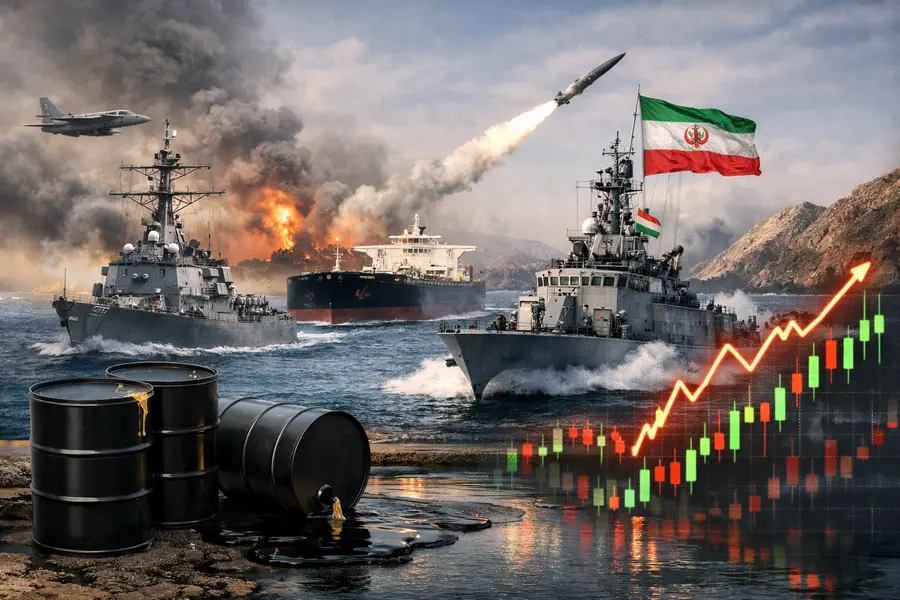
Brent crude rose 3.5% to $78.68 on July 13 as the US and Iran each claimed control of the Strait of Hormuz after a weekend of cross-regional military strikes.
- Brent crude rose 3.51% to $78.68/bbl; WTI gained 3.47% to $73.89 as competing US-Iran Hormuz control claims renewed supply fears.
- Vessel transits through the Strait of Hormuz fell to six on Sunday from 18–22 daily crossings recorded earlier in July, ship-tracking data showed.
- The strait carries roughly one-fifth of global daily oil and LNG supplies; world output remains approximately 9.4 mb/d below pre-conflict levels.
Lead
Oil markets surged on Monday, July 13, 2026, after both the United States and Iran asserted control over the Strait of Hormuz following a weekend of intensifying military exchanges that stretched across the broader Middle East. Brent crude futures rose $2.67, or 3.51%, to $78.68 a barrel by 07:43 GMT, while West Texas Intermediate gained $2.48, or 3.47%, to $73.89 per barrel — reversing a weeks-long slide that had returned prices toward pre-conflict levels.
What Happened
The immediate trigger was a fresh round of U.S. airstrikes on Iranian military infrastructure, launched after Iranian forces attacked the MV GFS Galaxy, a Cyprus-flagged container ship transiting the strait. U.S. Central Command confirmed the vessel suffered severe damage to its engine room from an onboard fire caused by the Iranian strike, rendering it unable to complete its voyage.
Washington subsequently carried out dozens of targeted strikes on Iran to degrade Tehran's capacity to threaten commercial shipping. Iran's Revolutionary Guards countered by striking American military facilities in Kuwait and Bahrain, with state media reporting additional attacks on bases in Jordan, Qatar, and Oman. The United Arab Emirates condemned the Iranian strikes on Gulf states in the strongest terms, underscoring the regional scale of the escalation.
Competing Claims Over the Strait
By Monday morning, both powers declared control over the Strait of Hormuz — one of the most consequential assertions in global energy markets in decades. Iran's government announced the waterway was closed "until further notice." U.S. Central Command categorically denied this, stating that American naval and air assets were actively operating to ensure freedom of navigation.
The dispute traces directly to the June 17 memorandum of understanding under which Washington and Tehran agreed to reopen the strait following months of conflict. Under that framework, Iran committed to facilitating safe passage and waived transit tolls for 60 days. The agreement left precise transit corridors undefined — a structural ambiguity that now underpins the standoff. President Donald Trump announced he was reinstating a blockade on Iran and reiterated his intent for the United States to seize Strait of Hormuz control, framing it as a revenue opportunity: the U.S. would "get paid a lot of money" for guarding the strategic waterway.
Market Reaction
The oil price surge July 13 snapped a protracted retreat in crude oil price trends across both major benchmarks. North Sea Dated prices had fallen to $68 a barrel by early July — their lowest since January and marginally below pre-war levels — as the partial resumption of Hormuz flows in June allowed a supply recovery. That recovery now looks fragile.
Strategic Context and Global Energy Stakes
The Strait of Hormuz — an 80-kilometer chokepoint at the mouth of the Persian Gulf — handled approximately one-fifth of global energy supply daily and a substantial share of liquefied natural gas exports before the February conflict. Since the outbreak of hostilities, production has contracted sharply. International Energy Agency data show world output reached 98.8 mb/d in June, up 4.1 mb/d from May as the ceasefire enabled partial Gulf production recovery — yet still roughly 9.4 mb/d below pre-conflict levels. Gulf oil exports, including volumes re-routed around the strait, recovered to 16.1 mb/d in June, well short of the 24 mb/d average before the war began.
The conflict has simultaneously compressed demand. Global oil consumption is forecast to contract by an average of 1.2 mb/d across 2026, with emerging-market economies hardest hit by elevated prices and slower trade flows.
Geopolitical Dimension
The current crisis reflects a broader contest over governance of critical maritime infrastructure. The U.S. position — that American naval power guarantees freedom of navigation — directly contradicts Tehran's assertion of sovereign authority over adjacent waters. Neither party has a clear pathway to establishing unchallenged dominance without significant additional escalation.
Gulf Cooperation Council states find themselves caught between their security dependence on Washington and their geographic exposure to Iranian retaliation, as Sunday's strikes on Kuwait and Bahrain demonstrated. The UAE's condemnation signals alignment with the U.S. position but stops short of active military participation. The June MOU's failure to define transit routes — initially viewed as a diplomatic face-saving device — has become a structural fault line. Any durable resolution requires either a formal, verifiable demarcation agreement or sufficient deterrence to suppress Iranian enforcement actions.Outlook
The near-term crude oil price trend will track the pace and severity of military exchanges. Any further reduction in Hormuz transits below six daily vessels risks pushing Brent toward the $85 to $90 range, a threshold consistent with prior severe disruptions to this waterway. A verified de-escalation and resumption of normal shipping could rapidly return prices toward the $68 to $70 pre-escalation corridor. The IEA projects that normalized transit volumes would allow global energy supply to expand by up to 7.5 mb/d in 2027, substantially rebalancing markets. The June MOU remains nominally in force, but its credibility has been severely tested. The three-to-twelve-month trajectory for global energy prices hinges almost entirely on whether Washington and Tehran can negotiate — or impose — a workable transit regime for Strait of Hormuz control before the summer shipping season reaches peak demand.
Mentioned tickers: BZ=F, CL=F, USO, XOM, CVX, BP, SHEL