Pomegra
China confirmed contact with Washington and Moscow on a possible Trump-Putin-Xi summit at APEC in Shenzhen on November 18-19, an unprecedented meeting.
- Beijing says it is "maintaining communication" with the US and Russia on a possible three-leader meeting at APEC.
- No such Trump-Putin-Xi summit has ever taken place; Moscow wants it finalized within days.
- Brent crude held near $95 a barrel and the MOEX Russia index rose 0.56% on November 5.
Lead
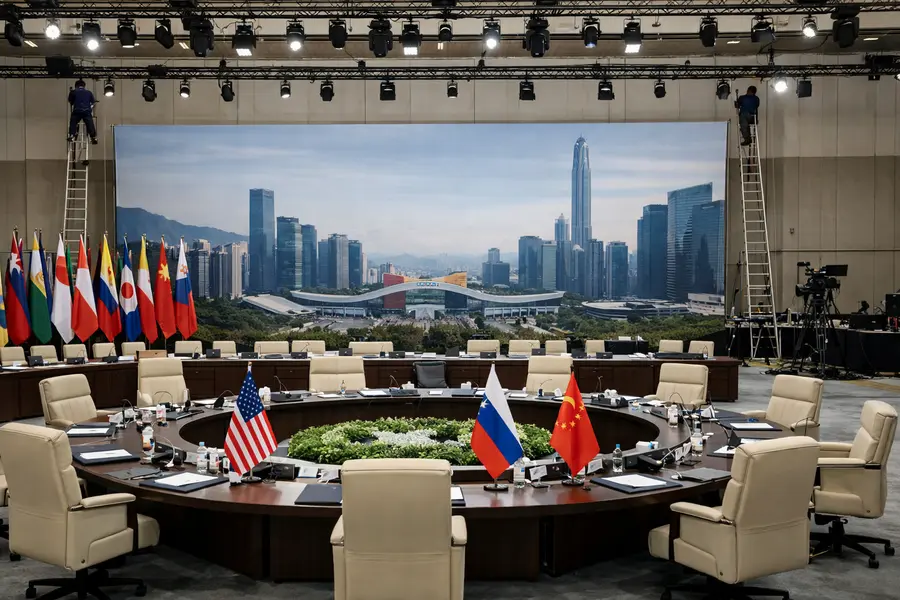
China's Foreign Ministry confirmed on November 4 that it is in contact with the United States and Russia about a possible meeting of the three countries' leaders on the sidelines of the Asia-Pacific Economic Cooperation summit in Shenzhen on November 18-19. Spokeswoman Mao Ning said Beijing "is maintaining communication with relevant parties regarding a potential meeting among Chinese, Russian and US leaders." It was China's first public acknowledgment of talks that Moscow and Washington had already discussed openly. The summit would bring Donald Trump, Vladimir Putin and Xi Jinping together for the first time.
What Has China Confirmed About the Trump-Putin-Xi Summit?
China has confirmed communication, not a commitment to hold the meeting. The wording is deliberately general and does not say that a summit is scheduled or that Beijing has agreed to host one.
The Kremlin has been more forthcoming. Spokesman Dmitry Peskov said Moscow hopes arrangements will be "finalized in the coming days" and called China, as APEC host, "the main organizing force." Both Trump and Putin have publicly said they would attend such a meeting.
The Kremlin has also said it does not expect substantive Ukraine negotiations at the session. Officials from the three countries have reportedly held undisclosed talks for about two weeks, with Washington and Moscow both encouraging Beijing to proceed.
How Did the Idea Emerge?
The idea came from Putin, who proposed a three-way format to Trump in October as a route to a settlement in Ukraine on terms favorable to Moscow. Trump said he was open to the meeting but wants to focus on nuclear arms control, which he calls denuclearization, rather than Ukraine alone.
The two sides want different things from the same room. Moscow wants Chinese backing for a Ukraine deal. Washington wants China, the third major nuclear power, drawn into arms control talks. China has so far resisted joining trilateral arms control negotiations.
Beijing also has to weigh the cost to its own event. Hosting APEC is a diplomatic showcase for China, and a summit dominated by the Ukraine war and nuclear issues could crowd out its regional trade agenda.
Why Is Beijing Cautious?
Beijing's caution reflects its efforts to manage ties with Washington while keeping its partnership with Moscow. Relations with the US have stabilized since Trump's May visit to Beijing, which produced a "constructive strategic and stable" framework, an order for 200 Boeing (BA) aircraft and permission for ten Chinese companies to buy Nvidia (NVDA) H200 chips. A summit that appeared to align China with Russia on Ukraine could put that progress at risk.
China's public line on Ukraine has not changed. After talks in Beijing on October 29, German President Frank-Walter Steinmeier said Xi described the war as a "European conflict" and said Europeans should be at the negotiating table. A three-way summit without Kyiv or European governments would sit uneasily with that position.
Moscow, for its part, reads Beijing's hesitation as a wish to claim credit only once a settlement is in sight.
Market Reaction
Markets have started to price in diplomatic movement without treating a deal as likely. The MOEX Russia index rose 0.56% to about 2,456 points on November 5, helped by expectations of Russia-US-Ukraine consultations and a rebound in oil. The crude oil price stood near $95 for Brent, up from the prior settlement of $94.62, with a premium that reflects continued supply risk from the Iran conflict and sanctions on Russian exports.
A visible easing in US-Russia relations could weigh on that premium. A failed or cancelled meeting would more likely leave prices unchanged than push them sharply higher.
What Comes Next for the Summit?
Three outcomes are possible before November 18. A formal announcement would confirm a three-way meeting on the sidelines of the Economic Leaders' Meeting in Shenzhen. Two separate bilateral meetings, Trump-Xi and Putin-Xi, would let Beijing keep its role as host without becoming a party to Ukraine or arms control talks. Or the proposal could lapse if the three sides cannot agree on an agenda.
Within three to twelve months, the structural issue is whether China will join nuclear arms control discussions as the last bilateral limits between Washington and Moscow have lapsed. A meeting would be a step toward that, but a commitment is not expected at a first encounter.
Outlook
China's confirmation moves the summit from Kremlin and White House statements to a live item on Beijing's diplomatic calendar. With about two weeks to go, the decision rests with Xi as host, who must balance the prestige of convening both leaders against the risk of an agenda he does not control. Oil and Russian equities are watching for signals, but neither shows a strong expectation of a breakthrough.