Pomegra
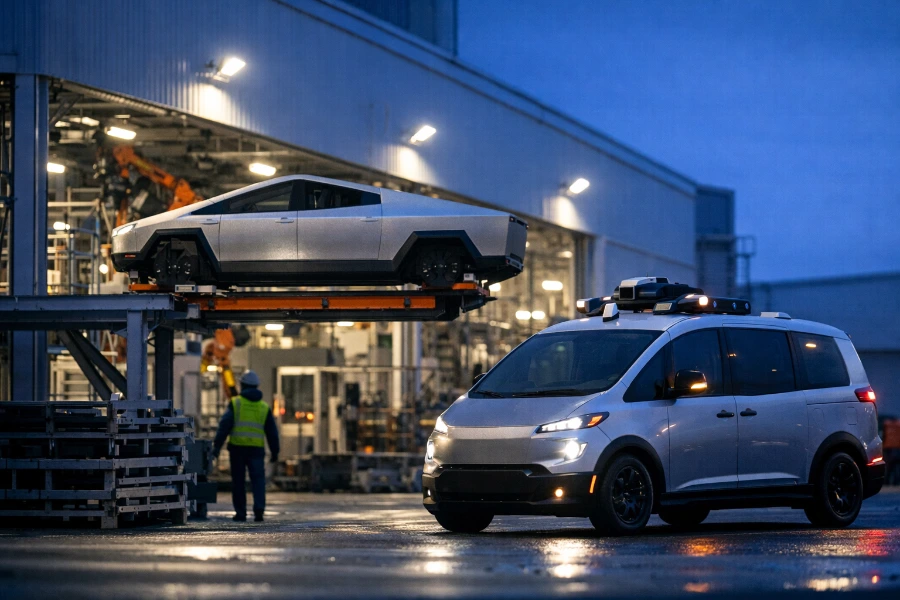
Tesla will wind down Cybertruck output at Gigafactory Texas around mid-2027 and refund many deposits, with Cybercab robotaxi production taking the factory space.
- Tesla will shut the Cybertruck line in Texas in about eight months and return deposits to many customers.
- The freed space goes to the Cybercab, a two-seat robotaxi with no steering wheel or pedals.
- Tesla shares closed up 4.2% at $358.22 on Friday and rose about 5.5% to roughly $378 in early trading Monday.
Lead
Tesla (TSLA) will end Cybertruck production at its Texas plant around the middle of 2027. Chief Executive Elon Musk said the company will redirect the factory space to the Cybercab robotaxi. In a post on X, Musk said Tesla would build as many Cybertrucks as possible before the line shuts in about eight months. He added that the company would have to return deposits to "a lot of people" because the order rate far exceeds the production rate.What Did Musk Say About the Cybertruck Deposits?
Musk said Tesla will refund reservation deposits to many Cybertruck customers because open orders exceed what the plant can build before shutdown. He did not say how many orders remain, how much money the deposits total, or which customers will be refunded. Tesla is adding an extra production shift to fill as many remaining orders as possible. Musk called the Cybertruck the best vehicle Tesla has ever made and described the wind-down as the end of an era.
Why Is Tesla Replacing Cybertruck With Cybercab?
Tesla is giving up the Cybertruck because Cybercab production is worth more to the company than the complexity of the pickup. Musk said the opportunity cost of that complexity is vastly outweighed by the value of incremental Cybercab output.
The sales record supports the decision. U.S. Cybertruck sales fell 48% to 20,237 in 2025, from 38,965 in 2024, according to the figures cited in coverage of the announcement. Sales declined a further 28% in the first nine months of 2026. Musk once projected annual demand of 250,000 units, so current volumes are a small fraction of that target.
Gigafactory Texas is the only known Tesla plant that builds the Cybertruck. Cybercab production began there earlier in 2026 on a line with installed capacity above 125,000 vehicles a year. Paid Cybercab rides started in Austin in September, and Tesla has been adding the vehicles to its Robotaxi fleet. Cybercab does not yet appear as a separate revenue line in Tesla's financial reports.
Strategic Context
The move continues a pattern of Tesla clearing factory space for autonomy and robotics. Model S and Model X production ended in January 2026, and the Fremont lines were converted to Optimus humanoid robot manufacturing. A line there is rated to eventually build 1 million robots a year. Together with the Cybertruck decision, Tesla is retiring its lower-volume, higher-complexity vehicles in favor of a business built around autonomous ride-hailing and robots.
How Did Tesla Stock React to the Announcement?
Tesla stock rose on both sessions that followed the announcement. Shares gained 4.23% to close at $358.22 on Friday, November 6, then climbed 5.5% to about $378 by mid-morning Monday, November 9. The stock trades at more than 160 times 2027 earnings forecasts, against roughly 19 times for the S&P 500. That valuation leaves the shares reliant on delivering autonomous-vehicle and robotics revenue rather than on current vehicle sales.
What Comes Next for Cybertruck Owners and Tesla?
The next milestones are the size of the refund program and the pace of Cybercab output once the Cybertruck line closes. Existing owners are not affected by the production end date. Tesla has not yet detailed service or parts commitments for the vehicle beyond mid-2027. Investors will look to upcoming quarterly results for the first Cybercab volumes and for any charge tied to the Cybertruck wind-down.
Outlook
Tesla is closing the Cybertruck chapter roughly four years after volume production began and ahead of its original ambitions. The Texas plant becomes a Cybercab hub with capacity above 125,000 units a year. The company's valuation now depends on how quickly that capacity turns into robotaxi revenue.