Pomegra
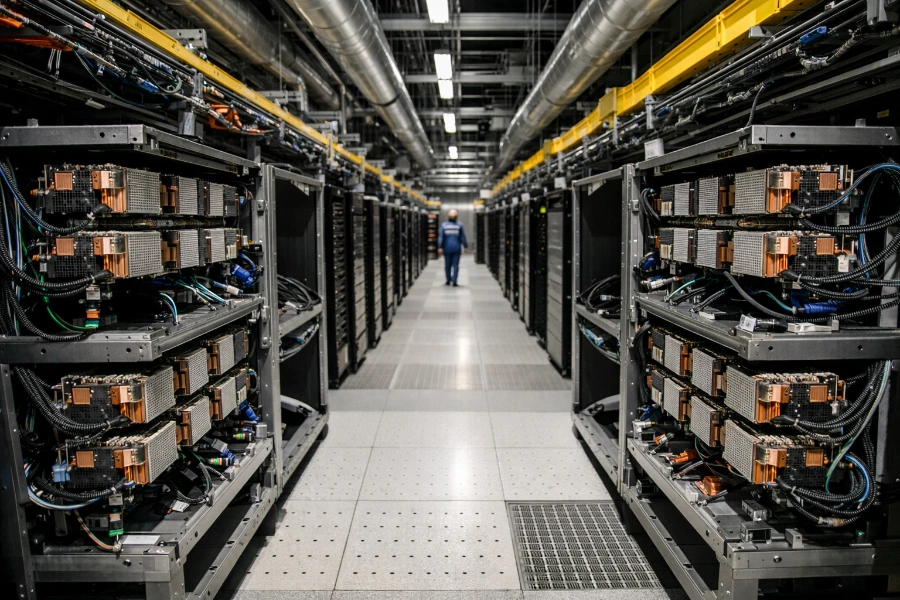
Google's new TPU 8tx and TPU 8i Max chips, plus a customer base nearing 100 that includes Apple, Meta and Oracle, widen its push against Nvidia in AI hardware.
- Google unveiled the TPU 8tx for confidential AI and the TPU 8i Max for long-context workloads on November 9, 2026.
- Nearly 100 customers now use Google's TPUs, including Apple, Meta and Oracle.
- Alphabet shares rose about 3% to roughly $293 in early trading while Nvidia fell more than 4%.
Lead
Alphabet (GOOGL) unveiled two new AI processors on Monday, the TPU 8tx and TPU 8i Max, extending its challenge to Nvidia (NVDA) in the market for AI computing. Both chips are due to be available in 2027. Google said its tensor processing unit business now serves nearly 100 external customers, among them Apple (AAPL), Meta Platforms (META) and Oracle (ORCL). Alphabet shares rose 3.16% to $293.77 by 10:44 a.m. ET. Nvidia shares fell more than 4% in the session and closed at their lowest level since April 7, also weighed by separate company-specific headlines.What Are the TPU 8tx and TPU 8i Max?
The two chips are variants of the TPU 8 family that Google introduced at Cloud Next in April, when it launched the TPU 8t for large-scale training and the TPU 8i for real-time reasoning.
The TPU 8tx is built on the TPU 8t architecture and adds a hardware-level secure enclave for confidential inference. It targets government bodies and regulated industries that must keep sensitive data protected while running AI agents. It is paired with a custom host processor from Advanced Micro Devices (AMD), using the company's fifth-generation EPYC technology and its security features. Google describes this as the first hardware-based confidential computing for its cloud TPUs.
The TPU 8i Max packages two TPU 8i chips together. That doubles compute, on-chip memory and high-bandwidth memory capacity per socket while fitting twice the silicon into the same rack footprint. It is aimed at larger models and very long context windows, where an AI system must process large volumes of text or code in one pass. Google's leading Gemini model handles about 1 million tokens, while smaller models typically manage 128,000 to 256,000.
Google has now introduced four TPU systems this year, the most in any single year.
Why Does Google's TPU Customer Base Matter for Nvidia?
The customer base matters because it shows Google's custom silicon is becoming a merchant product rather than an internal tool. Apple, Meta and Oracle are all large buyers of AI compute and have historically relied heavily on Nvidia's GPUs.
Oracle has said it will offer TPU capacity to its cloud customers starting next year. That is the first time Google's chips will be sold through another major cloud provider's platform. Available TPU capacity is already contracted to customers.
Cost is the central argument. Google's TPUs are estimated to cost about 30% less than comparable Nvidia GPUs, with competitive performance and lower power use on certain tasks. Industry estimates put TPU-related sales at about $12 billion this year and above $135 billion by 2028.
How Did Markets React?
Alphabet gained as much as 3% on the day, with the stock near $293 by mid-morning. Nvidia fell more than 4%, the weakest close in seven months, as investors weighed what a broader customer base for Google's silicon means for Nvidia's pricing power and market share.
The move shows how sensitive AI stocks have become to any sign that large buyers are diversifying away from a single supplier.
Strategic Context
The AMD partnership is notable. Google has developed its own Arm-based Axion processor, yet chose AMD's x86 architecture for the 8tx because of its security capabilities. The choice shows Google prioritizing compliance-ready features for regulated buyers over strict in-house integration.
Nvidia retains advantages in software ecosystem, developer familiarity and supply across the market. The TPUs remain tied largely to Google's own cloud and its partners, which limits how fast they can displace GPUs.
Outlook
Both chips arrive in 2027, so the immediate effect is on expectations rather than revenue. The next tests are how quickly Oracle's TPU offering reaches customers, whether regulated buyers adopt the 8tx, and whether further large buyers join the nearly 100 already on Google's platform. Nvidia's lead in AI computing is intact, but its customers now have a credible and cheaper second source.
Mentioned tickers: GOOGL, NVDA, AAPL, META, ORCL, AMD