Pomegra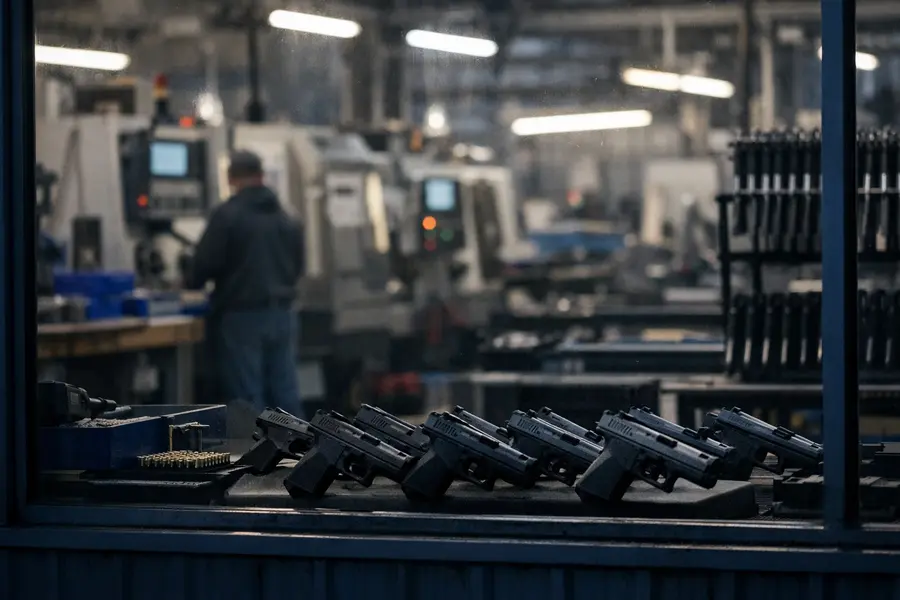
Smith & Wesson Brands delivered its strongest sales quarter since 2021, crushing analyst estimates as geopolitical anxiety and domestic security concerns drove an unexpected firearms demand revival heading into fall.
- SWBI Q2 CY2026 net sales reached $12.6M, up 32.3% year-over-year, against a $8.7M consensus estimate.
- The company posted $0.06 EPS versus an expected $0.05 loss, marking a sharp earnings reversal.
- Dealer restocking, Middle East escalation fears, and rising domestic security anxiety combined to produce the quarter's outperformance.
Lead
Smith & Wesson Brands (SWBI) shares surged 11.7% in Wednesday trading after the gunmaker reported second-quarter calendar 2026 net sales of $12.6M, a 32.3% year-over-year increase that handily beat the $8.7M consensus. The company swung to a $0.06 earnings-per-share profit against analyst forecasts of a $0.05 loss, representing the most decisive demand reversal the firearms sector has recorded since the pandemic-era surge of 2021. The results arrive six weeks ahead of the Federal Reserve's September policy decision, lending an unexpectedly charged signal to the consumer sentiment backdrop the central bank is trying to read.What Drove the Demand Reversal?
Three forces converged in the quarter to produce SWBI's outperformance. Escalating tensions across the Middle East lifted consumer anxiety about global stability, a pattern that has historically correlated with spikes in civilian firearms purchases in the United States. Simultaneously, domestic security concerns -- amplified by an active news cycle around urban crime and border policy -- pushed retail demand higher in key Sun Belt and Midwest markets. The third factor was structural: firearms dealers had drawn down inventory aggressively over the prior six quarters amid weak demand and elevated interest costs. With channel inventory at multi-year lows, restocking orders accelerated sharply when end-market pull-through improved, creating a multiplicative effect on SWBI's wholesale numbers.
How Does This Compare to the 2021 Supercycle?
The 2021 demand surge -- driven by pandemic-era anxiety and a first-time buyer wave -- set a benchmark the industry has struggled to revisit. SWBI's Q2 CY2026 print does not match 2021 peak volumes in absolute terms, but the sequential acceleration in the rate of change is the fastest since that period. The company's gross margin profile also improved materially relative to prior quarters, reflecting better factory utilization as production lines absorbed the higher order flow. Analysts had not modeled a recovery of this magnitude until late 2027, making the earnings beat one of the wider positive surprises in the consumer discretionary sector this year.
Why Did Markets React This Way?
SWBI's 11.7% single-session gain reflects not only the magnitude of the earnings beat but the revision in forward estimates it demands. The consensus had priced the stock for continued volume weakness and margin compression; instead, management's commentary pointed to order books that remain well ahead of the year-ago comparable period. Equity markets interpreted the quarter as a sign that the firearms demand revival has legs beyond a single data point, driving both the share price and sector peers higher in sympathy. The broader read -- that consumers are spending on security-oriented discretionary goods despite a uncertain macro environment -- also fed into discussions about the resilience of household balance sheets, a topic the Federal Reserve is actively monitoring.
Geopolitical Dimension
The Middle East escalation narrative is not incidental to SWBI's results; management cited heightened international tension explicitly as a factor shaping the demand environment. Historically, periods of elevated geopolitical risk have produced short, sharp spikes in civilian firearms demand that partially unwind once tensions stabilize. Whether the current anxiety proves durable or recedes before year-end is the central variable for the quarter ahead. The dealer restocking cycle, however, operates on its own timeline regardless of geopolitical temperature: once inventory replenishment reaches normalized levels, wholesale orders will moderate even if retail demand holds.
What Does This Signal for the September Fed Decision?
The firearms demand revival adds a complicated data point to the Federal Reserve's September read on consumer spending. A sector long considered a contra-cyclical indicator of anxiety rather than confidence is showing robust demand precisely when policymakers are assessing whether prior rate increases have cooled spending sufficiently. Strong consumer expenditure on security goods, combined with resilient labor market data, could reinforce the case among Fed officials for holding rates steady or signaling a higher-for-longer posture, rather than pivoting toward cuts.
Outlook
SWBI's quarter establishes that a firearms demand revival is underway, driven by geopolitical escalation fears, domestic security anxiety, and channel restocking -- three forces that need not all persist simultaneously for the momentum to continue. The company's full-year trajectory now depends on whether dealer inventory replenishment can be sustained by matching end-consumer demand, and whether geopolitical conditions remain elevated enough to keep urgency in the retail purchase cycle. The Federal Reserve's September decision will set the cost-of-capital backdrop for SWBI's dealer network, making the central bank's language on rates nearly as consequential for the stock as the next demand print.
Mentioned tickers: SWBI