Pomegra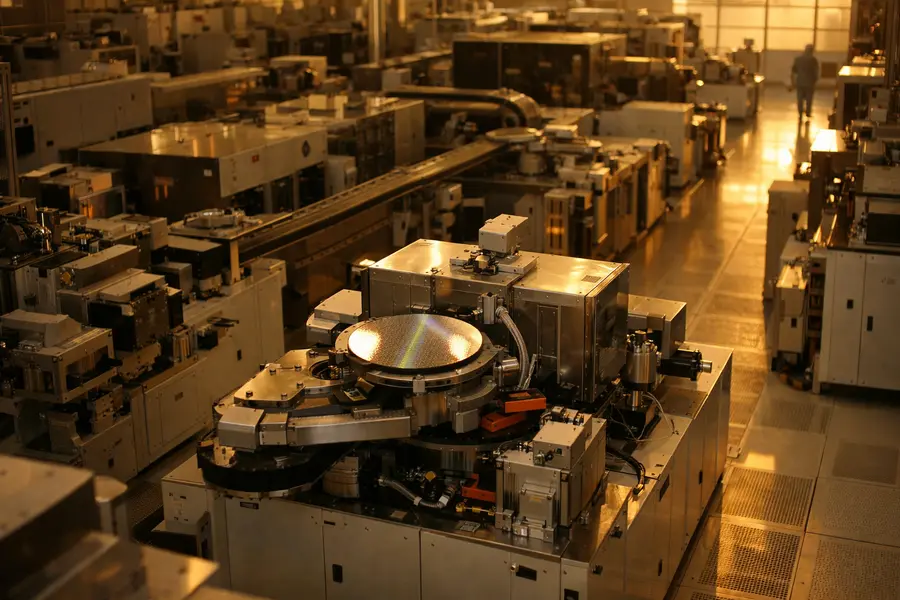
KLA Corporation surged to a multi-month high as AI-driven wafer fabrication investment accelerates, validating the thesis that semiconductor equipment makers are the next leg of the AI infrastructure trade.
- KLAC rose more than 7% to $185.60, the stock's highest close in several months, as semiconductor equipment makers led broad market gains.
- KLA forecasts $4 billion in revenue for the September quarter, lifting its 2026 wafer equipment market outlook to the low $150 billion range.
- Advanced packaging process-control revenue is on track to reach approximately $1.1 billion in calendar 2026, a rise of more than 70% year over year.
Lead
KLA Corporation (KLAC) climbed 7.4%, gaining $12.66 to close at $185.60 on Friday, September 5, 2026 -- its strongest single-session advance in months -- as semiconductor equipment stocks delivered the week's most decisive sector outperformance. Applied Materials (AMAT) and Lam Research (LRCX) posted comparable gains in tandem, pushing the VanEck Semiconductor ETF (SMH) sharply higher and lifting leveraged semiconductor proxies, including SOXL, by double digits. The move reflected a recalibrated investor consensus: with AI chip production running near theoretical capacity limits at the world's leading foundries, the capital flowing into advanced-node fabs now targets the inspection, metrology, and process-control equipment that makes those fabs run -- tools that KLA dominates.
Why Did KLAC Break Out on This Session?
The proximate catalyst was a confluence of signals that demand for wafer fabrication equipment has become both larger and longer-dated than the market had modeled. A landmark capital-spending commitment from South Korean chipmakers -- widely reported at roughly $800 billion spread over several years -- underlined the scale of global fab expansion underway, and analysts noted that KLA, as the leading provider of process-control and yield-management systems, captures a disproportionate share of spending at advanced nodes where inspection intensity is highest.
At the same time, KLA's most recent earnings cycle reinforced the structural story. Fiscal fourth-quarter 2026 revenue came in at $3.66 billion, up 15.2% year over year, with management guiding Q1 FY2027 revenue to $4 billion -- a range that would represent further acceleration. The company simultaneously raised its projection for the 2026 wafer equipment market to the low $150 billion range, up from prior estimates, and flagged that order lead times are extending and backlog strength is deepening across logic, memory, and advanced packaging.
What Is Driving Demand Visibility to Record Levels?
Management's language around visibility was unusually direct. Chipmakers building out advanced-node capacity for AI training clusters are committing to multi-year equipment cycles rather than the shorter purchase windows typical of prior semiconductor upcycles. That structural shift -- driven by the long lead times, enormous capital intensity, and competitive urgency of building AI-optimized fabs -- gives equipment vendors forward visibility closer to aerospace supply chains than to the historically volatile chip-equipment cycle.
How Does KLAC Compare Within the Equipment Peer Group?
The rally was sector-wide, but KLA's position within it is structurally differentiated. Applied Materials (AMAT) gained comparable ground on the session and is up approximately 98% year to date, propelled by deposition and etch tool demand tied to the same advanced-node cycle. Lam Research (LRCX), up roughly 117% year to date, reflects similar tailwinds in memory-adjacent etch applications.
KLA's distinct claim on the AI equipment narrative rests on process control intensity -- the share of wafer fab equipment budgets allocated to inspection and metrology rises as node geometries shrink and defect tolerances tighten. At 2-nanometer and below, where TSMC and Samsung are committing the next wave of AI-logic capacity, KLA tools become more embedded in the production flow, not less, with each successive node transition. The company holds roughly 50% market share globally in the segment, a position reinforced by the software and data analytics services tied to its installed base.
ASML Holding (ASML), the EUV lithography monopoly, rose in tandem, completing a quartet of equipment names that now collectively represent the clearest proxy for the AI infrastructure build-out beyond the chip designers themselves.
Market Reaction
The broader semiconductor complex followed KLA's lead. SMH closed higher by approximately 4%, while SOXL -- the leveraged semiconductor index instrument -- advanced more than 8% on the session. NVDA, the bellwether for AI chip demand, held its gains from earlier in the week, providing an underlying bid for the equipment narrative. The rotation reflected a considered rather than reactive bid: volume in KLAC ran above its 30-day average, and the price gain held into the close without significant late-session fading.
Outlook
KLA's management has made clear that the 2026 equipment cycle does not resemble previous boom-bust patterns. With greenfield fab construction at multi-decade highs across the United States, Japan, South Korea, and Taiwan -- each driven partly by national AI competitiveness strategies and partly by private hyperscaler demand -- the company's order pipeline extends well into fiscal 2027 and beyond. The $4 billion September-quarter revenue target, if met, would represent a record, and the company's advanced-packaging process-control franchise, combined with its services revenue stream tied to an ever-larger installed base, provides durable income through any moderation in new tool orders. As AI infrastructure spending matures beyond the chip-design layer into the physical production infrastructure that makes advanced chips possible, KLA's position as the essential quality-assurance layer of that infrastructure becomes increasingly central to the trade.
Mentioned tickers: KLAC, AMAT, LRCX, ASML, NVDA, SMH, SOXL