Pomegra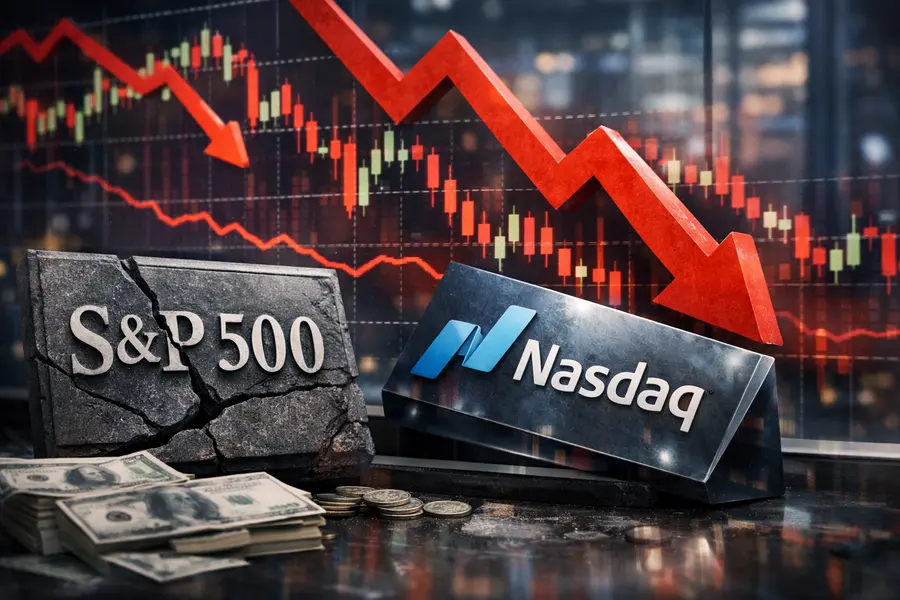
The S&P 500 and Nasdaq Composite closed lower for the week ended July 18, 2026, as a fresh Chinese AI model release reignited AI bubble concerns and drove a sharp tech stock sell-off across semiconductors and large-cap growth names.
- The Nasdaq slid 2.9% for the week, the S&P 500 fell 1.6%, and the Dow declined 0.9% as tech led declines.
- Chinese startup Moonshot unveiled its Kimi K3 model, triggering comparisons to the 2025 DeepSeek shock and hammering chip stocks.
- The Philadelphia Semiconductor Index fell 11% on the week and confirmed entry into a bear market, down roughly 24% from its June peak.
Lead
Wall Street's major benchmarks ended the week on a sour note, with the Nasdaq Composite dropping 2.9% — its steepest weekly decline in months — and the S&P 500 shedding 1.6% to close at 7,457.69, as tech stocks bore the brunt of renewed selling pressure. The Dow Jones Industrial Average fell 406.55 points, or 0.77%, to 52,146.42, finishing the week off 0.9%. Losses accelerated Thursday and Friday as investors responded to the surprise release of a high-capability AI model from Chinese startup Moonshot, deepening an already festering debate over the sustainability of AI-driven valuations — a debate that has become the defining feature of a market increasingly described as carrying echoes of 1999.
What Happened
The immediate catalyst was Moonshot's Thursday launch of Kimi K3, an open-weight model carrying 2.8 trillion parameters — the largest of its kind publicly disclosed to date. The company positioned Kimi K3 as performing on par with leading systems from OpenAI and Anthropic, with full model weights scheduled for public release on July 27. Markets reacted swiftly. The announcement drew direct comparisons to the January 2025 DeepSeek episode, when a Chinese laboratory released a model matching US rivals at a fraction of the reported training cost, causing a single-session rout in semiconductor shares.
The pattern repeated almost precisely. Nvidia shares dropped more than 2% on the week, briefly ceding the title of world's most valuable company to Apple, which managed to hold ground on continued enthusiasm surrounding Apple Intelligence and its Siri expansion. Alphabet declined sharply mid-week before partially recovering. Arm Holdings, Applied Materials, Lam Research, Intel, KLA Corp., and Micron Technology each fell 2% to 4% across the period.
The Semiconductor Rout
No sector absorbed more damage than semiconductors. The VanEck Semiconductor ETF (SMH) logged its third weekly decline in four weeks, ending the period down roughly 9%. The Philadelphia Semiconductor Index (.SOX) dropped 11% on the week and confirmed a technical bear market, having now retreated approximately 24% from its historical peak set at the end of June. The index has lost more than 17% in July alone.
The SOX's bear market confirmation carries symbolic weight: the semiconductor sector had functioned as the de facto proxy for AI infrastructure investment since the rally began accelerating in 2023. Its slide into bear territory suggests that the capital expenditure thesis — which posited that enormous spending on data centers, advanced chips, and custom silicon would compound for years — is now being scrutinized rather than assumed.
AI Bubble Concerns Take Center Stage
The Kimi K3 release sharpened an unease that has been building for several weeks. AI bubble concerns have been gaining traction in institutional circles throughout the summer, with some prominent analysts noting that 2026's market structure rhymes uncomfortably with 1999 — a period when genuine technological progress was real, but valuations had outpaced any plausible near-term earnings path.
The core anxiety is straightforward: US hyperscalers and chip designers are committing hundreds of billions of dollars in annual capital expenditure to AI infrastructure. Justifying those outlays requires that AI capabilities translate into measurable revenue and margin expansion at a scale and pace that earnings results have not yet confirmed. Each new low-cost, high-performance model from China — whether DeepSeek in 2025 or Moonshot's Kimi K3 now — forces the market to revisit that assumption, because it implies the cost of frontier intelligence may fall faster than the infrastructure incumbents have priced in.
Market Reaction in Context
Not all technology names bled equally. Apple reclaimed the top spot in global market capitalization during Friday's session, supported by sustained momentum around its on-device AI strategy and the expanding rollout of Apple Intelligence features. The divergence underscored a developing rotation within tech: hardware and infrastructure-dependent names faced selling pressure, while companies seen as beneficiaries of cheaper AI models — software platforms, consumer applications, and device makers — held up comparatively better.
The broader S&P 500 tech sector sell-off also unfolded against a backdrop of mixed macro signals. Inflation readings earlier in the week came in near consensus, providing modest support on Monday and Tuesday before semiconductor losses overwhelmed that cushion by Thursday. Trading volumes in chip names were notably elevated during the selloff, suggesting the move was driven by conviction rather than thin summer liquidity.
Geopolitical Dimension
Moonshot's Kimi K3 also injected a geopolitical undercurrent into an already complex week. The model's release came as US-China technology competition remains a live policy front, with export controls on advanced chips still in force. Yet Kimi K3's capabilities, achieved despite those controls, reinforced a view gaining ground in Washington and among institutional investors: that export restrictions may be slowing but not stopping Chinese AI development. The strategic implications — for US chip demand, for the capex cycle, and for the premium that markets assign to American AI leadership — are difficult to quantify in a single week but are clearly beginning to be reflected in prices.
Outlook
The week's US stock weekly close leaves the S&P 500 and Nasdaq in technically weakened positions heading into a stretch of second-quarter earnings reports from major technology companies. How those results address AI monetization — specifically, whether revenue growth justifies the infrastructure spending that has driven semiconductor demand — will likely determine whether the current pullback represents a healthy recalibration or the early stages of a broader repricing. The semiconductor sector's bear market confirmation and the persistence of AI bubble concerns give investors ample reason to watch the coming weeks with more than usual attention. The burden of proof now rests with earnings.