Pomegra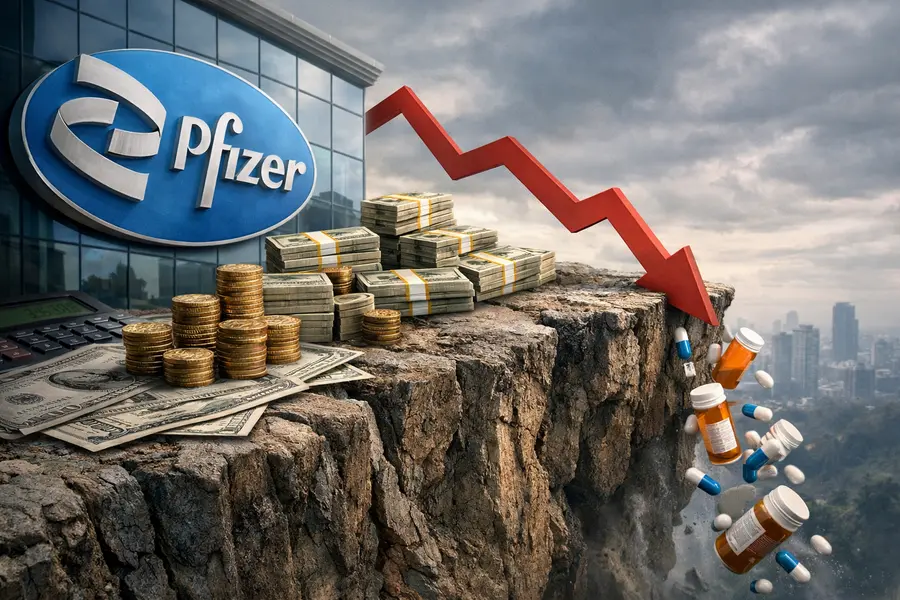
Pfizer's $4.6 billion semi-annual dividend commitment draws scrutiny as patent expirations threaten up to $17 billion in annual revenue through 2030, raising questions about the long-term sustainability of PFE stock's near-7% yield.
- Pfizer's trailing-twelve-month payout ratio exceeded 130% of earnings and 103% of free cash flow as of Q1 2026, intensifying concerns about Pfizer dividend sustainability.
- Patent expirations on Eliquis and Ibrance put an estimated $15–$17 billion in annual revenue at risk of generic erosion by 2030 under the pharma patent cliff impact.
- Pfizer reaffirmed full-year 2026 revenue guidance of $59.5–$62.5 billion and points to a 108-candidate pipeline as its primary bridge across the cliff.
Lead
Pfizer Inc. (NYSE: PFE) has disbursed approximately $4.6 billion in dividend payments in the first half of 2026 — part of a $14.6 billion payout over the past six quarters — as investors and capital-allocation observers scrutinize whether the drugmaker can sustain that commitment through the most severe patent-expiration cycle in the company's modern history. With blockbuster medicines losing exclusivity from 2026 through 2028, and free cash flow that fell short of dividends paid in fiscal 2025, Pfizer financial health is under a level of scrutiny not seen since the post-Covid revenue correction.What Happened
Pfizer paid $9.771 billion in dividends in fiscal year 2025 against free cash flow of $9.076 billion — a gap of roughly $695 million. Through the first two quarters of 2026, the pace of distribution has continued at a similar rate, with the company paying an estimated $4.6–$4.8 billion in shareholder returns.
The dividend currently stands at $1.72 per share annually, implying a yield of approximately 6.7–7.0% based on a share price in the mid-$25 to low-$26 range. That elevated yield reflects market skepticism: when a pharmaceutical franchise of Pfizer's scale yields nearly seven times the S&P 500 average, it signals investors are pricing in non-trivial probability of a cut.
Pfizer management reiterated on its May 2026 first-quarter earnings call that maintaining and supporting the dividend remains a stated priority. However, the company's most recent increase amounted to a single penny per share — a freeze in real terms — and the December 2025 quarterly rate held flat, patterns consistent with a company conserving flexibility rather than projecting confidence.
The Patent Cliff at the Center of the Debate
The structural challenge driving dividend scrutiny is the pharma patent cliff impact Pfizer faces across its top revenue-generating medicines. Management has publicly guided that approximately $17–$18 billion in annual revenue is at risk from loss-of-exclusivity events between 2026 and 2028.
Eliquis, the blood-thinning agent co-marketed with Bristol-Myers Squibb (NYSE: BMY) that contributes an estimated $6–$7 billion annually to Pfizer's revenue, saw its European patent exclusivity expire in May 2026. U.S. exclusivity is expected to follow by 2026–2027. Independent forecasts project Eliquis sales could fall by as much as 92% from peak levels by 2030 as generic competition builds. Ibrance, Pfizer's oncology franchise drug for hormone receptor-positive metastatic breast cancer, faces a comparable timeline, with exclusivity expiring in 2027. Xeljanz and Xtandi add further pressure. Together, these four products represent the core of the revenue base now exposed to biosimilar and generic substitution.Pfizer Financial Health: Balance Sheet and Cash Position
Pfizer's trailing-twelve-month free cash flow stood at approximately $9.5 billion as of March 2026 — a figure that technically covers the annualized dividend run rate of roughly $9.8 billion only at the margin. With a cash payout ratio of 103% and an earnings-based payout ratio above 130%, the Pfizer financial health picture reveals a company spending more than it currently earns to sustain its distribution.
The balance sheet carries a debt-to-equity ratio of 0.71 and a current ratio of 1.16, both acceptable but offering limited buffer if operating cash flows compress through the loss-of-exclusivity transition. Adjusted diluted earnings per share guidance for full-year 2026 ranges from $2.80 to $3.00, against a $1.72 annual dividend — a ratio that provides more comfort on an EPS basis than on a free-cash basis.
Pipeline as the Long-Term Answer
Pfizer's strategic defense rests on a pipeline that now encompasses 108 drug candidates, roughly one-third of which are new molecular entities. Recently launched and acquired products generated $10.2 billion in revenue during 2025 and are projected to grow at double-digit rates in 2026.
In oncology — the segment Pfizer has identified as central to post-cliff revenue recovery — atirmociclib, a next-generation CDK4 inhibitor being evaluated in first-line HR+/HER2-negative metastatic breast cancer, and sigvotatug vedotin, an antibody-drug conjugate targeting metastatic non-small cell lung cancer, represent the company's most advanced pipeline bets. Pfizer has characterized its oncology investment as exceeding $10 billion in acquired and developed assets.
Obesity therapeutics represent a second strategic bridge, with Pfizer working to establish a position in a market that rivals are already monetizing at scale.
Market Reaction
PFE stock has reflected investor uncertainty. Shares have traded in the mid-$25 to low-$26 range in recent months, largely rangebound as bulls weigh pipeline optionality against bears pricing in a dividend reduction. The 7% yield has attracted income-oriented capital while simultaneously functioning as a signal of market skepticism. First-quarter 2026 revenues of $14.5 billion — a 5% increase over the prior year period — provided modest reassurance, with earnings per share of $0.75 exceeding consensus estimates of $0.72.Outlook
Pfizer enters the second half of 2026 with revenue guidance intact and a pipeline capable, in principle, of eventually absorbing losses from expiring franchises. The immediate pressure point is the next 24–36 months, when Eliquis and Ibrance revenues fall away before replacement assets reach peak commercial scale. Free cash flow coverage of the dividend will remain below parity during that transition unless cost reductions or licensing income accelerate faster than current guidance implies. Whether Pfizer dividend sustainability survives the cliff intact depends less on the company's willingness to pay than on whether atirmociclib, its obesity program, and other late-stage assets begin generating material cash before the current blockbuster base fully deflates.