Pomegra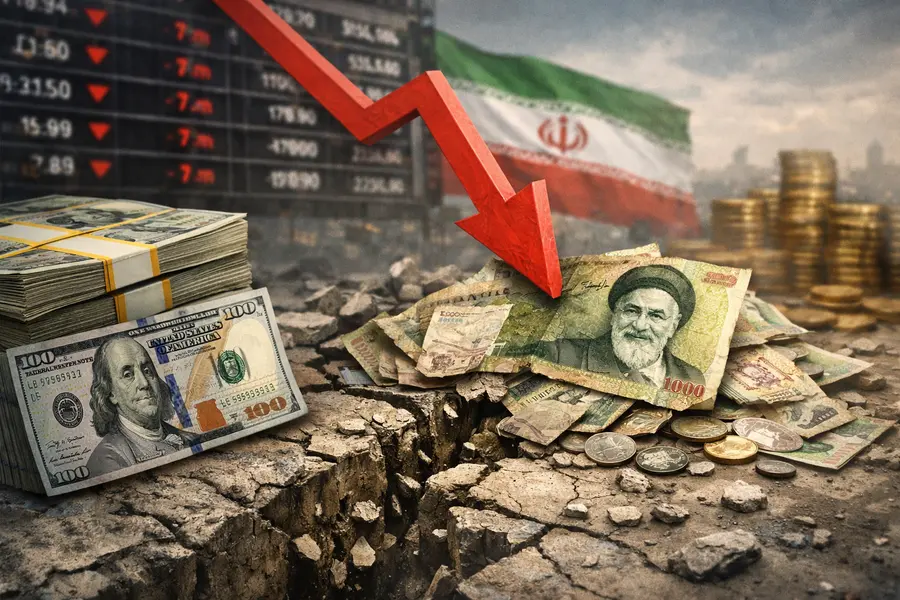
The US dollar Iranian rial exchange rate breached 1.94 million rials on Saturday, extending a 43.7% collapse in Iran's currency since January as U.S. military strikes and a naval blockade compound a deepening economic crisis.
- The dollar surged to 1.941 million rials on Tehran's free market Saturday, a single-day gain of 32,000 rials, or 1.67%, marking an all-time record.
- Iran currency crash accelerates as annual consumer-price inflation reaches 88.6%, the highest level since the Second World War.
- The IMF projects Iran's economy will contract 6.1% in 2026, with inflation averaging 68.9% for the full year.
Lead
Tehran's free market, July 18 — The US dollar climbed to an all-time high against the Iranian rial, touching 1.941 million rials on Saturday as fresh U.S. air strikes on Iran's southern regions and an active naval blockade of the country's coastline triggered a new wave of currency selling. The milestone extends a collapse that has erased roughly 43.7% of the rial's value since the start of 2026, when one dollar bought approximately 1.35 million rials, fueling fears among Iranian households and businesses of another sharp acceleration in already runaway inflation.
What Happened
The latest move in the rial weakening trend came after Washington launched a new round of strikes aimed at degrading Iran's military capabilities and reinforcing a naval cordon around the Strait of Hormuz, the narrow passage through which roughly 20% of global seaborne oil transits. The operations compounded pressure on a currency already battered by decades of U.S.-led sanctions, chronic budget deficits, and sustained monetary expansion that has kept the printing presses running to cover government shortfalls.
At 1.941 million rials per dollar, the exchange rate quoted on Tehran's unofficial open market — the benchmark most Iranians use to protect savings and price traded goods — has now more than doubled from levels seen just eighteen months ago. The official rate set by the Central Bank of Iran remains far below the market rate, a gap that historically has encouraged arbitrage, fueled black-market activity, and deepened public distrust in monetary institutions.
Earlier in 2026, the rial had already recorded a series of successive lows. The dollar broke through 1.47 million rials in January, pierced 1.76 million to 1.81 million rials in April following a 15% two-day collapse, and continued its ascent through the spring months as battlefield and diplomatic developments repeatedly disappointed hopes for a stabilizing ceasefire.
Market Reaction
The Iran currency crash has moved in near-lockstep with military escalation. Each new strike cycle or blockade announcement has produced a fresh sell-off in Tehran's open market, where ordinary citizens line up at licensed exchange counters or turn to informal dealers to convert rials into dollars, euros, or gold coins — the traditional store of value in Iran. Gold prices in Tehran have risen sharply in tandem with the dollar.
The correlation points to a currency crisis driven as much by psychology and capital-flight dynamics as by trade-balance fundamentals. Net capital outflows reached approximately $9 billion in the months leading up to June 2025, when the current conflict began in earnest, and the pace has accelerated since, according to figures compiled by regional economists tracking Iran's balance of payments.
Geopolitical Dimension
At the center of the Middle East economic impact is the Strait of Hormuz. The International Energy Agency has characterized the closure of the strait as the "largest supply disruption in the history of the global oil market." The blockade has severed Iran's primary avenue for oil export revenue — the hard-currency lifeline that the government uses to service imports and defend the rial — while simultaneously pushing global crude benchmarks higher, a dynamic that benefits Iran's regional rivals and adversaries even as it amplifies Tehran's fiscal strain.
The war's direct economic toll has been severe. Iranian officials have put the damage figure at roughly $270 billion, equivalent to approximately 57% of the country's pre-war gross domestic product. Senior advisers to President Masoud Pezeshkian have reportedly warned that full economic recovery could take more than a decade, even under optimistic assumptions about a post-conflict reconstruction program.
Inflation and Social Pressure
Annual consumer-price inflation, which stood at 52.6% at the end of 2025, accelerated to approximately 68% by February 2026 and climbed further to 88.6% as of the most recent monthly reading — a pace not recorded since the years immediately following the Second World War. Monthly inflation in May alone ran at 8.8%, suggesting the annualized rate has not yet peaked.
Food prices have risen faster than the headline index, squeezing lower-income households that spend the largest share of their budgets on necessities. Prices of basic goods were expected to rise an additional 20% to 30% in coming weeks as the exchange-rate pass-through works its way through the supply chain.
Social unrest, which erupted in late December 2025 with protests across Tehran, Isfahan, Shiraz, and Mashhad, has persisted intermittently into 2026, adding a further layer of political risk to an already fragile governance environment.
Structural Vulnerabilities
The rial weakening reflects vulnerabilities that predate the current conflict. Chronic budget deficits financed through the banking system have expanded the money supply far faster than output growth, embedding inflation expectations that make each new shock harder to absorb. Sanctions have limited Iran's access to foreign exchange reserves held abroad, reducing the central bank's ability to intervene in the open market. Capital flight — estimated at around $20 billion in 2024 alone — has hollowed out domestic savings and constrained investment.
Outlook
The US dollar Iranian rial exchange rate is likely to remain under pressure as long as military operations continue and the Strait of Hormuz remains contested. The IMF's April 2026 World Economic Outlook projected a 6.1% contraction in Iranian GDP for the full year, with inflation averaging 68.9% — figures that may already prove conservative given the trajectory of the past two months. With reserves constrained, the fiscal position deteriorating, and public confidence in the rial at historic lows, the conditions for a further leg of Iran currency crash remain firmly in place. Any meaningful stabilization would require either a credible ceasefire agreement or a significant structural shift in the government's monetary and fiscal policy framework, neither of which appears imminent.
Mentioned tickers: None