Pomegra
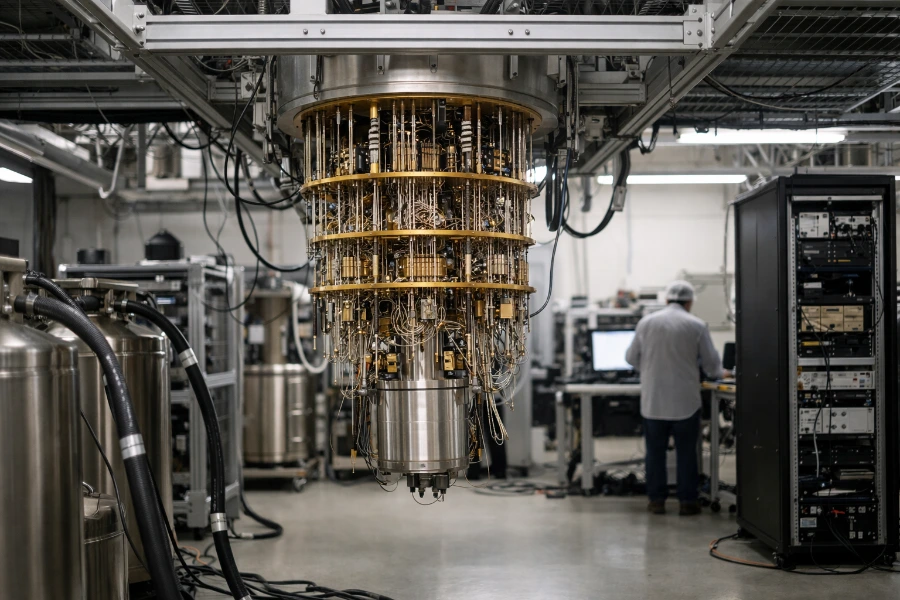
Rigetti Computing shares fell about 7% after hours as Q3 2026 revenue of $1.41 million missed estimates and the CFO flagged heavy capital spending into 2027.
- Q3 revenue of $1.41 million trailed the $3.67 million consensus and fell about 27% from a year earlier.
- The CFO expects 2027 capital spending to stay broadly in line with 2026's elevated level.
- RGTI closed at $12.15 on Tuesday, then traded near $11.29 after hours.
Lead
Rigetti Computing (NASDAQ: RGTI) reported third-quarter 2026 revenue of $1.41 million on Tuesday, well below the $3.67 million consensus and down from $1.9 million in the same quarter of 2025. Shares, which fell 6.39% in the regular session to $12.15, slid a further 7.08% to about $11.29 in extended trading. The CFO told investors that capital expenditure will remain heavy through 2027, which pushed the cash-burn question to the center of the reaction.What Happened in Rigetti's Third Quarter?
Rigetti missed revenue expectations by roughly $2.26 million, or about 60%. Revenue in the quarter fell about 27% from a year earlier.
Nine-month revenue reached $10.9 million, up about 110% from $5.2 million in the first nine months of 2025. That gain reflects lumpy system sales earlier in the year rather than a steady run rate, and the third quarter showed how uneven that revenue can be.
Gross margin improved to about 61% from about 21% a year earlier. The operating loss was $33.2 million. Cash, cash equivalents and available-for-sale investments stood at $497.1 million at quarter-end, down from $541.3 million on June 30, with no debt.
Why Did the Stock Fall After Hours?
The stock fell because the quarterly miss was paired with a spending outlook that extends well beyond the current year. The CFO said 2026 capital expenditure is elevated by dilution refrigerator capacity, Fab 1 equipment and infrastructure for higher-qubit-count systems. He said 2027 spending should be relatively consistent with 2026. Cash used for capital expenditure totaled $42.6 million in the first nine months of the year.
The full-year revenue target adds pressure. Rigetti's roughly $20 million forecast for 2026 requires about $9.1 million in the fourth quarter. That figure depends on its customer C-DAC accepting a quantum computing system in the period, which would allow Rigetti to book the related sale. A single delivery therefore carries most of the remaining year.
How Much Cash Does Rigetti Have to Fund Expansion?
Rigetti holds $497.1 million in liquidity, which covers current spending for an extended period. Quarterly cash fell about $44 million in the third quarter, a pace that includes both operating losses and equipment purchases.
The company also expects a $100 million investment from the U.S. Department of Commerce. It will be paid for 7.7 million newly issued shares and recorded as equity. That adds to the balance sheet but dilutes existing holders, and it ties part of the company's funding to a government industrial-policy push for domestic quantum capacity.
Technology Progress and Roadmap
The technical results were stronger than the financial ones. Rigetti's 108-qubit Cepheus-1-108Q system reached 99.5% median two-qubit gate fidelity. It reached 99.6% on an 80-qubit sublattice and 99.7% on a 50-qubit sublattice. Fidelity measures how often a two-qubit operation succeeds, and error rates are the main barrier to useful quantum computation.
Management is targeting a system of more than 300 qubits at about 99.7% fidelity by mid-2028. The chiplet-based design that Rigetti uses assembles larger processors from smaller, higher-yielding chips. The capital spending flagged for 2027 is tied to that build-out.
Strategic Context for Quantum Computing Stocks
Quantum computing companies largely earn small, irregular revenue from research contracts, system sales and cloud access. They are valued on technical milestones and the pace of government and enterprise adoption. Share prices tend to react sharply when quarterly figures show how far commercial revenue lags the engineering story.
Rigetti's profile is typical of the group. It has a large cash buffer and improving unit economics, but its revenue is concentrated in a handful of deals and its capital needs are rising. Investors are weighing whether the fidelity roadmap converts into recurring sales before spending absorbs the cushion.
Outlook
The next test is the fourth quarter. A C-DAC system acceptance would close most of the gap to the $20 million revenue target, while a delay would leave 2026 well short of it. Capital spending that stays near 2026 levels in 2027 will keep operating cash outflows elevated even as the $100 million Commerce investment arrives. The roadmap toward 300 qubits by mid-2028 remains the central driver of how the market values Rigetti.
Mentioned tickers: RGTI