Pomegra
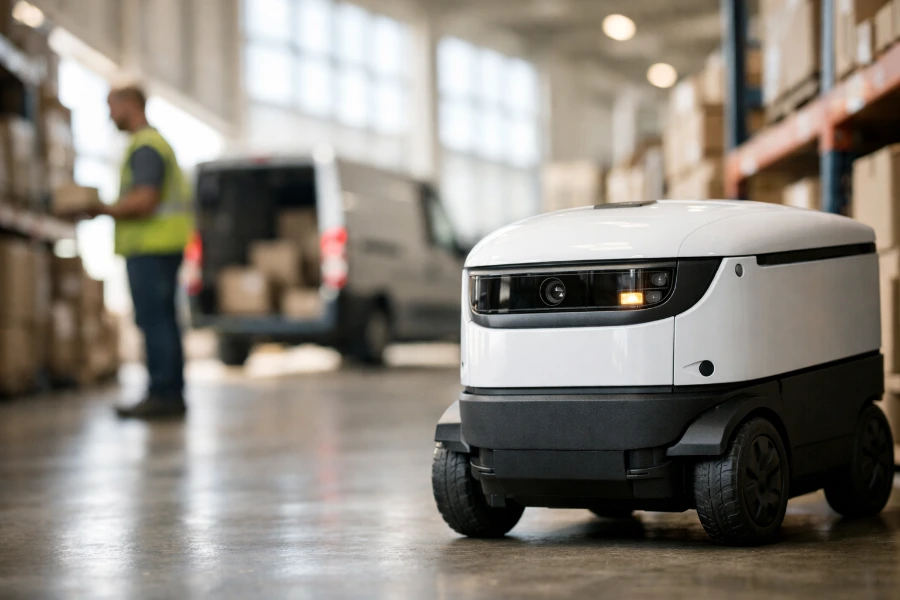
PORT, the London e-bike operator, has raised €14.5M in equity and debt to build autonomous delivery robots on top of the courier networks it already runs.
Key Takeaways
- PORT raised €14.5M in equity and debt on 10 November 2026, led by EBRD and Balnord.
- The round lifts total funding to €29M, after €14.5M in earlier pre-seed and seed rounds.
- PORT runs 24 microhubs and 3,500 e-bikes across three UK cities, and is working with Royal Mail on a robotic delivery system.
Lead
PORT, a London-based e-mobility operator for delivery couriers, announced a €14.5M round on 10 November 2026 that combines equity and debt. The European Bank for Reconstruction and Development (EBRD) and Balnord led it, with participation from existing and new investors whose names were not disclosed. The money will go toward PORT's proprietary AI Driver, its own autonomous delivery vehicles, and R&D and AI hiring.
The company did not disclose a valuation, the equity-to-debt split, or revenue. That leaves the round hard to benchmark. Debt-heavy financing would suggest a company funding hardware and hub leases. Equity-heavy financing would suggest investors are paying for the AI data story.
What Does PORT Actually Do?
PORT rents electric bikes to delivery couriers and provides the infrastructure around them. It supplies a fleet of 3,500 e-bikes on weekly, monthly or daily terms, and operates 24 microhubs for charging and storage in London, Manchester and Birmingham. More than 50,000 couriers use the network. The hubs occupy about 52,000 square feet of urban space, including underground car parks, warehouses and railway arches.
The robotics plan builds on that base. Chief executive and founder Kamil Suda has argued that "robotised logistics does not start with the robot," and that it starts with the infrastructure, operations and data needed to put robotics to work in the real world. Co-founders Matas Simonavicius and Dmitri Liberman serve as CTO and COO.
How Does PORT Plan to Train Its Robots?
PORT trains its AI Driver on footage collected from its own bike fleet. A portion of the e-bikes carry Nvidia-powered cameras and lidar sensors that capture kerbs, cyclists, drop-off points and edge cases during ordinary deliveries. The data uploads automatically when the bikes return to a PORT hub.
This is the core of the pitch. Most autonomous delivery startups pay for pilot fleets to gather road data. PORT collects it as a by-product of a courier business that already exists, at a marginal cost close to the price of the sensors. Whether data from a cycling courier's viewpoint transfers cleanly to a wheeled robot is an open technical question that the company has not addressed publicly.
Who Is Backing the Round?
The EBRD, a multilateral development lender, and Balnord lead the round. The presence of a development bank is consistent with the debt component, since institutions of that kind typically provide structured financing rather than pure venture equity. Neither lead investor's ticket size has been disclosed.
The round roughly doubles PORT's total capital. The €14.5M raised through pre-seed and seed rounds now sits alongside an equal amount in new financing, bringing the total to €29M. Few details have emerged on how the new money compares with the prior valuation, so the step-up cannot be assessed.
What Is PORT Building With Royal Mail and Its Partners?
PORT is developing a robotic delivery system with Royal Mail, the UK's national postal operator. Terms, fleet size, trial timelines and launch locations have not been disclosed. The company is also a member of the Urban Microhub Alliance alongside parking operators including Apcoa, Q-Park, Saba and NCP, and counts Deliveroo among its partners. Those parking groups matter because they control the underground and car-park space where microhubs fit.
The first expansion outside the UK is a microhub in central Paris, planned for the end of 2026.
What Are the Risks?
The central risk is timing. Autonomous sidewalk and kerbside delivery has absorbed large amounts of capital across the sector, and regulatory approval for robots operating on UK public roads and pavements remains slow. PORT's courier business gives it revenue while the robots mature, which few pure-play robotics rivals can claim. The cost is that it must run a hardware-heavy operations business and an AI research programme at once, on €14.5M of fresh capital.
Outlook
PORT has the distribution, the hub footprint and a data pipeline already running, and it now has funding from two lead investors to turn them into robots. The undisclosed valuation and debt split limit any reading of investor conviction. The Paris hub, due by the end of 2026, and any announced trial dates with Royal Mail will be the first measurable tests of whether the model can move from bikes to autonomous vehicles.