Pomegra

Alterra Labs, a New York startup, raised a $12.5M seed led by Oak HC/FT to build simulated clinical environments that test and train medical AI models.
Key Takeaways
- Alterra Labs closed a $12.5M seed round led by Oak HC/FT, announced November 10, 2026.
- Flare Capital Partners and Company Ventures joined the round. Valuation was not disclosed.
- Frontier AI labs are the company's fastest-growing customer group.
Lead
Alterra Labs, a New York company founded in 2025, announced a $12.5M seed round on November 10, 2026. Oak HC/FT led the financing, with Flare Capital Partners and Company Ventures participating. Alterra builds simulated medical environments in which AI models work through clinical tasks while physicians grade their decisions. Those grades become scoring criteria and rewards for reinforcement learning. Valuation was not disclosed.
What Does Alterra Labs Actually Build?
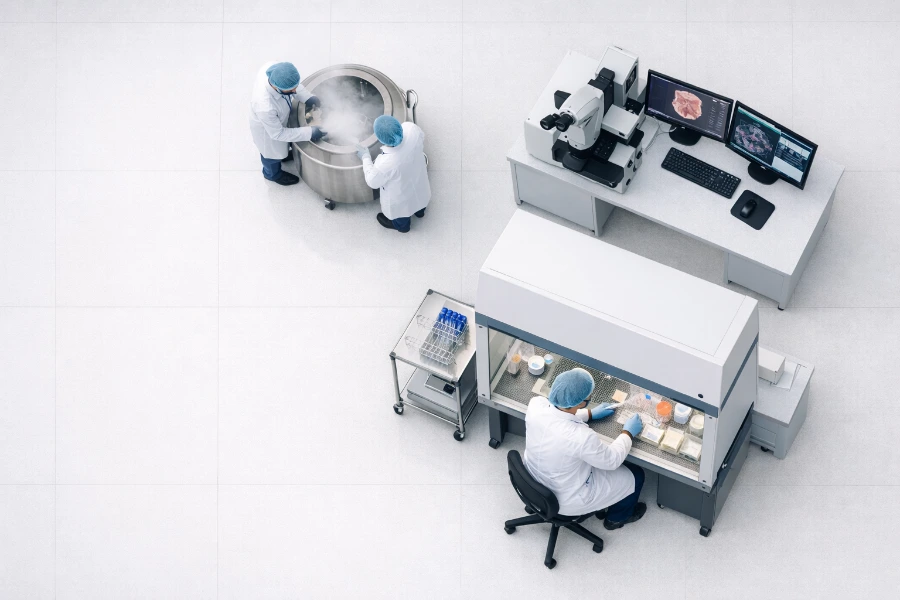
Alterra builds simulated patient scenarios that expose where medical AI fails and then convert those failures into training material. In one example, a model decides which tests to order for a simulated patient. Clinicians judge whether the choices are medically appropriate. Those judgments are written into scoring rubrics, and the model is rewarded for repeating stronger decisions and penalized for behaviors experts flag as unsafe.
The company also builds environments for medical imaging, clinical trials and telehealth. It earns revenue from the training environments themselves and from post-training services. Its customers include several frontier AI labs, hospitals, medical societies and applied AI companies. The labs are the fastest-growing group.
Who Is Behind the Company?
Akash Kapoor is founder and CEO. He studied machine learning before moving into medicine, did healthcare-focused ML research at the National Institutes of Health, and completed three years at Columbia Medical School. He left before his final year to work on the company full time.
Kapoor has a personal reason for the focus. At age 20 he found X-ray findings that had gone unreported and pointed to a possible tumor. He was later diagnosed with osteosarcoma and had surgery. The company began under the name ChartR, studying how frontier models behaved in clinical settings alongside healthcare providers, before becoming Alterra.
Why Do Medical AI Models Need Simulated Environments?
Static question-and-answer benchmarks say little about whether a model can handle the sequence of decisions in real care. Stanford research using the PhysicianBench and HealthAdminBench benchmarks found that the best-performing agents completed fewer than half of their clinical and administrative tasks. The agents struggled to follow patients over time, process large volumes of information and string decisions together. They also failed to recognize when they lacked enough information to act safely. Some described the correct action but could not carry it out in real systems.
Kapoor has described the gap in plain terms: "The models don't know when not to do something for a patient, and how to deal with uncertainty." A simulated environment lets a model make that kind of mistake repeatedly without a patient bearing the consequences, and lets clinicians correct it at scale.
What Does the Round Say About Investor Appetite?
The round points to money moving from raw data toward the infrastructure that teaches models to perform work. Oak HC/FT partner Vig Chandramouli framed the shift this way: "All of the money that went into 'I need data' is now evolving into 'I need to understand how to successfully do work.'"
Size matters here. Dealroom data places the $12.5M seed in the top 4% of US health seed deals by amount. A recent comparison is BioStack's $9.5M raise in October, which targets turning hospital records into training datasets. Together the two rounds suggest investors are funding the supply chain around medical models, from data to evaluation, rather than the models themselves.
The skeptical reading is straightforward. The company sells to a small number of frontier labs, and concentrated demand can shift quickly if those labs build similar tooling internally. Strong performance inside a simulation also does not prove safer care. Simulated results still need validation against real clinical outcomes.
How Will the Funding Be Used?
Alterra plans to expand its library of simulated medical environments and increase its capacity to deliver training and post-training services to frontier labs and healthcare providers. Headcount, revenue and contract terms were not disclosed.
Outlook
Alterra enters the market with a defensible niche, a lead investor with deep healthcare experience and customers on both the AI and provider sides. Its main test is evidence. Frontier labs and hospitals will want proof that models trained in its environments make fewer unsafe decisions outside them. If that evidence arrives, simulated clinics could become a standard stage between model development and clinical deployment. If it does not, the category risks looking like another benchmarking exercise.