Pomegra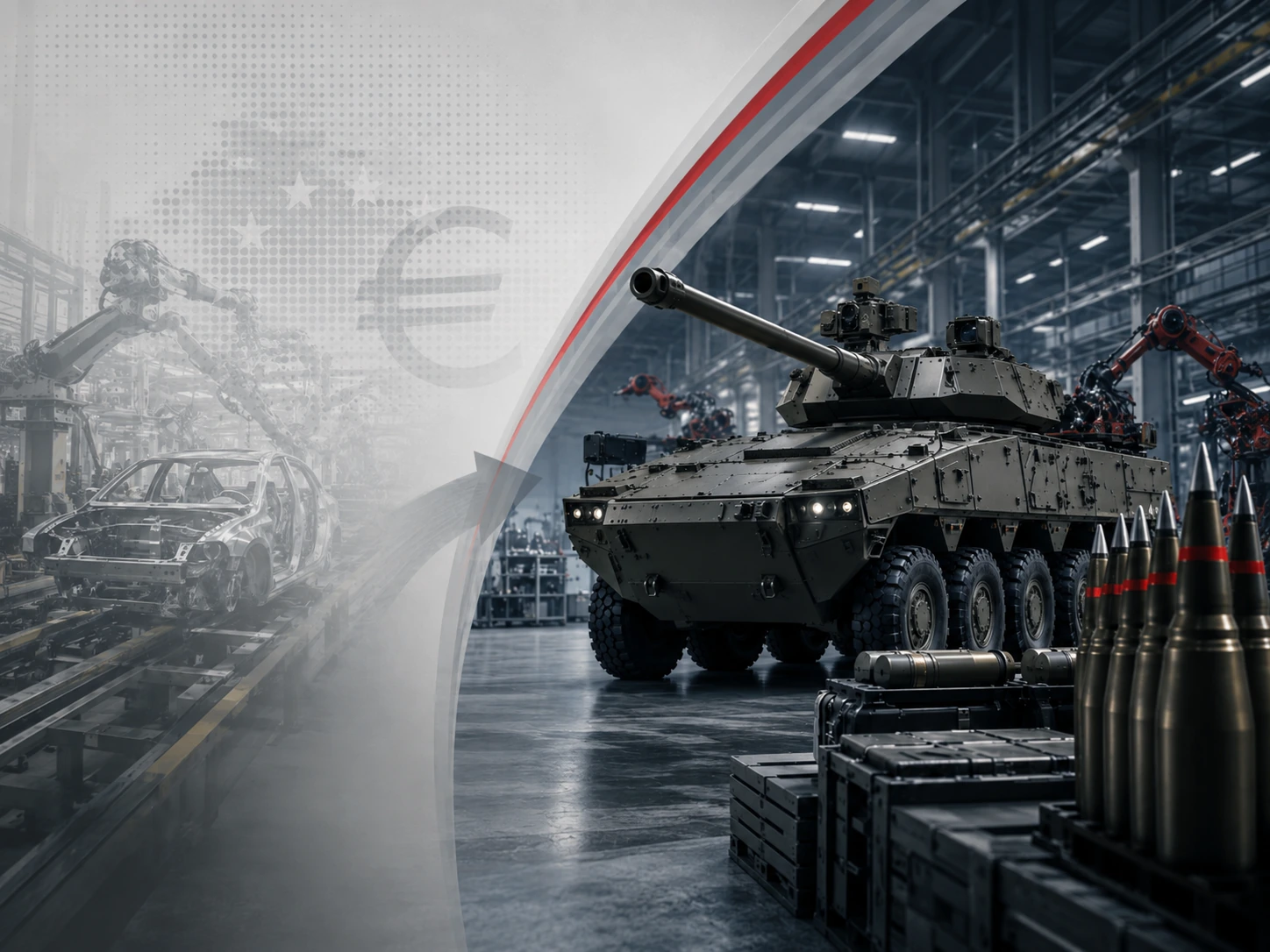
Germany's Rheinmetall completes its pivot to pure-play defense by selling its automotive Power Systems division to Aequita for €350 million, targeting €50 billion in annual revenue by 2030.
- Rheinmetall sells automotive unit to Munich-based Aequita for €350M; deal expected to close Q4 2026, retaining ~6,250 employees
- Defense order backlog hit €64B in September 2025, on track for €80B by year-end, underpinning 40–45% sales growth guidance for 2026
- RHM shares trade around €1,171 on the Frankfurt exchange, off a 52-week high of €2,008 but up sharply over the two-year defense spending cycle
Lead
Rheinmetall AG has agreed to sell its civilian automotive Power Systems division to Munich-based industrial group Aequita for a provisional €350 million ($406 million), the company announced, completing its transformation into a pure-play defense industry company. The deal, structured as a 100% share sale subject to standard market-adjustment mechanisms, is expected to close in the fourth quarter of 2026. Chief Executive Armin Papperger described the move as a deliberate concentration on "the high-margin business with military customers, where we have excellent growth opportunities."What Happened
Rheinmetall's automotive segment had operated as a legacy civilian business alongside the company's expanding defense divisions. Deterioration in the broader automotive sector weighed on the unit's value and accelerated the divestiture timeline. Aequita, the buyer, plans to retain approximately 6,250 Power Systems employees, with certain German sites continuing through a medium-term joint venture arrangement and a Spain facility sustaining both civilian and military production during a transitional phase before converting to defense-only output.
The €350 million consideration, while modest relative to Rheinmetall's overall scale, removes a structural distraction. The group recorded consolidated revenue of €9.94 billion in 2025, up 28.8% year-over-year, with Vehicle Systems alone contributing €4.99 billion — a 32% increase. The automotive unit, by contrast, had become a drag on margin and narrative.
Market Reaction
RHM shares on the Frankfurt Stock Exchange trade at approximately €1,171, down from a 52-week peak of €2,008 reached in October 2025 but far above the €630 52-week trough. The pullback from highs reflects broader profit-taking across European stocks in the defense sector after a historic re-rating cycle, not a deterioration in fundamentals. Eighteen analyst recommendations carry a "Buy" designation, with a consensus 12-month price target of €1,889, implying significant upside from current levels. The stock trades at a forward price-to-earnings multiple of roughly 40x, elevated against the company's own 10-year median of 20x but justified by a backlog and growth trajectory few industrial companies can match.Strategic Context
The divestiture is the culmination of a multi-year strategy to position Rheinmetall defense as Europe's leading integrated land-systems and ammunition manufacturer. The company's order backlog stood at €64 billion in September 2025, with management projecting growth to €80 billion by year-end, a figure that effectively pre-sells multiple years of production capacity. For 2026, Rheinmetall guides for group sales of €14.0 to €14.5 billion — a 40 to 45% increase — at an operating margin of approximately 19%.
The longer-term ambition is more striking: Rheinmetall targets €50 billion in annual revenue by 2030, a fivefold expansion from 2025 levels, anchored by €13–15 billion from Vehicle Systems and €14–16 billion from Weapons and Ammunition. To support this, the company is pursuing near-full vertical integration in artillery and missiles, expanding into naval systems through the acquisition of shipbuilder Naval Vessels Luerssen, and extending into space-based intelligence with a €1.7 billion contract for a synthetic aperture radar satellite constellation.
Geopolitical Dimension
The deal lands against a backdrop of record European defense spending. EU member states collectively spent €343 billion on defense in 2024, a 19% increase from the prior year, and are on course to reach €381 billion in 2025. Defense investment — equipment procurement, R&D, and infrastructure — exceeded €100 billion for the first time in 2024, growing 42% in a single year. Sixteen EU states raised defense budgets by more than 10% in 2024–2025 alone.
That structural shift transforms Rheinmetall from a cyclical industrial company into one of the primary beneficiaries of a sustained, policy-driven spending supercycle. Germany, Poland, Spain, Sweden, and the Netherlands are among the fastest-growing markets, all of which overlap directly with Rheinmetall's core product lines.
Outlook
Rheinmetall's exit from automotive removes the final vestige of its legacy industrial identity and focuses capital, management attention, and production capacity entirely on defense industry growth. With a backlog approaching €80 billion, 2026 guidance implying nearly 45% revenue growth, and a stated target of €50 billion by 2030, the company's trajectory is among the most clearly defined in European industrials. The key execution risk is capacity ramp — converting orders into deliveries at scale — while European stocks in the defense sector broadly face the challenge of sustaining premium valuations as the initial re-rating phase matures.
Mentioned tickers: RHM