Pomegra
Qualcomm (QCOM) fell about 5% after hours despite a Q4 beat, as the memory shortage cut handset sales and first-quarter profit guidance missed estimates.
- Qualcomm shares fell about 5% to 6% after hours on Wednesday despite a fiscal fourth-quarter beat.
- Handset revenue fell 26% to $5.14 billion as the memory shortage raised phone costs and curbed demand.
- Q1 EPS guidance of $2.15 to $2.35 has a midpoint below the roughly $2.27 to $2.32 consensus.
Lead
Qualcomm (NASDAQ: QCOM) shares dropped roughly 5% to 6% in extended trading on Wednesday, November 4, after the chipmaker beat fiscal fourth-quarter estimates but guided first-quarter earnings below expectations. The company said a global memory shortage is raising device costs and weighing on smartphone sales, its largest business. Adjusted earnings were $2.17 per share against a consensus of about $2.16. Adjusted revenue was about $10.4 billion, ahead of the roughly $10.1 billion expected but down about 7% from a year earlier.What Did Qualcomm Report for Fiscal Q4 2026?
Qualcomm reported adjusted EPS of $2.17 and revenue of about $10.4 billion, a modest beat on both lines, with a sharp split between segments.
Handset revenue fell 26% to $5.14 billion from $6.96 billion a year earlier, slightly below the roughly $5.2 billion to $5.3 billion expected. Automotive was the standout, rising 89% to a record $1.99 billion, well above the $1.66 billion estimate. Internet-of-things revenue rose 4% to $1.89 billion. Licensing revenue at QTL fell 7% to $1.30 billion.
The chip unit, QCT, generated $9.02 billion in revenue, down 8%. Its earnings-before-tax margin narrowed to 27% from 30%. For the full fiscal year, handset revenue totaled $24.07 billion, down 13%, while automotive reached $6.00 billion, up 52%.
Why Did Qualcomm Shares Fall Despite the Beat?
Shares fell because guidance paired higher expected sales with lower expected profit, which points to margin pressure rather than a demand problem.
For the first quarter, Qualcomm forecast revenue of $10.4 billion to $11.2 billion. The $10.8 billion midpoint is above the roughly $10.5 billion to $10.6 billion consensus. Adjusted EPS guidance of $2.15 to $2.35 has a $2.25 midpoint, short of the $2.27 to $2.32 range analysts had expected.
Spending added to the concern. Full-year capital expenditure is running near $2.5 billion, about 30% above the roughly $1.9 billion forecast. Management said semiconductor input costs are rising across wafer fabrication, assembly, testing, advanced packaging and memory. It also said the full margin benefit of its mitigation measures would arrive only in the second half of fiscal 2027.
How Is the Memory Shortage Hitting Smartphone Sales?
The memory shortage is hitting smartphone sales through higher component prices, which force handset makers to raise device prices and trim volumes.
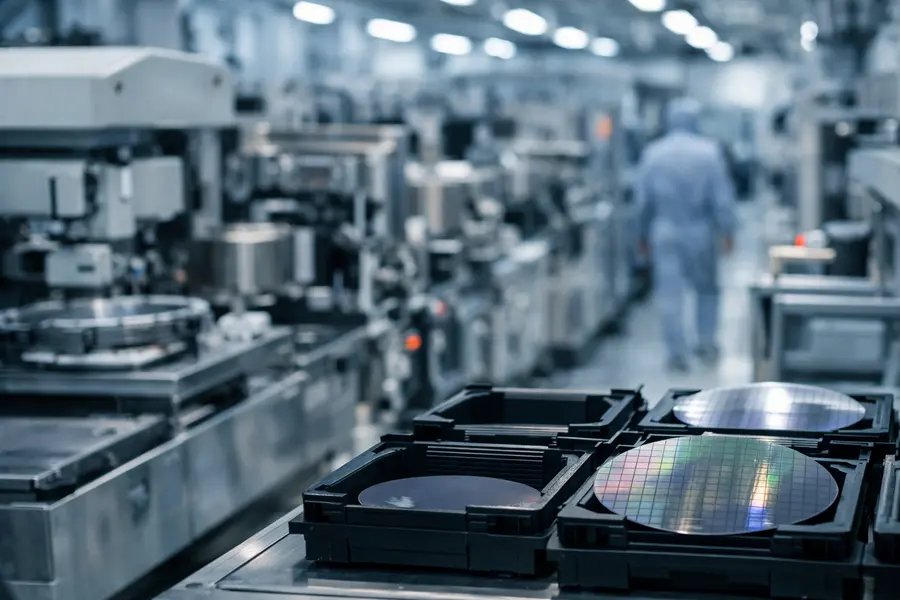
Memory suppliers have shifted capacity toward high-bandwidth memory for AI data centers. That has left less supply, and higher prices, for the mobile memory used in phones. Producers such as Micron Technology (MU) have benefited from the AI-driven demand. Smartphone makers and the chip designers that supply them are absorbing the cost.
Qualcomm said Android shipments in China have bottomed and projected the handset market to be flat in 2027. Handsets still account for about half of company revenue, so the squeeze reaches the whole earnings base.
Can Data Center and Auto Offset the Handset Slump?
Qualcomm argues they can, and it has framed fiscal 2027 as the start of a non-handset revenue inflection.
Chief Executive Cristiano Amon said the company expects non-handset businesses to grow more than 60% in fiscal 2027. Qualcomm is targeting about $5 billion in data center revenue that year, against about $650 million in the latest period. Amon said the data center business does not have a demand issue but a supply issue.
Automotive is the proof point so far. The segment has nearly doubled year over year and is now almost 20% of quarterly revenue. Even so, the data center push requires capital spending ahead of revenue, which accounts for the elevated capex and the near-term margin drag.
Strategic Context
The report shows Qualcomm's diversification strategy running ahead of its handset business is still shrinking. The company has spent several years reducing its dependence on phones by building automotive, IoT and, more recently, AI data center products. Automotive and IoT together contributed about $3.9 billion in the quarter, nearly 38% of revenue.
The memory shortage also shows how AI infrastructure demand can compress margins in consumer electronics. The same supply constraints that lift memory makers' pricing power raise bill-of-materials costs for phone makers, which pass them on to buyers.
Outlook
Qualcomm enters fiscal 2027 with a handset business under cost pressure and a growth plan that depends on automotive and data center products. Near-term earnings will track memory pricing and supply, with management pointing to the second half of fiscal 2027 for the full margin benefit of its mitigation measures. The first-quarter revenue guidance of $10.4 billion to $11.2 billion shows demand holding, while the lower profit midpoint and higher capex set the terms on which the stock is judged.