Pomegra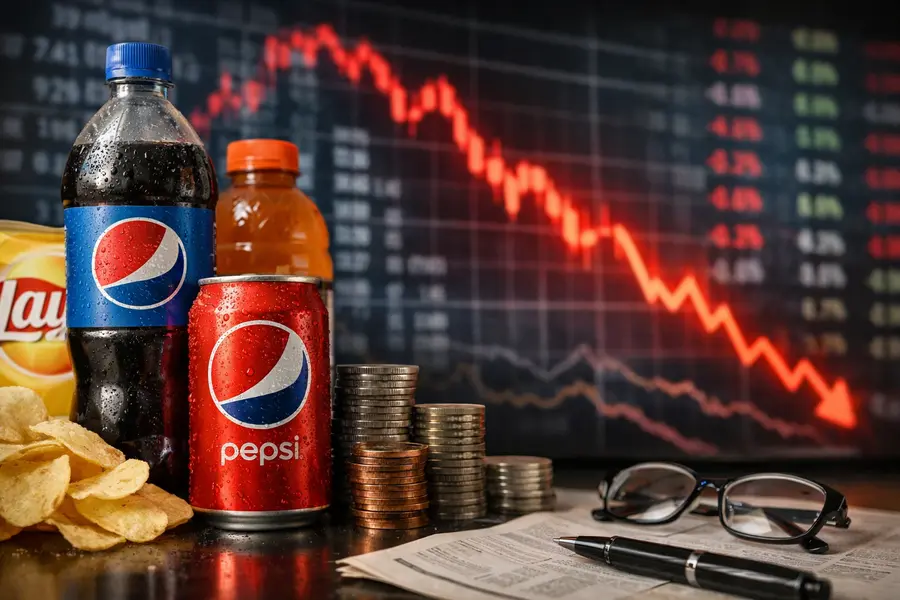
PepsiCo shares hover at a 52-week low after Q2 2026 earnings revealed faltering North American volumes, margin pressure, and a full-year guidance range skewed firmly to its floor.
- PEP stock touched a 52-week low of $132.96 as adjusted Q2 EPS of $2.20 narrowly missed the $2.21 consensus
- Organic volume declined 4% overall, with North American beverage volume down an equal 4% year over year
- Management expects full-year organic revenue growth and EPS growth to land at the low end of their 2–4% and 4–6% guidance ranges
Lead
PepsiCo (PEP) shares settled near their one-year low of $132.96 following the company's second-quarter 2026 results on July 9, as a deteriorating U.S. consumer backdrop pushed organic volumes lower across its flagship beverage and snack businesses. Net revenue reached $24.18 billion — a 6.4% year-over-year gain that beat the $23.95 billion street estimate — yet adjusted earnings per share of $2.20 fell a penny short of expectations, and management signaled that the remainder of the year will track the low end of prior guidance.What Happened
PepsiCo's North American operations bore the brunt of the quarter's weakness. Organic volume declined 4% across the consolidated business, with the North American beverage division matching that drop and the food segment recording flat volumes. The company's chief executive attributed the shortfall directly to consumer finances, noting that gasoline prices had tightened household budgets more sharply than internal models had anticipated.To arrest volume losses, PepsiCo cut prices on Lay's and Doritos by as much as 15% in North America — a significant reversal after years of inflation-driven price increases that had propped up revenue while eroding unit sales. At the same time, the company outlined plans to raise prices on portions of its fresh-snack portfolio later in the year to offset rising commodity and labor costs, creating a delicate dual-pricing strategy that analysts warn could further confuse consumers already trading down.
Reported operating profit reached $4.02 billion, with operating margin expanding to 16.6% from 7.9% in the year-ago period — a year-over-year comparison distorted by a large restructuring charge recorded in Q2 2025. Adjusted metrics told a more cautious story: management guided full-year core constant-currency EPS growth to the low end of the 4–6% range, citing commodity inflation as the primary headwind even as a roughly one-percentage-point tailwind from tariff refunds provides partial offset.
Market Reaction
PEP stock sank toward its 52-week low immediately after the July 9 release, reflecting disappointment with the volume trajectory and the tempered outlook. Multiple sell-side firms lowered price targets in the days that followed: Bernstein cut to $142, TD Cowen moved to $150, and Piper Sandler revised to $178, while UBS and Barclays also reduced their targets, citing persistent North American execution risk. The consumer staple sector broadly underperformed, with the SPDR Consumer Staples ETF (XLP) remaining more than 1% negative year-to-date and trailing the S&P 500 by a substantial margin — continuing a multi-year trend in which the sector has lagged the broader index by roughly 187 percentage points cumulatively over the past two decades.Beverage Industry Challenges
The pressures confronting PepsiCo are not confined to its own portfolio. The broader beverage industry faces structural headwinds including slowing U.S. beer consumption, a wine category where dollar sales dropped 4.7% over the 52 weeks ending April 2026, and a consumer migration toward ready-to-drink formats that is reshuffling shelf allocation across retail. Regulatory complexity adds a further burden: the FDA has accelerated the phase-out of synthetic food dyes, including Red No. 3, with a 2027 compliance deadline, forcing industry-wide reformulation that carries both cost and reputational risk. Energy, water, and labor costs continue to climb, while food and beverage manufacturing is projected to lose nearly a quarter of its workforce to retirement by 2030.
Strategic Context
PepsiCo's international segment offered a relative bright spot, with revenue rising approximately 7% in the quarter, reinforcing management's emphasis on geographic diversification as North American growth stalls. The company maintained its dividend — a signal of long-term balance-sheet confidence that has historically underpinned its appeal to income-oriented investors in the consumer staple sector. Yet the dividend yield's attraction is tempered by a share price at a one-year trough and an uncertain near-term volume recovery path.The company's pricing pivot illustrates a broader dilemma across the branded consumer goods space: years of price-led growth have stretched the consumer tolerance ceiling at precisely the moment commodity costs are rising again. Rebuilding volume without permanently sacrificing margin requires a calibration that few peers have managed cleanly in the current macro environment.