Pomegra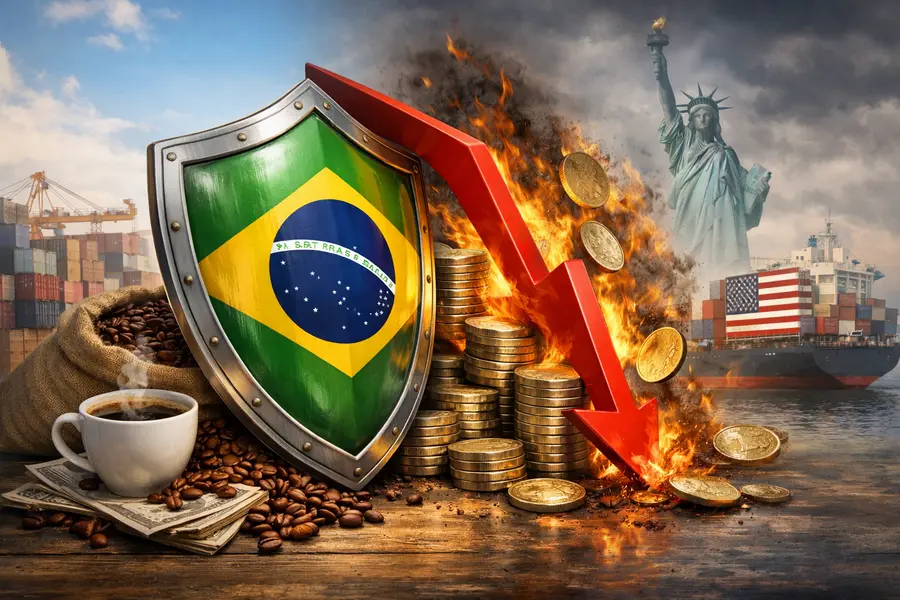
Brazil's coffee sector escapes a sweeping 25% U.S. tariff announced July 16, shielding up to $2.5 billion in annual global coffee exports from disruption.
- The U.S. imposed 25% tariffs on Brazilian goods effective July 22, citing unfair trade practices; coffee, beef, and key commodities are formally exempt.
- The Brazil coffee tariff exemption protects between $2 billion and $2.5 billion in annual Brazilian coffee sales to the United States.
- Brazil condemned the measures as illegal and arbitrarily imposed, pledging WTO litigation and retaliatory countermeasures under its Reciprocity Law.
Lead
The United States announced a 25% tariff on a broad range of Brazilian imports on July 16, 2026, set to take effect July 22 — but carved out protections for coffee, beef, oranges, orange juice, select energy products, and aerospace components. The move follows a yearlong Office of the U.S. Trade Representative (USTR) investigation that concluded Brazil maintained a pattern of unfair trade practices against American companies and products. For the global coffee export industry, the exemption represents a critical lifeline after a bruising 18 months of tariff exposure that had already reshaped trade flows.
What Happened
The USTR concluded that Brazil engaged in a range of practices deemed unreasonable and discriminatory, including lax anti-corruption enforcement, unfair domestic tariffs directed at U.S. technology and financial-services firms, restrictions on American ethanol market access, inadequate intellectual property protections, and preferential tariff treatment extended to competing trade partners.
The resulting 25% levy targets manufactured goods and a wide array of processed products. Exemptions cover commodities where the United States either lacks sufficient domestic production or where supply-chain disruption would fall directly on American consumers and industries. Coffee qualified on both counts: the U.S. produces virtually no commercial coffee, and Brazil supplies approximately 32% of all green coffee beans imported into the country.
Secretary of State Marco Rubio attributed the tariffs explicitly to the bilateral relationship under Brazilian President Luiz Inácio Lula da Silva. Rubio stated that Lula had not negotiated with the United States in good faith over the preceding year and that economic policies pursued by Brasília were harmful to both Americans and Brazilians. The tariffs, Rubio indicated, were the direct price of that posture.The Coffee Exemption: Stakes and Scope
The Brazil coffee tariff exemption is among the most economically significant carve-outs in the order. The Brazil economic interest in this outcome is substantial: the Brazil coffee sector exports between $2 billion and $2.5 billion worth of product to the United States annually, making the American market one of the country's largest and most consistent revenue sources.
The stakes were sharpened by what preceded this ruling. Instant coffee had remained subject to U.S. tariffs even after Washington revoked duties on most Brazilian products, including green coffee beans and flavored instant varieties. The result was severe: Brazilian instant coffee exports to the United States collapsed by nearly 30% in 2025 versus the prior year. The US Brazil trade relationship in coffee had been deteriorating precisely because of this uneven tariff application, which the latest exemption corrects by covering all coffee categories.
The exemption also extends to beef, oranges and orange juice, certain petroleum oils and gas products, and aerospace parts and components — sectors where US supply dependency or domestic industry partnerships created aligned incentives for Washington and Brasília.
Brazil's Economic and Trade Context
Brazil is the world's largest coffee producer and exporter by a wide margin, a position that underpins the country's outsized weight in global coffee export markets. The Brazil economic footprint in coffee runs deep: the sector generated $47.53 billion in export value in 2025 across 8.76 billion kilograms shipped globally. Export revenue for the first four months of 2026 totaled approximately $4.5 billion, a 17.4% decline year-on-year partly attributable to prior tariff friction.The forward picture, however, is notably stronger. A record harvest is forecast for the 2026/27 crop year, with total exports projected to surge 30% to 49.07 million bags — including 45 million bags of green coffee and 4 million bags of soluble and instant products. The coffee exemption positions Brazilian exporters to capitalize on that production surge without tariff headwinds in their largest single-country export destination.
Brazil's Retaliation Posture
Brasília did not accept the tariff announcement without objection. President Lula characterized the measures as lacking justification and described them as illegally and arbitrarily imposed. Brazil signaled it would pursue parallel tracks: formal dispute resolution through the World Trade Organization and domestic countermeasures under its Reciprocity Law, which authorizes equivalent retaliatory tariffs on American goods entering the Brazilian market.
The diplomatic framing from Rubio — framing the tariffs as a consequence of Lula's personal choices rather than structural policy differences — introduces a political dimension that complicates the path to negotiated resolution. US Brazil trade negotiations have stalled for over a year, and the current posture from both capitals suggests the standoff is unlikely to resolve quickly.
Manufactured goods, which represent a significant share of Brazilian export earnings and face the full 25% levy, will bear the primary economic cost. The selective exemptions for coffee, beef, and energy signal that Washington calibrated the order to maximize pressure on Brazilian industrial policy while insulating American consumers from commodity price shocks.
Outlook
The Brazil coffee tariff exemption averts the most disruptive scenario for global coffee export markets, preserving U.S.-bound flows from the world's dominant producer at a moment when a record Brazilian crop is about to enter global supply chains. The broader US Brazil trade rupture, however, remains unresolved: the 25% levy on manufactured goods takes effect July 22, and Brasília's stated intention to retaliate and litigate through the WTO ensures the bilateral relationship will remain a source of market and geopolitical uncertainty through the remainder of 2026. The durability of the coffee exemption itself will depend on whether broader Brazil economic negotiations advance, or whether the current diplomatic impasse deepens.
Mentioned tickers: SBUX, BURL, KDP, JM