Pomegra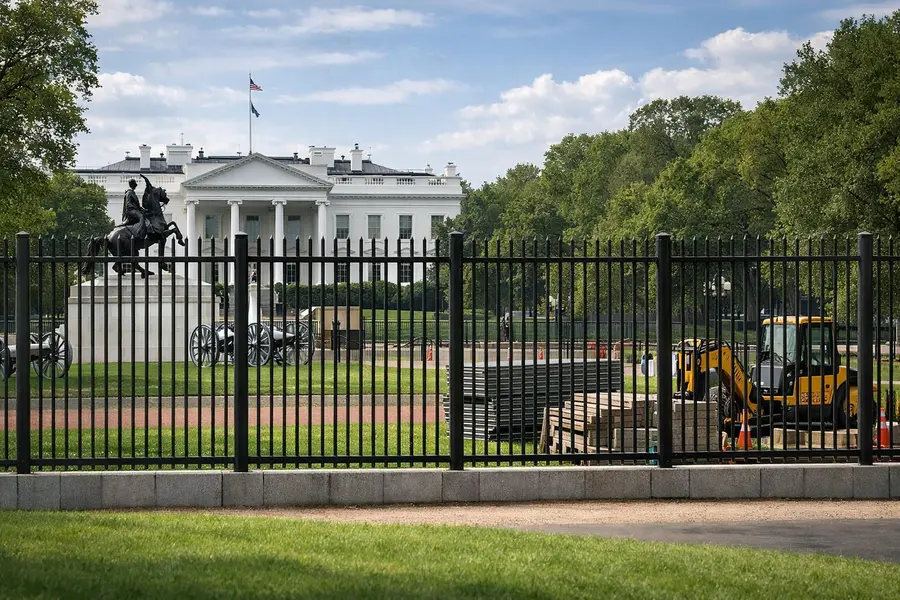
The Trump administration's proposal to ring Lafayette Park with permanent 8-to-9-foot fencing advances White House security while reigniting debate over public access to a landmark protest site.
- The Secret Service proposes permanent 8-to-9-foot fencing around the 8-acre Lafayette Park, with gated north and south entrances controlled by law enforcement.
- A companion plan targets Pennsylvania Avenue's north corridor — from the Treasury Building at 15th Street to the Eisenhower Executive Office Building at 17th Street.
- Phased construction is slated to begin in 2027, contingent on appropriated funding; the U.S. Commission of Fine Arts reviewed the 79-page plan on July 16.
Lead
The Trump administration formally advanced a White House security proposal on July 16, 2026, placing before a federal design panel a detailed plan to enclose Lafayette Park — the 8-acre green space directly north of the White House — with permanent steel fencing between 8 and 9 feet tall. The U.S. Secret Service and the Executive Office of the President, acting with the Department of the Interior, submitted the 79-page document to the U.S. Commission of Fine Arts for architectural review, setting in motion the most significant restructuring of the park's public access in decades.
What Happened
The administration's proposal calls for perimeter fencing running the full circumference of Lafayette Park, with gated access points at the north and south entrances. Under heightened security conditions, law enforcement would have authority to close those gates, effectively sealing the park from pedestrian entry. The plan also presents two options on the four corner monuments: one design incorporates the statues within the secured perimeter; a second excludes them, leaving the monuments accessible without passing through gates.
Beyond Lafayette Park, the same US executive branch safety framework extends to Pennsylvania Avenue, where comparable fencing is proposed along the White House's entire northern face — a roughly two-block stretch connecting the Treasury Department at 15th Street to the Eisenhower Executive Office Building at 17th Street. Should both elements be built, the White House complex would be encircled on all sides by controlled barriers.
Historical Context
Lafayette Park has served as the nation's most prominent protest corridor for more than two centuries, its proximity to the Oval Office giving demonstrators direct symbolic access to executive power. That tradition faced its most recent interruption in June 2020, when authorities erected tall temporary black fencing around the park's northern edge following large-scale protests over the death of George Floyd — barriers that remained for months and drew widespread criticism.
The history of White House perimeter hardening stretches further. President Bill Clinton permanently closed Pennsylvania Avenue to vehicular traffic in 1995 following the Oklahoma City bombing, citing a vulnerability that a vehicle-borne explosive could exploit. Each security escalation has followed a threat event; the current proposal follows no single disclosed incident but rather a broader reassessment of static versus deployable barriers.
The Secret Service noted in supporting documents that existing temporary barriers require up to 72 hours to install and dismantle, creating gaps in protection during fast-moving threat scenarios. Permanent fencing, the agency argues, addresses that operational lag while offering an aesthetically controlled solution that the agency describes as "historically compatible."
The Security Case
The administration frames the Lafayette Park fence as a structural fix to a documented operational weakness. Temporary crowd-control barriers, while flexible, are logistically intensive and visually disruptive; the proposal states they are also "aesthetically unappealing." A fixed perimeter eliminates the deployment window and allows the Secret Service to modulate access through a smaller number of controlled entry points rather than managing an open boundary. President Trump referenced the park directly in an April post on Truth Social, stating he had already made what he described as a "multimillion contribution" to beautification efforts there — signaling personal investment in the site's physical transformation.
Civil Liberties Dimension
Critics of the Trump administration security plan center their objections on the symbolic weight of the site. Lafayette Park has hosted protest activity spanning civil rights demonstrations, anti-war movements, and more recent political mobilizations. Enclosing it behind gated fencing, opponents argue, converts a traditionally open civic space into a managed zone accessible only at government discretion. Civil liberties advocates have characterized the proposal as disproportionate, with some describing it as a barrier against peaceful assembly rather than a counter-terrorism measure.
The Commission of Fine Arts review, while focused on architectural compatibility, provides a public record of the design's aesthetics and scale — criteria that may factor into any legal challenge over historic-preservation obligations governing the park.
What Comes Next
The Commission of Fine Arts review completed July 16 is one step in a multi-agency approval chain. Actual construction is not expected to begin before 2027, with the administration noting that implementation will be "phased" and "sequenced according to funding availability." Congressional appropriation will therefore determine pace, giving legislators a leverage point over the project's timeline and scope. No total cost estimate has been publicly released.
Outlook
The administration's Lafayette Park fence proposal represents a continuation of the incremental fortification of the White House complex that has accelerated since the 1990s. If funded and constructed on the outlined schedule, the permanent perimeter would effectively transform the park from an open public space into a controlled-access zone — a structural shift with lasting implications for White House security, public assembly rights, and the visual identity of one of Washington's most historically charged civic sites. Whether Congress allocates the necessary funds in the next budget cycle will determine whether the 2027 construction target holds.