Pomegra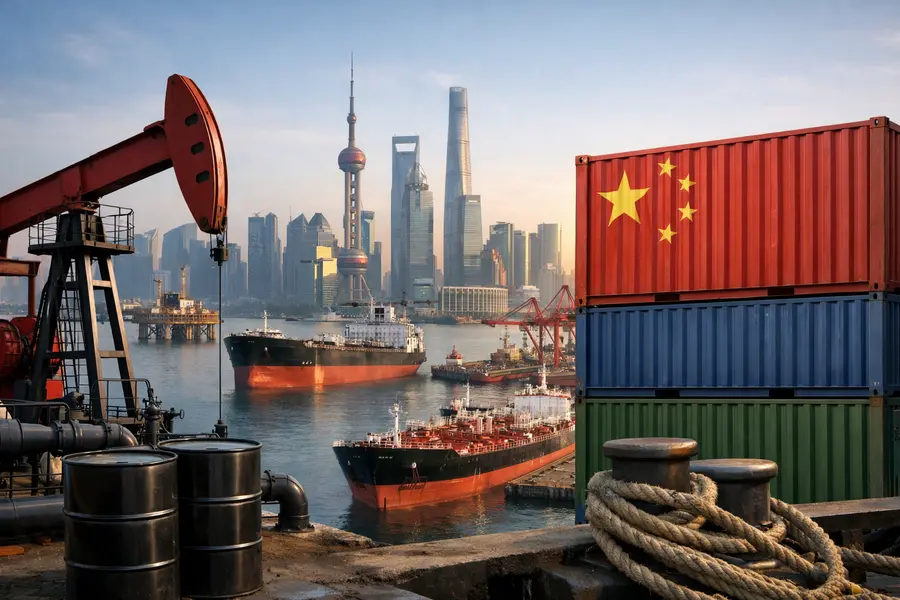
China's 1.4 billion-barrel crude stockpile has made Beijing the world's first oil swing importer, giving it the power to cap oil price volatility and reshape global oil demand in ways no consuming nation has managed before.
- China's crude oil imports hit a record 11.65 million barrels per day in 2025, with roughly 1.1 mb/d channeled into strategic and commercial reserves.
- Beijing cut purchases by nearly 3 million barrels per day during the 2026 Iran crisis, deploying stockpiles to offset the Strait of Hormuz shock.
- China's unilateral decisions on when to buy or abstain now set an effective floor and ceiling on global oil prices.
Lead
China has formally joined the ranks of oil market power brokers, becoming the first consuming nation to function as a swing importer — a demand-side counterpart to the role Saudi Arabia has long played on the supply side. By accumulating 1.4 billion barrels of crude reserves through 2025 and then drawing them down sharply as the Iran conflict disrupted Gulf flows in 2026, Beijing demonstrated an unprecedented ability to calibrate its own impact on global oil demand and, by extension, on prices worldwide. The shift has permanent structural implications for energy markets, oil price volatility, and the geopolitics of petroleum.
What Happened
China's crude imports averaged 11.65 million barrels per day in 2025, a 5.7 percent increase from 11.02 mb/d in 2024 and the highest annual average on record. The U.S. Energy Information Administration estimates that approximately 1.1 mb/d of those imports went directly into state and state-directed commercial inventories rather than into refineries — a deliberate, sustained stockpiling campaign that took total crude stocks to nearly 1.4 billion barrels by December 2025.
Then, as Israeli and U.S. military operations disrupted Iranian exports in early 2026 and shipping through the Strait of Hormuz became constrained, Beijing executed the reverse maneuver. Between February and late May 2026, China cut spot crude purchases from roughly 11.7 mb/d to below 9 mb/d — absorbing domestic refining demand instead from accumulated inventories. The drawdown, estimated at close to 1 billion barrels over the spring, was the single largest private-sector offset to the supply shock, eclipsing coordinated strategic petroleum reserve releases from the United States, Europe, and Japan combined.
The Swing Importer Defined
The concept of a swing importer mirrors that of a swing producer. Saudi Arabia's swing-producer role rests on the ability to add or withdraw millions of barrels per day from global supply, moderating price spikes and troughs. Until now, no consuming nation had the reserve depth, the administrative coordination, or the sheer import scale to replicate that function on the demand side.
China energy security doctrine has quietly engineered exactly that capability. Beijing's national oil companies — operating under direct government guidance — accumulated stockpiles during periods of low prices and geopolitical calm, then released them in a controlled drawdown when disruption hit. The mechanism is not a market response; it is a policy decision executed by a command economy with unified control over both import volumes and storage logistics. That distinction is critical: no democratic market economy has the institutional architecture to match it.China Energy Security Architecture
The storage infrastructure underpinning China's swing-importer status is formidable and still expanding. New commercial crude storage capacity of approximately 271 million barrels is scheduled to come online across eight sites in 2026, pushing China's total installed capacity above 2.39 billion barrels. China's national oil companies plan to complete at least 169 million barrels of additional capacity by the end of the year.
At a 72 percent import dependency for liquid fuels — well above the International Energy Agency's traditional warning threshold — China energy security has historically been viewed as a vulnerability. The stockpiling strategy inverts that framing. Import dependency becomes strategic optionality when reserves are large enough to cover months of domestic consumption while simultaneously reshaping the global balance.
Oil Price Volatility Impact
The oil price volatility impact of China's swing-importer role cuts in two directions. On the upside, sustained Chinese buying in 2025 — roughly 900,000 to 1.1 mb/d directed to reserves — placed a meaningful floor under global oil demand signals, keeping Brent crude in the $68–$72 per barrel range through much of the year despite persistent OPEC+ production increases. Without that demand pull, prices would likely have tested the low $60s.
On the downside, markets have grown acutely sensitive to any deceleration in Chinese procurement. Analysts estimate that a halt in China's reserve-building program would release approximately 1 mb/d of effective demand from the market, sufficient to push Brent below $60 per barrel and force an emergency OPEC+ response. China oil swing importer behavior therefore compresses the commodity's trading range at both ends — a structural dampening effect on volatility that benefits importing nations broadly, but also concentrates price-setting power in Beijing.
During the 2026 Iran crisis, intraday crude swings of 8 to 15 percent that would have been routine in prior conflict episodes were muted by the knowledge that Chinese inventories were absorbing the shock. The market priced in Chinese buffer capacity as a de facto strategic reserve for the entire import-dependent world.
What Comes Next
Chinese crude imports are expected to recover in the second half of 2026 as near-term storage capacity utilization normalizes and refinery run rates climb. The structural trajectory — more storage, sustained state-directed procurement, deeper integration of reserve policy with foreign policy — points toward an increasingly assertive Chinese role in global oil demand management.
OPEC+ faces a strategic recalibration. The cartel's traditional price-management tools assume that major consumers are passive price takers. A China that can unilaterally cut spot purchases by 3 mb/d, wait out a price spike on reserves, and re-enter at a lower entry point is something qualitatively different: a counterparty with its own supply-side leverage.
Outlook
China's emergence as the world's first oil swing importer marks a structural shift in how global oil demand is formed and how oil price volatility is distributed. With 1.4 billion barrels already in reserve, 271 million barrels of new storage arriving in 2026, and administrative machinery capable of toggling import volumes by millions of barrels per day, Beijing has converted its energy import dependency into a geopolitical instrument. The implications extend beyond commodity markets to trade, alliance politics, and the long-term architecture of China energy security — and will define the oil market's power dynamics for the decade ahead.