Pomegra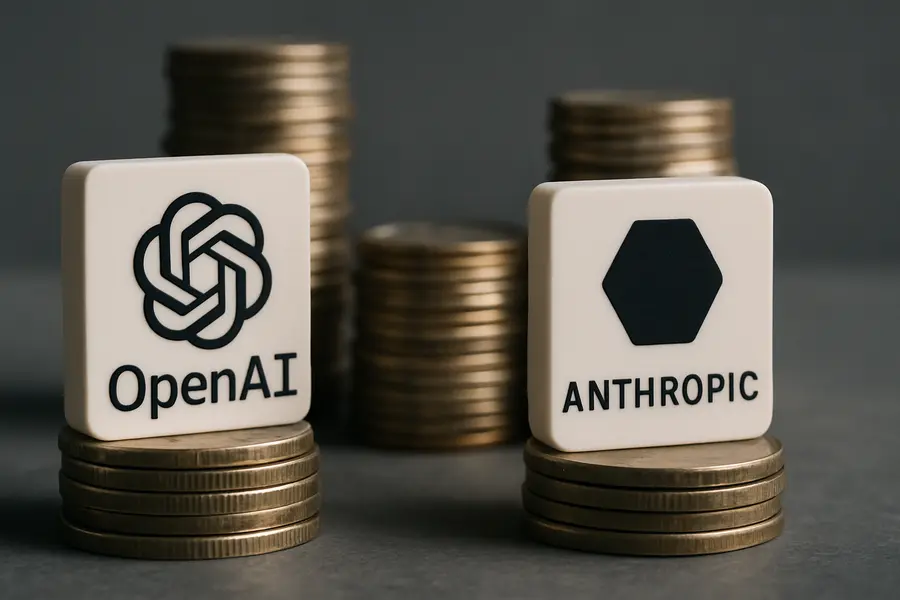
OpenAI is considering steep token price reductions to counter Anthropic's explosive growth, with both AI giants racing toward public listings in late 2026.
- OpenAI is weighing token price cuts targeting Anthropic customers as Claude Code drives rival's revenue to a $47B annualized run rate.
- Both companies have confidentially filed IPOs; OpenAI targets a $1 trillion Q4 2026 listing while losing $1.22 per revenue dollar.
- Enterprise AI budgets face ceiling pressure, with CEO Sam Altman calling AI costs "a huge issue" for business customers.
Lead
OpenAI is preparing to slash the prices it charges for artificial intelligence tokens — the unit by which AI companies bill for their services — in a preemptive move against rival Anthropic, whose coding tool Claude Code has rapidly eroded ChatGPT's dominance among software engineers. The potential OpenAI pricing overhaul, first reported by The Wall Street Journal on June 11, 2026, marks a new phase in the escalating AI price war between the two leading large-language-model developers, both of which are burning billions of dollars as they race toward public market debuts.What Happened
OpenAI is weighing cuts to token pricing — the per-unit charge developers pay to query its models through an API — explicitly anticipating that Anthropic will move first. The ChatGPT maker currently offers consumer subscriptions at $8, $20, and $100-plus per month for access to its flagship GPT-5.5 models; Anthropic charges $17 per month for Claude Pro on an annual subscription.Beyond API and subscription rates, OpenAI is also reportedly considering subsidizing enterprise customers to retain accounts at risk of migrating to Claude. The deliberations follow a broader industry trend: Google's Gemini team implemented significant model price reductions earlier in 2026, compressing margins across the sector and accelerating the AI price war dynamic.
The Anthropic Surge
The urgency behind OpenAI's deliberations reflects a striking shift in competitive momentum. Anthropic posted roughly $9 billion in annualized revenue at the close of 2025; by May 2026 that figure had reached $47 billion, representing 80x growth in a single quarter by the company's own account. Claude Code, the agentic AI coding tool launched publicly in mid-2025, is the primary driver: the product hit $1 billion in annualized revenue within six months of launch and surpassed $2.5 billion in run-rate revenue by February 2026. Anthropic is now on track to generate approximately $10.9 billion in second-quarter 2026 revenue alone.
That trajectory briefly pushed Anthropic's implied valuation above OpenAI's. Anthropic closed a $65 billion Series H funding round in late May 2026, establishing a post-money valuation of approximately $965 billion. OpenAI is currently valued at $852 billion.
IPO Race Adds Pressure
Both companies have confidentially filed for initial public offerings with the U.S. Securities and Exchange Commission. Anthropic submitted its S-1 on June 1, 2026. OpenAI is targeting a Q4 2026 listing at a valuation of up to $1 trillion.
The parallel IPO race introduces a structural tension in any AI price war strategy. OpenAI is estimated to lose $1.22 for every dollar of revenue generated, driven by the enormous computational cost of running large-scale inference. Cutting OpenAI pricing on tokens would deepen those losses at precisely the moment public-market investors scrutinize unit economics most carefully.
For enterprise buyers, however, the AI price war represents meaningful near-term relief. Per-token API costs across the industry have fallen substantially over the past 18 months as model efficiency improves and competition intensifies. Further cuts of 30 to 50 percent on standard model tiers are expected if OpenAI and Anthropic move simultaneously.
Enterprise Budget Ceilings
CEO Sam Altman has publicly acknowledged that AI infrastructure costs have become "a huge issue" for business customers. Enterprise enthusiasm for generative AI deployment — fueled by boardroom mandates to integrate the technology — has increasingly collided with budget constraints, procurement scrutiny, and questions about measurable ROI.
That friction partly explains Anthropic's rapid gains with Claude Code: the tool addresses a high-frequency, easily measurable developer workflow rather than a broader and harder-to-evaluate productivity claim. Reducing ChatGPT API and subscription prices would lower the friction for enterprise procurement teams comparing platform costs line by line, potentially stemming developer migration before it becomes structural.
Strategic Context
The competitive dynamic between OpenAI and Anthropic has deepened beyond a chatbot rivalry. Both companies are constructing full platforms — ecosystems of APIs, enterprise tooling, developer infrastructure, and consumer applications. Platform lock-in requires mass adoption, and pricing is a direct lever on the speed of that adoption.
OpenAI's dominant installed base provides some buffer: ChatGPT remains the most widely recognized AI consumer brand globally. But developer mindshare is increasingly contested. Claude Code's traction among software engineers signals that Anthropic has penetrated the community most likely to drive bottom-up enterprise adoption decisions — a dynamic that makes the AI price war a question of strategic urgency, not just margin management.Outlook
The AI price war between OpenAI and Anthropic is entering its sharpest phase, driven simultaneously by competitive pressure, IPO preparation, and enterprise budget constraints. Whether OpenAI formalizes price reductions depends partly on Anthropic's next move; both companies are navigating the trade-off between capturing market share and preserving the unit economics public investors will demand at listing. Further OpenAI pricing compression on both token and subscription tiers appears probable in the second half of 2026, with enterprise customers the primary beneficiaries.
Mentioned tickers: