Pomegra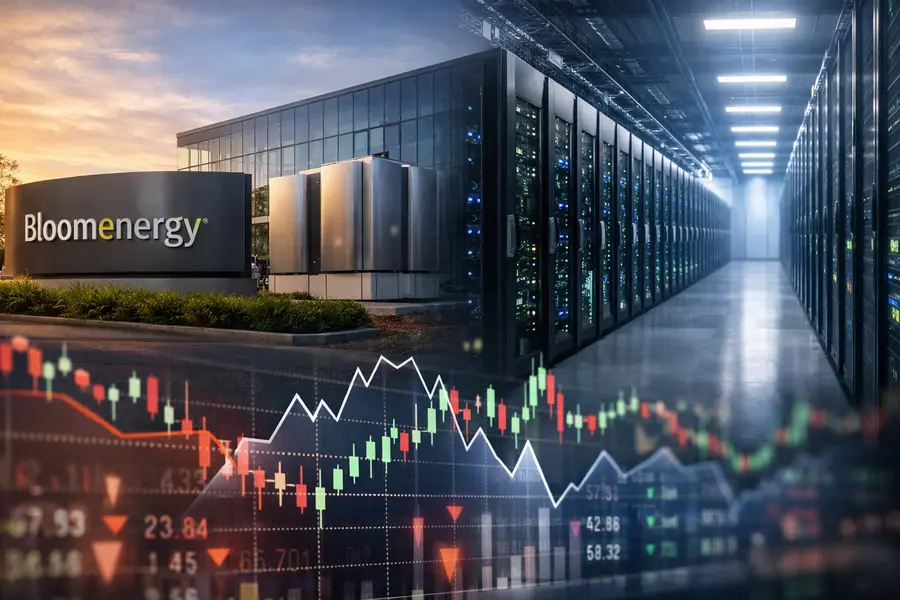
Bloom Energy reports Q2 2026 earnings on July 28 with Wall Street expecting a near-tripling of EPS, driven by $7.65 billion in signed AI data center power contracts.
- Options markets imply a 32.4% post-earnings swing in BE stock, nearly triple the stock's historical 12% average reaction.
- Consensus Q2 revenue stands between $767M and $849M, representing 91%–107% year-over-year growth powered by solid oxide fuel cell deployments.
- Bloom Energy shares fell roughly 43% in a single month ahead of the print, creating a high-stakes setup around a backlog now exceeding $20 billion.
Lead
Bloom Energy (NYSE: BE), the San Jose-based solid oxide fuel cell manufacturer, will release second-quarter 2026 financial results after market close on July 28, with management hosting a conference call at 5:00 p.m. Eastern Time. The report arrives as the company sits at the center of an accelerating race to power artificial intelligence data centers without waiting years for utility grid interconnection — and after a severe stock pullback that wiped away more than 40% of market value in roughly four weeks.What Wall Street Expects
The Zacks consensus places Q2 revenue at $766.88 million, implying 91% year-over-year growth. A competing set of estimates, incorporating more recent contract bookings, projects the figure as high as $849.67 million — a 106.5% year-over-year increase. On the bottom line, adjusted earnings per share are expected at $0.39 to $0.41, representing a 290%–310% jump from the $0.10 reported in Q2 2025.
Those projections follow a strong first quarter, in which Bloom Energy posted $751 million in revenue — up 130% year over year — with non-GAAP EPS of $0.44, beating consensus estimates. The company subsequently raised full-year 2026 guidance to a midpoint of $3.6 billion in revenue and EPS of $1.85 to $2.25.
Data Center Power: The Core Thesis
The engine behind the growth is demand from AI infrastructure developers unable to secure power from an overloaded electric grid. Bloom Energy's solid oxide fuel cell systems can be installed on-site, bypassing interconnection queues entirely — a decisive advantage when hyperscalers need hundreds of megawatts within months rather than years.
Between October 2025 and January 2026 alone, hydrogen fuel cell and fuel cell companies locked in $7.65 billion in binding agreements to power AI data centers, with Bloom Energy capturing the majority of that flow. Brookfield Asset Management committed $5 billion to deploy its solid oxide systems at AI factories globally. In January 2026, American Electric Power finalized a $2.65 billion, 20-year offtake agreement for up to 1 gigawatt of capacity. In April 2026, Oracle signed a master services agreement covering up to 2.8 gigawatts of Bloom's systems.
Crusoe and Tallgrass selected Bloom's technology for the 900-megawatt first phase of their Cheyenne AI Factory specifically because it sidesteps the interconnection queue entirely, according to project disclosures. The total company backlog has grown to more than $20 billion, with service contracts running 10 to 15 years.
The Pullback and Its Causes
Despite the contract momentum, BE stock closed at $185.81 on July 24, down roughly 43% from its one-month peak. The decline followed a 14.9% single-session drop driven by concerns over the company's ability to meet its raised revenue guidance for the second half of 2026, compounded by short-seller allegations and supply chain scrutiny. Analysts covering the stock retain a Moderate Buy consensus with an average price target of $286.20, implying significant upside from current levels if Q2 results confirm the underlying demand trajectory.
Strategic Context: Manufacturing and Scale
To meet contracted demand, Bloom Energy is expanding manufacturing capacity to 2 gigawatts annually by end of 2026 — a level the company has acknowledged may still fall short of the signed pipeline. The capacity constraint is a central risk for investors interpreting the Q2 print: revenue recognition depends on system delivery, and any shipment delays would pressure near-term results even as bookings remain robust.
The broader data center power news backdrop reinforces the long-range opportunity. The global fuel cell for data center market is valued at $361 million in 2026 and is forecast to reach $1.19 billion by 2033, a compound annual growth rate of 18.6%. AI workload growth is driving data center capacity announcements toward 35 gigawatts over five years globally.
Outlook
The July 28 earnings release will be scrutinized for three signals: whether Q2 revenue lands above the high end of the consensus range; whether management reaffirms or raises full-year guidance given the contract backlog; and whether commentary on manufacturing ramp and delivery timelines addresses investor concerns about execution. The options market's implied 32.4% swing underscores how binary the print has become. A beat on both revenue and forward guidance would validate the thesis that Bloom Energy is converting the AI power demand surge into durable financial performance; a miss or guidance reduction would test whether the recent stock decline has been sufficient to reset expectations.