Pomegra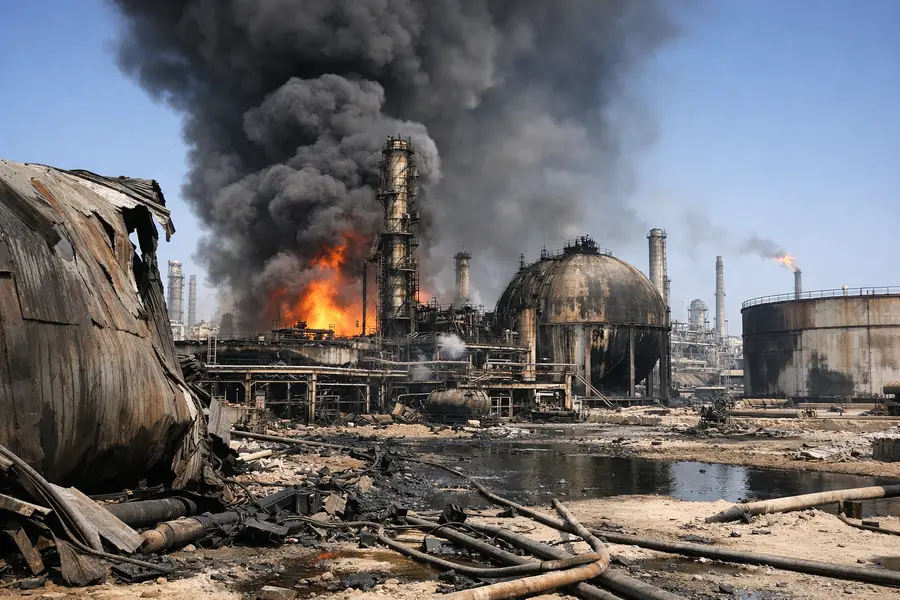
Iran-backed Houthi forces launched simultaneous ballistic missiles and drones at four Saudi cities Wednesday, wounding 73 and reigniting fires at the Jizan refinery for a second time in a month as Brent crude holds near $101 per barrel.
- Houthi forces struck Jizan City, Najran, Abha, and Khamis Mushait in a coordinated multi-city barrage of ballistic missiles and drones
- 73 casualties confirmed; fires at Saudi Aramco's Jizan refinery recorded for the second consecutive month
- Brent crude near $101 per barrel before the attack; the assault opens a sustained second front in the Gulf energy war beyond the Strait of Hormuz
Coordinated Barrage Hits Four Cities at Once
Iran-backed Houthi forces launched a simultaneous multi-vector assault against Saudi Aramco's southern industrial corridor Wednesday, firing ballistic missiles and armed drones at Jizan City's refinery complex, Najran, Abha, and Khamis Mushait in what Saudi civil defense authorities described as the largest coordinated strike package directed at the kingdom's energy infrastructure this year. The attacks wounded 73 people and triggered a sustained fire at the Jizan refinery - the same facility that sustained a damaging blaze fewer than 30 days prior. Saudi Aramco confirmed operational disruptions at the Jizan site without specifying volume impact, while emergency crews worked through the night to contain secondary fires across adjacent storage and processing units.
The simultaneity of the strikes across four geographically separated targets in Asir and Jizan provinces signaled a meaningful evolution in Houthi operational planning. Prior attacks on Saudi energy infrastructure concentrated on a single facility or corridor; Wednesday's barrage required coordinated launch sequencing across multiple fronts, a capability that points to deepened logistical and intelligence support from Iranian Revolutionary Guard Corps networks operating inside Yemen.
What Does the Jizan Refinery Produce?
The Jizan Economic City refinery processes approximately 400,000 barrels per day of Arabian Heavy crude, supplying refined products to domestic markets in southern Saudi Arabia and providing export volumes that feed shipping lanes through the Red Sea. A sustained outage - or even a prolonged reduction in throughput - forces Aramco to reroute supply from northern facilities, tightening the national grid and drawing down strategic reserves. The refinery's repeat targeting in consecutive months suggests Houthi forces have locked it in as a persistent pressure point rather than an opportunistic objective, a posture that raises the cost of any single repair cycle by keeping the threat of re-ignition credibly imminent.
Saudi Aramco (2222.SR) has not disclosed the cumulative production impact of the two Jizan incidents, but energy analysts tracking Saudi export loadings noted a measurable reduction in Red Sea tanker traffic in the 72-hour window following the first strike, a pattern that could repeat as port authorities reassess safety protocols.
Why Are Crude Oil Prices Responding?
The attack lands at one of the more sensitive moments in global oil markets: crude oil prices were already trading near $101 per barrel on Brent benchmarks before Wednesday's barrage, driven by a combination of OPEC+ supply restraint, a drawdown in U.S. commercial inventories, and residual risk premiums tied to prior Houthi maritime interdiction campaigns in the Red Sea. The Jizan strike adds a new dimension that shipping-lane disruption alone cannot capture - the physical degradation of refinery throughput on the Arabian Peninsula's western flank.
Energy traders lifted Brent further in after-hours activity on reports of the attack, with the key question centering on whether Aramco can restore full Jizan output before a third strike forces a longer-term rerouting of crude allocation. A sustained $100-plus Brent environment compounds inflationary pressure in oil-importing economies already navigating elevated interest rates, while simultaneously extending the fiscal windfall for Gulf producers and funding flows that underwrite broader regional geopolitical maneuvering.
Is This a New Strategic Front Beyond the Strait of Hormuz?
The Strait of Hormuz has historically anchored the West's energy-security calculus for the Persian Gulf, with roughly 20 percent of global oil supply transiting the narrow passage between Iran and Oman. Wednesday's strikes confirm that Houthi forces - operating with expanded Iranian ballistic missile inventories and drone production capacity - are now threading a second axis of pressure through Saudi Arabia's southwestern industrial heartland, a geography that sits outside Hormuz's traditional risk perimeter.
This bifurcation of threat vectors complicates Saudi and allied defense posture. Patriot and THAAD batteries deployed around Riyadh and the Eastern Province's Abqaiq and Ras Tanura facilities cannot be redistributed to Jizan and Khamis Mushait without creating gaps elsewhere. The United States Central Command has not publicly confirmed whether additional interceptor assets will be repositioned to cover the southern corridor, but the tactical pressure to do so is significant.
Iran's calculus in sustaining and expanding Houthi strike capability appears tied to ongoing nuclear negotiations and the broader contest for influence across the Levant, Iraq, and the Red Sea littoral. Each successful strike on Aramco infrastructure serves as a demonstration of deterrence capacity without triggering direct Iranian military attribution - a deniability framework that has held since at least the 2019 Abqaiq-Khurais attack.
Outlook
The recurrence of Jizan refinery strikes within a single month establishes a pattern rather than an episode. So long as the Yemen ceasefire architecture remains absent and Iranian proxy networks retain missile and drone resupply access, Saudi energy infrastructure in the southern corridor faces persistent attrition risk. Aramco's ability to sustain production guidance and maintain its role as the global swing supplier hinges on accelerating hardening of exposed facilities and securing more robust air-defense coverage for the Jizan corridor. With Brent near $101 and global spare capacity already stretched by OPEC+ discipline, any multi-week outage at Jizan would move crude oil prices materially higher, applying renewed inflationary pressure on central banks in Europe and Asia that are already managing fragile disinflation trajectories. The next 72 hours of damage assessment from Aramco will be decisive for market pricing of Gulf supply risk.
Mentioned tickers: 2222.SR