Pomegra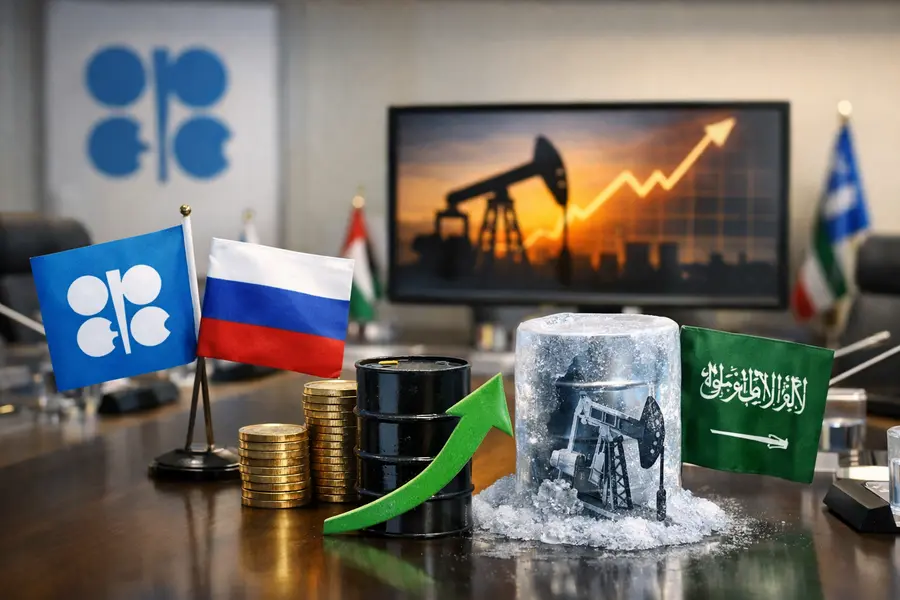
OPEC+'s seven core producers approved a 188,000 bpd September hike at Vienna, completing 2023's voluntary cut rollback before freezing output through Q4 2026.
- The September quota increase completes the phased rollback of a 1.65 million bpd voluntary supply cut agreed in April 2023, with the UAE no longer part of the group after departing in May.
- OPEC+ will freeze further output increases through Q4 2026, leaving roughly 2 million bpd of legacy cuts from 2022 intact while it negotiates new 2027 production baselines.
- Actual output gains remain largely theoretical: the Iran war and Houthi attacks on Red Sea shipping have constrained Gulf and Russian export capacity for months.
Lead
Seven core OPEC+ producers — Saudi Arabia, Russia, Iraq, Kuwait, Kazakhstan, Algeria, and Oman — agreed Sunday to lift collective output targets by 188,000 barrels per day for September, completing the phased unwinding of a 1.65 million barrel-per-day voluntary supply cut agreed in April 2023. Convening via video call, oil ministers from the Vienna-aligned group simultaneously confirmed that production levels will hold flat through the fourth quarter, leaving approximately 2 million bpd of earlier, deeper OPEC curbs dating to 2022 undisturbed. Brent crude settled at $90.12 a barrel and West Texas Intermediate closed at $84.67, each rising more than 1% on the day.
What Happened
Sunday's session was the sixth consecutive month in which the alliance voted to expand output by the same 188,000 bpd increment — and the fourth month at that exact level. Country allocations for September are as follows: Saudi Arabia and Russia each absorb 62,000 bpd, lifting their respective targets to 10.4 million and 9.94 million bpd. Iraq receives an additional 26,000 bpd (target: 4.43 million bpd), Kuwait 16,000 bpd (2.67 million bpd), Kazakhstan 10,000 bpd (1.62 million bpd), Algeria 6,000 bpd (1.01 million bpd), and Oman 5,000 bpd (841,000 bpd).
With September's increase, the group closes out its commitment to restore the voluntary reductions made in 2023 — commitments undertaken when the United Arab Emirates was still a member. Abu Dhabi formally departed the coalition in May, narrowing the alliance to seven active producers.
Market Reaction
Oil prices gained on the session even as headline output rose, with traders focused on the freeze that follows. Brent crude had surged approximately 24% over the course of July alone — its strongest monthly gain since March — as conflict across the Strait of Hormuz and sustained Houthi drone and missile strikes in the Red Sea constrained physical supply. Brent briefly crossed $100 per barrel during July's most acute geopolitical pressure, before retreating as an uneasy pause in US-Iran hostilities reduced the immediate risk premium. The announcement of a Q4 freeze removed a further layer of market uncertainty, supporting prices rather than pressuring them.
The widening gap between headline quota decisions and actual barrel flows has fundamentally altered how traders read OPEC communiqués. Multiple months of approved quota increases have never materialized as incremental physical supply reaching global markets.
Strategic Context
The decision to pause after September reflects two intersecting pressures: external price management and the internal complexity of rebalancing member quotas for 2027.
OPEC+ is conducting a comprehensive production capacity review aimed at establishing new output baselines for next year — a process that requires members to accept potentially lower individual allocations than many have sought. Iraq's prime minister made clear his government expects "a fair share for Iraq," signaling Baghdad's intention to push for a higher baseline. Similar friction exists with Kazakhstan, which has repeatedly overproduced relative to its agreed ceiling.A Q4 freeze provides the diplomatic runway for those negotiations without the compounding pressure of monthly quota votes. The approximately 2 million bpd in legacy cuts from 2022 — separate from the now-completed 2023 voluntary tranche — remain in place indefinitely, giving the alliance its principal lever for future supply responses.
Geopolitical Dimension
The Vienna agreement was reached under conditions of acute supply uncertainty. The Strait of Hormuz remains largely closed to commercial traffic, disrupting Gulf crude flows. Houthi forces in Yemen have continued strikes on tankers in the Red Sea and Bab el-Mandeb, forcing Saudi and other Gulf exporters to reroute cargoes at significant logistical cost. The Ukraine conflict has similarly curtailed Russian export capacity.
An uneasy pause in direct US-Iran hostilities provided temporary relief after months of escalating military pressure, though no formal resolution has been reached. The geopolitical premium built into Brent has overridden the alliance's formal output schedule as the principal driver of price discovery — a dynamic that reduces, but does not eliminate, the market significance of OPEC+ decisions.
Outlook
With its 2023 voluntary cut rollback complete and a Q4 production freeze confirmed, OPEC+ enters a period of internal negotiation over its longer-term production architecture. New 2027 baselines must be agreed before the coalition can credibly move toward further quota increases — a process that the group's history suggests will be contentious, particularly given Iraq's and Kazakhstan's stated ambitions.
Near-term price direction will continue to be set by developments at the Strait of Hormuz and Red Sea chokepoints rather than by alliance decisions. Any durable ceasefire in the Iran conflict that restores Gulf export capacity would reintroduce the question of how quickly the alliance releases its remaining 2 million bpd supply buffer — a decision now deferred until at least January, when oil ministers are expected to reconvene and set new production terms.
Mentioned tickers: USO, BNO, XOM, CVX, BP, SHEL