Pomegra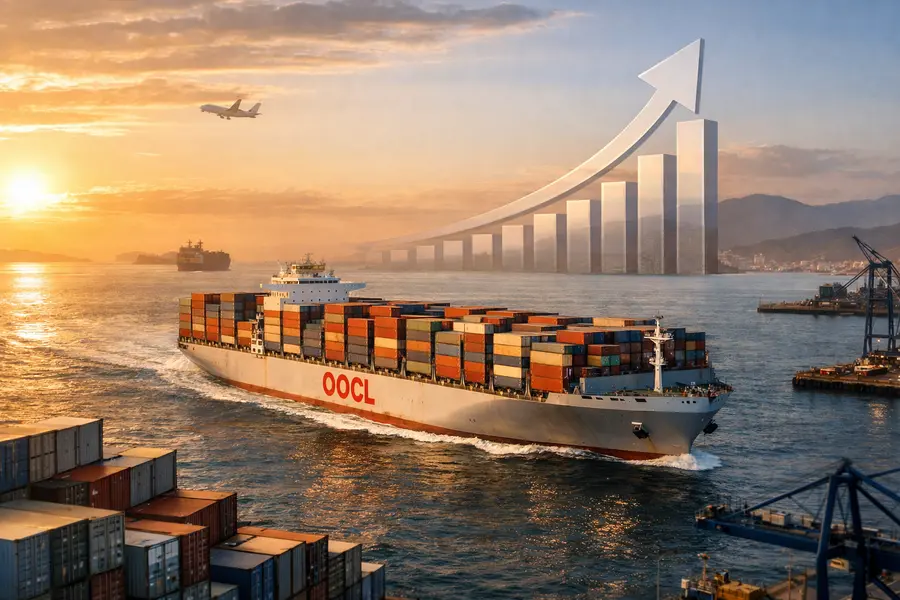
OOCL's Q2 2026 liner revenue climbed 19.8% to $2.54 billion as trans-Pacific trade volumes surged 21.5%, marking a sharp turnaround for the shipping industry.
- OOCL Q2 2026 liner revenue rose 19.8% year-over-year to $2.537 billion, with total liftings climbing 8.8% to 2.135 million TEUs.
- Trans-Pacific trade liftings jumped 21.5% to 608,979 TEUs, with lane revenue surging 29.3% to $973.7 million.
- Average liner revenue per TEU improved 10.1%, the strongest unit-economics gain in six quarters, as load factors expanded 1.9 percentage points.
Lead
Orient Overseas (International) Limited recorded liner revenue of $2.537 billion in the second quarter of 2026, a 19.8% increase from the same period a year earlier, with the trans-Pacific trade emerging as the carrier's top-earning lane and the engine of a broader global logistics turnaround. Total liftings reached 2.135 million twenty-foot equivalent units, up 8.8%, while loadable capacity grew 6.3%, indicating that volume gains outpaced fleet expansion and drove utilization higher. The results, released in July 2026, mark the strongest quarterly OOCL shipping results in approximately 18 months.What Happened
OOCL's trans-Pacific performance reversed a first-quarter contraction in which liftings on the Asia–U.S. corridor fell 5.9% and lane revenue dropped 16.8% to $744.8 million. In the second quarter, the same trade registered 608,979 TEUs — a 21.5% year-on-year increase — and generated $973.7 million in revenue, a 29.3% jump that accounted for more than 38% of total liner revenue for the quarter.The recovery was broad-based but uneven across lanes. Asia-Europe liftings grew 6.9% to 386,513 TEUs, and revenue on that corridor rose 17.6% to $520.9 million, benefiting from firmer demand and an easing of the Red Sea disruption premium that had inflated costs in prior periods. The trans-Atlantic was the laggard: liftings edged up 1.8%, but revenue contracted 1.3% to $191.5 million, reflecting persistent softness in European import demand.
The fleet-wide average liner revenue per TEU rose 10.1% compared with Q2 2025. That metric had been under sustained pressure since peak-pandemic freight rates unwound through 2023 and 2024, and its recovery in the second quarter signals that the repricing cycle — at least on the trans-Pacific — has begun to stabilize.
Strategic Context
The second-quarter rebound arrives against a volatile macro backdrop. U.S.-China tariff escalation had suppressed bookings in late 2024 and early 2025, contributing to the 41.3% decline in OOIL's full-year 2025 profit to $1.513 billion from $2.577 billion in 2024. Annual revenue fell 9.2% to $9.72 billion over the same period.
The Q2 2026 data suggest importers have adjusted to the tariff environment, front-loading shipments ahead of peak season and pulling cargo that had been deferred through the first quarter. Trans-Pacific spot rates for U.S. West Coast lanes reached approximately $6,700 per FEU by mid-year, a level that, while below pandemic highs, represents a meaningful improvement over the sub-$2,000 readings recorded in February 2026.
OOCL's fleet expansion is running concurrently with the volume upturn. The carrier took delivery of nine 16,828-TEU vessels during 2025 and is scheduled to receive 24,000-TEU methanol dual-fuel ships in 2026, positioning the fleet for larger economies of scale on long-haul trades. Capacity additions at this scale would ordinarily weigh on utilization, but a 1.9-percentage-point improvement in load factor suggests that demand acceleration is absorbing new tonnage.
Shipping Industry Earnings Landscape
The strength in OOCL shipping results tracks a wider pattern across the shipping industry earnings cycle. Carriers that managed utilization tightly through Q1 2026's tariff-induced slowdown have emerged in Q2 with improved unit economics. The trans-Pacific trade remains the bellwether: its swing from a 16.8% revenue decline in Q1 to a 29.3% gain in Q2 within a single financial year illustrates the lane's capacity to shift rapidly on demand signals and rate momentum.
For the first half of 2026, OOIL reported liner revenue growth of 5.5% and volume growth of 5.2%, framing the Q2 rebound as more than a seasonal blip and supporting the case for a durable global logistics turnaround.
Outlook
OOCL enters the second half of 2026 with cargo volumes running above year-earlier levels and the trans-Pacific trade re-established as its primary revenue contributor. Whether that momentum persists hinges on peak-season import flows, the trajectory of U.S.-China trade policy, and the pace at which new capacity joins the global fleet. With a net cash position of $6.24 billion against debt maturities of $568 million due in 2026, OOIL retains the financial flexibility to navigate further disruption. A sustained firming of freight rates through Q3 would provide the clearest evidence that the shipping industry's recovery has legs beyond a single quarter's inventory cycle.
Mentioned tickers: OOIL.HK, 1919.HK