Pomegra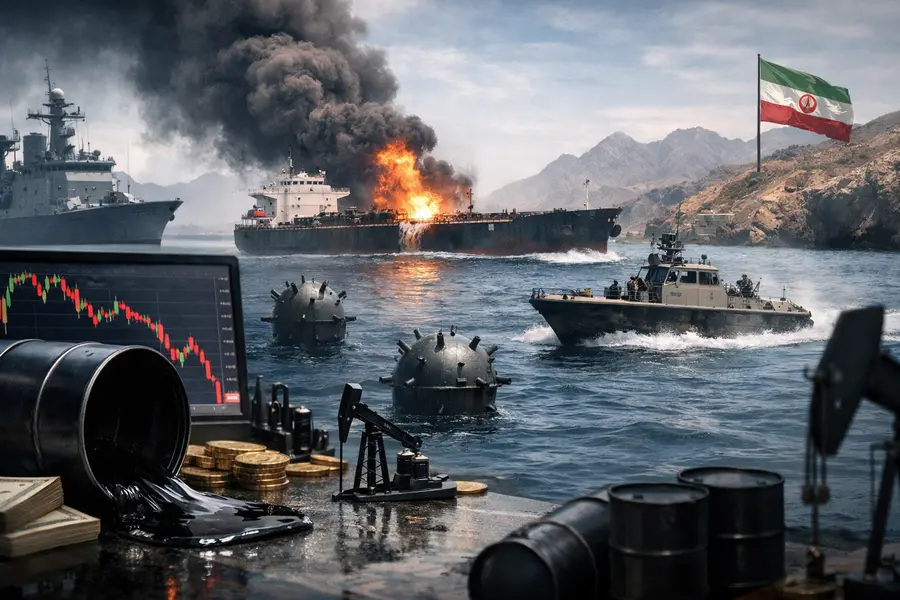
Brent crude climbed back above $89 a barrel on Monday as a fresh tanker strike near the Strait of Hormuz shattered hopes of a durable ceasefire between the United States and Iran, raising the prospect of a renewed blockade of the world's most critical oil chokepoint.
- Brent crude rose 1.3% to $89.22/barrel; WTI gained 0.9% to $83.23 as ceasefire hopes faded.
- Iran intercepted four vessels over the weekend; a tanker fire 8 nautical miles east of Oman renewed blockade fears.
- All OPEC spare capacity sits behind the Strait of Hormuz, limiting any supply-side buffer.
What Happened
A commercial tanker transiting waters near Limah, Oman reported being struck on Sunday, triggering a fire aboard and generating distress calls that reverberated through energy markets before Asian trading opened Monday. Iran's Islamic Revolutionary Guard Corps has not claimed responsibility, but Western maritime security agencies described the episode as consistent with an attack rather than an accident — a distinction that carries enormous market weight given the pattern of strikes on shipping lanes since February.
The incident follows Iran's announcement over the weekend that it had intercepted four vessels attempting to transit the Strait of Hormuz without IRGC authorisation. Days earlier, President Donald Trump warned that Iran would face severe consequences after the deaths of three U.S. service members in exchanges of fire with Iranian forces over the past two days. The Pentagon has since confirmed additional airstrikes against targets in southern Iran.
The combined sequence of events — tanker fire, vessel intercepts, U.S. military fatalities, and retaliatory airstrikes — has effectively confirmed what oil traders had begun pricing in last week: the memorandum of understanding signed by Washington and Tehran in late June is no longer operative.
Market Reaction
Brent crude futures settled at $89.22 per barrel on Monday, a gain of approximately 1.3% on the session. West Texas Intermediate advanced 0.9% to close at $83.23. Both benchmarks have now risen roughly 20% in July alone, erasing a brief decline that followed the MOU announcement.The current price level represents a substantial but incomplete recovery from the crisis peak. At the height of the initial Strait of Hormuz closure in late March, Brent surged to $126 per barrel, recording the largest single-month percentage gain in the history of the global oil supply benchmark. The partial reopening of the strait in May-June allowed prices to retreat, but Monday's moves confirm the market is repricing for an extended disruption scenario rather than a swift diplomatic resolution.
Shipping insurance premiums for vessels attempting Hormuz transits have risen sharply since Saturday. Tanker operators with exposure to the Persian Gulf are the most acutely affected; LNG carriers serving Qatar face particular risk after Iran targeted the Qatari gas tanker Al-Rekayyat earlier this month.
The Chokepoint That Can't Be Bypassed
The Strait of Hormuz, the narrow passage between Iran and Oman that links Gulf producers to open ocean routes, carried approximately 20 million barrels per day before the February crisis — roughly one-fifth of total global petroleum consumption. There is no simple alternative routing. The Saudi East-West pipeline and the Emirati Abu Dhabi Crude Oil Pipeline offer partial relief, but neither can absorb more than a fraction of Hormuz-dependent volumes.
The spare capacity question compounds the supply problem. According to Vitol Group chief executive Russell Hardy, every barrel of the world's effective spare production capacity today sits geographically behind the Strait of Hormuz — held by Saudi Arabia, the UAE, Kuwait, and Iraq. OPEC member states could theoretically pump more, but those additional barrels face the same transit bottleneck as existing production.
The International Energy Agency noted in April that Gulf crude and product exports via all routes had plunged 15.8 million barrels per day to 8.7 million at the crisis peak, with flows through the strait averaging just 2.3 million barrels per day — roughly 10% of pre-war levels. Even after partial reopening, normalisation has been slow, and energy market analysts now warn that Monday's incidents could reverse recent progress entirely.
Geopolitical Dimension
The conflict's trajectory has defied the diplomatic calendar. The June MOU had been framed by both sides as a pathway toward formal negotiations, but analysts note that it contained no enforcement mechanism and left unresolved the core dispute over Iran's uranium enrichment programme and U.S. sanctions.
Trump's statements Monday — indicating Iran would "pay" for the service members' deaths — signal the administration has returned to a posture of military pressure. That posture was effective in February in triggering an Iranian response that closed the strait; the risk now is that an escalation spiral resumes before any diplomatic framework can contain it.
Iranian officials have previously stated they would formally close the strait to all maritime traffic in the event of further U.S. strikes against Iranian territory. The strike package confirmed Monday by the Pentagon suggests that threshold may again be approaching.
For producers dependent on Hormuz transit — Saudi Arabia, Iraq, Kuwait, the UAE, and Qatar among them — the renewed uncertainty is existential for near-term export revenue. European and Asian refiners that rebuilt inventories during the June lull now face decisions about whether to replenish stocks at current prices or reduce exposure ahead of potential supply shock.
What Comes Next
Industry analysts polled in the past week placed the probability of a full Hormuz closure at between 35% and 50% over the next 30 days, contingent on whether Washington and Tehran can establish a back-channel communication line quickly enough to interrupt the escalation cycle. In a closure scenario, price projections cluster around $110–$130 per barrel for Brent within weeks, with food and fertiliser supply chains — heavily dependent on Gulf-originated energy — facing secondary disruption.
OPEC+ has no scheduled meeting before early August. Even if producers agreed to maximise output, the logistical constraint of the strait means additional production commitments would offer limited near-term relief.
Outlook
The tanker fire near Oman on Sunday is the latest episode in a crisis that has already demonstrated an ability to move oil price today faster than any prior geopolitical disruption in market history. With the US-Iran ceasefire functionally dissolved, OPEC's buffer inaccessible behind the chokepoint, and the U.S. military re-engaged, the conditions for another acute price shock are present. Whether diplomatic contact can interrupt the cycle before the strait is formally closed again remains the central variable for energy market news and global economic stability in the weeks ahead.