Pomegra
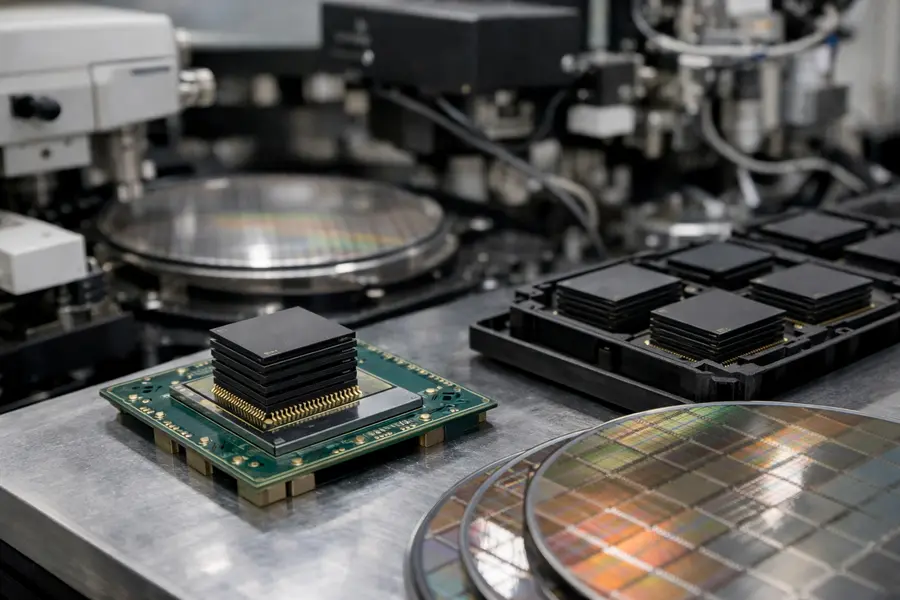
Asian chip stocks fell to their lowest since July after DeepSeek said V4.1 needs far less HBM, with Samsung and SK Hynix among the biggest drags on Monday.
- A Bloomberg gauge of Asian chipmakers fell more than 2% on Monday, October 19, to its lowest level since July.
- DeepSeek says its V4.1-Flash model needs about a quarter of the HBM earlier versions required.
- Kospi is coming off its worst week since October 2008, with SK Hynix down 24.3% and Samsung down 17.8%.
Lead
AI stocks across Asia extended a heavy sell-off on Monday, October 19. DeepSeek's latest model update raised the prospect that artificial intelligence workloads will need less memory, which would cut demand for high-bandwidth memory (HBM), the stacked DRAM used in AI servers. A Bloomberg gauge of Asian chipmakers slid more than 2% to its lowest since July. Samsung Electronics and SK Hynix were among the biggest drags, alongside Taiwan Semiconductor Manufacturing (TSM) and Advantest.
Japan's Nikkei 225 fell as much as 2.3% before paring its loss, and Taiwan's Taiex dropped 2%. South Korea's Kospi erased a decline of more than 3% during the session but stayed volatile.
What Did DeepSeek Announce?
DeepSeek released a new checkpoint, V4.1-Flash-1017, on Saturday, October 17, and opened paid search and fetch interfaces to all developers. The Chinese AI developer says the update is faster and leaner than the September build, with higher benchmark scores and shorter outputs.
The memory claim dates to the September 10 release of V4.1-Flash. DeepSeek says that model needs only a quarter of the HBM its predecessors required during inference, and one-eighth of the SSD storage. Investors read the weekend update as confirmation that efficiency gains in AI software could reduce the volume of memory each AI server needs.
Why Did Memory Stocks Take the Biggest Hit?
Memory makers were hit hardest because HBM has been the most profitable part of the AI hardware chain. Demand for it pushed memory prices to records and lifted Korean equities. Kospi remains up more than 30% this year despite the recent declines.
SK Hynix and Samsung supply HBM to accelerator makers such as Nvidia (NVDA), so any suggestion of lower memory intensity goes straight to their earnings outlook. Investors also watch Micron Technology (MU), the main US memory producer, as a read-across for the sector. The Micron technology stock and its Asian peers trade on the same assumption of rising HBM content per server.
Market Reaction
Monday's decline followed a severe week in Seoul. From October 12 to October 16, Kospi fell 14.5%, its worst week since October 2008. SK Hynix lost 24.3% and Samsung 17.8%. Foreign investors sold about 11.2 trillion won ($7.8 billion) of Korean shares in that period, including net sales of 3.48 trillion won in Samsung and 5.36 trillion won in SK Hynix.
The sell-off had several causes beyond DeepSeek:
- Chinese competition: On October 12, ChangXin Memory Technologies unveiled a new 4F² DRAM cell architecture and said it targets a server DDR5 module on that design by the end of 2026.
- Inflation and rates: A hot US inflation report raised expectations for higher borrowing costs.
- AI funding: Rising financing costs could squeeze the capital spending that has driven chip orders.
How Could Lower HBM Needs Change the AI Chip Trade?
Lower memory needs per workload do not automatically reduce total demand. Cheaper inference can widen AI adoption and raise the number of deployments. That was the counter-argument when DeepSeek first unsettled markets in early 2025. But the memory sector's valuations now rest on sustained growth in HBM volumes, and the market is pricing the risk that software efficiency erodes that growth.
For Samsung, the outcome also depends on how quickly it qualifies and ships advanced HBM, since its profits move with the same memory cycle as SK Hynix. For equipment and testing suppliers such as Advantest, the exposure is to AI capital spending, which now carries a higher financing cost.
Outlook
Asian chip stocks have retraced to July levels as three pressures combine: efficiency gains in DeepSeek's models, Chinese progress in DRAM and higher funding costs. The next tests are further foreign flows in Seoul, any response from HBM suppliers on demand and pricing, and upcoming spending commentary from major AI customers. Those will show whether Monday's drop is a reset in expectations or the start of a longer correction in the memory cycle.
Mentioned tickers: TSM, MU, NVDA