 Pomegra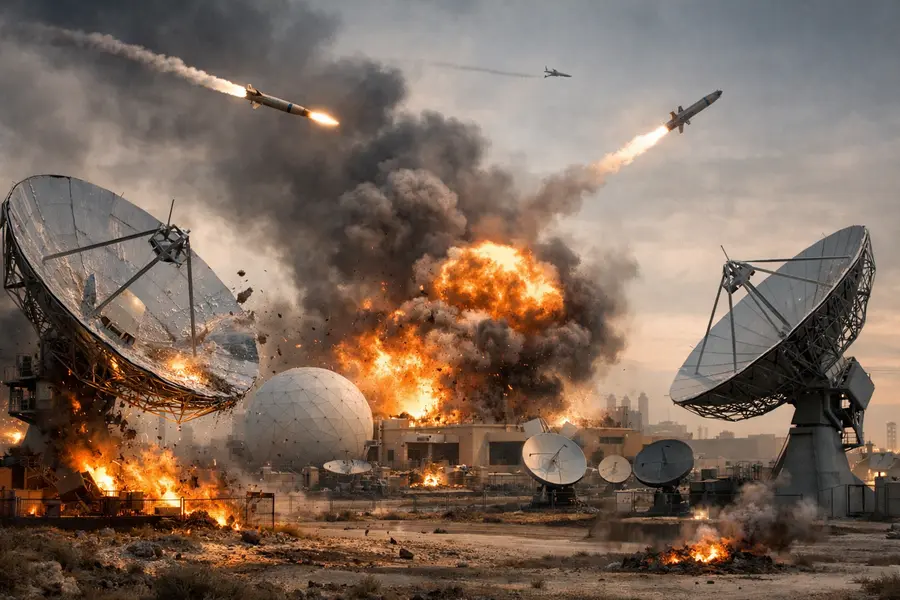
Iran targeted a U.S. satellite communications antenna in Qatar with drone strikes on July 9, intensifying the Middle East war after President Trump declared the April ceasefire "over" and U.S. forces hit 90 Iranian military targets overnight.
- Iran used drones to strike a satellite antenna at U.S. military sites in Qatar, a Patriot battery in Kuwait, and fuel depots in Bahrain on July 9.
- The AN/FPS-132 Block 5 early-warning radar — a $1.1 billion U.S. Space Force asset in Qatar — sustained damage in prior strikes; satellite images confirm significant destruction.
- Brent crude surged more than 5% to $78.02 a barrel, briefly breaching $80, as the fragile April ceasefire effectively dissolved.
What Happened
Iran launched a wave of drone strikes against U.S. military sites in Qatar, Kuwait, and Bahrain on July 9, 2026, targeting a satellite communications antenna in Qatar, a Patriot air-defense battery in Kuwait, and American fuel storage depots in Bahrain. The Iranian army said it deployed "a large number of various types of drones" in the coordinated assault.The Qatar strike hit communications infrastructure at and around Al Udeid Air Base, the largest U.S. military installation in the Middle East and the forward headquarters of U.S. Central Command. Iran's attacks came hours after President Donald Trump declared the interim ceasefire — brokered in April by Pakistani Prime Minister Shehbaz Sharif — to be "over," and within 24 hours of U.S. forces striking approximately 90 Iranian military targets, including missile and drone storage facilities and logistics nodes along Iran's southern coastline.
Trump framed the latest U.S. strikes as "retribution for yesterday's bombing of ships by Iran," referencing Iranian attacks on three commercial cargo vessels transiting the Strait of Hormuz on July 8. He warned on Truth Social that further Iranian escalation "will get much worse."
Strategic Target: Blinding U.S. Eyes in the Gulf
The Iran attack on the Qatar satellite site was part of a sustained campaign to degrade American intelligence, surveillance, and early-warning capabilities across the Gulf. The most strategically significant asset compromised in prior rounds of fighting was the AN/FPS-132 Block 5 ballistic missile early-warning radar, operated by the U.S. Space Force in northern Qatar. With a detection range of approximately 5,000 kilometers (3,100 miles), the system — valued at roughly $1.1 billion — is the largest such radar the United States operates in the Middle East. Satellite imagery published after earlier strikes showed substantial structural damage to the facility.
Al Udeid was also the site of the Combined Air Operations Center, the command hub that directed U.S. air campaigns in the region for more than two decades, including operations in Afghanistan, Iraq, and against the Islamic State. Multiple Iranian missiles struck that facility earlier in the conflict, rendering it inoperable. The U.S. military shifted air campaign command to Shaw Air Force Base in South Carolina, limiting operational disruption, but the symbolic and strategic significance of the repeated strikes on U.S. military sites in Qatar has been substantial.The Road to July 9
The current conflict traces to late February 2026, when U.S. and Israeli forces struck Iranian military infrastructure, prompting Iran's retaliatory strikes — codenamed Operation True Promise IV — against American and Israeli targets across the Gulf and Levant. During that initial wave, Al Udeid absorbed 44 missiles and eight drones. Iran also struck a Qatari liquefied natural gas terminal at Ras Laffan, reducing Qatar's LNG export capacity by an estimated 17 percent — a disruption analysts project could last three to five years.
A two-week ceasefire, announced by Trump on April 7, required Iran to reopen the Strait of Hormuz. Talks mediated by Pakistan stalled over disagreements on nuclear commitments, sanctions relief, and permanent arrangements for the strait. The agreement never fully held, and the July 8 ship attacks effectively ended it.
Market Reaction
Energy markets responded sharply to the renewed escalation. Brent crude gained more than 5% to settle at $78.02 a barrel, briefly touching $80 intraday — reversing a slide that had returned prices to near pre-war levels during the ceasefire period. West Texas Intermediate rose to approximately $73.50 a barrel. The U.S. Treasury simultaneously revoked a sanctions waiver on Iranian oil that had been in place to facilitate negotiations, with the restriction taking effect at 12:01 a.m. EDT on July 17, removing a meaningful supply buffer from global markets.
Asian equity markets closed mixed, with sharp declines in Tokyo and Seoul and gains in Taipei and Hong Kong. Defense sector names and Gulf-exposed energy equities showed divergent moves in early trading.
Geopolitical Dimension
The latest Iran retaliatory strikes place Gulf Arab states, particularly Qatar, in a structurally difficult position. Doha hosts the largest U.S. military presence in the region while simultaneously serving as a key global LNG supplier and longstanding diplomatic intermediary — including as a former interlocutor with Tehran. Qatar's dual role makes its infrastructure a high-value target and a diplomatic pressure point simultaneously.
Pakistan and other mediators continued to urge both Washington and Tehran to observe the terms of the April memorandum of understanding. That appeal carried diminishing weight on July 9 as both sides conducted fresh strikes, and Trump's public posture — framing the ceasefire as finished — significantly narrows the diplomatic space for a quick de-escalation.
The Middle East war has reshaped energy, shipping, and air traffic patterns across the region, with the Strait of Hormuz — through which roughly 20% of global oil flows — remaining a focal point for both military and economic pressure.
Outlook
The collapse of the April ceasefire and Iran's targeting of satellite and communications infrastructure at U.S. military sites in Qatar signals a shift toward higher-intensity and more strategically targeted warfare. With the Strait of Hormuz intermittently disrupted, Iranian sanctions reimposed, and both sides publicly committed to continued strikes, energy price volatility is likely to remain elevated. Diplomatic re-engagement will require a new mediation framework; the Pakistan-brokered channel has lost credibility with both parties. Near-term risk centers on whether Iran moves to fully close the strait — a step that would draw a broader international response — or whether back-channel contacts can establish a new, more durable pause.
Mentioned tickers: LMT, RTX, NOC, GD, XOM, CVX, COP, SLB, USO, BNO