 Pomegra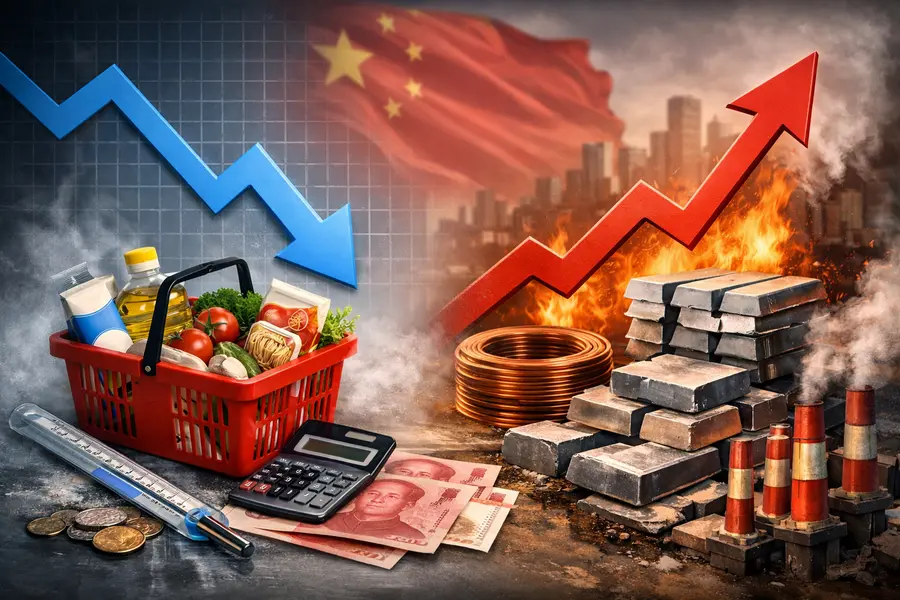
China's June CPI missed forecasts at 1.0% as PPI surged to its highest since July 2022, widening a gap between factory-gate strength and subdued household demand.
- China CPI June rose just 1.0% year-on-year, below the 1.1% consensus and slowing from 1.2% in May.
- China producer inflation rise accelerated to 4.1% year-on-year, the strongest reading since July 2022.
- The divergence underscores a two-track China economic recovery driven by exports and advanced manufacturing, not domestic consumption.
Lead
Beijing — China's National Bureau of Statistics released June inflation data on July 9, 2026, confirming a widening split within the country's economy. The consumer price index rose 1.0% year-on-year, falling short of the 1.1% median estimate and decelerating from 1.2% in May. Simultaneously, the producer price index climbed 4.1% year-on-year — the fastest pace since July 2022 and the fourth consecutive monthly acceleration — spotlighting a China economic recovery that is gaining momentum at the factory gate while household purchasing power stagnates.What Happened
The headline CPI print was pulled lower by continued weakness in food prices, which fell 1.6% year-on-year in June after declining 1.7% in May. Egg prices bucked the trend, rising 16.0% annually, and pork's drag narrowed marginally, but fresh vegetables and fresh fruit remained in deflationary territory.
Core CPI — stripping out food and energy — ticked down to 1.0% from 1.1% the prior month, signaling that underlying domestic demand has yet to build consistent momentum. On a monthly basis, the overall index fell 0.3%, steeper than the forecast 0.2% decline and worse than May's 0.1% dip, pointing to seasonal and structural headwinds.
Non-food prices also moderated. Transport costs rose 4.1% year-on-year after a 5.4% gain in May, partly reflecting government decisions in June to cut domestic retail gasoline and diesel prices as global oil market tensions showed initial signs of easing following a partial de-escalation in the Middle East.
China Producer Inflation Rise in Focus
The PPI told a starkly different story. The 4.1% year-on-year increase — matching economist forecasts — built on May's 3.9% reading and marked the steepest gain in nearly four years. Two forces drove the acceleration.
First, war-related commodity supply disruptions continued to push up input costs for raw materials and energy-intensive industries. Global oil price volatility stemming from Middle East conflict fed through to Chinese upstream sectors more quickly than it reached retail consumers, whose prices were partially insulated by state pricing mechanisms.
Second, and structurally more significant, explosive global demand for artificial intelligence infrastructure lifted prices for technology equipment and advanced components. Chinese semiconductor and computing hardware manufacturers recorded output surges exceeding 80% year-on-year in recent months, and growing order books translated directly into firmer factory-gate pricing. That dynamic contributed to semiconductor exports jumping more than 110% year-on-year in May, with computer hardware exports up 66% over the same period.
China Economic Recovery: Two Tracks
The PPI-CPI divergence is the central narrative of the mid-2026 China economic recovery. Real GDP expanded 5.0% year-on-year in the first quarter of 2026, accelerating from 4.5% in the fourth quarter of 2025, yet the composition of growth reveals an imbalance. Export-linked advanced manufacturing — AI computing, green energy equipment, electric vehicles — is generating genuine pricing power and revenue. Domestic consumption is not keeping pace.
Retail sales of consumer goods fell 0.6% year-on-year in May, the first outright contraction in more than three years, underscoring that the benefits of the export surge have not yet transmitted into broader household spending. The ongoing property sector downturn continues to depress household net worth and consumer confidence, while subdued wage growth constrains discretionary expenditure.China's trade surplus reached a record near $1.2 trillion in 2025, underpinned by exports growing approximately 5.5% to roughly $3.8 trillion while imports remained flat. That imbalance persists into 2026 and reflects the same structural tension: productive capacity at the frontier of global inflation-driving technology sectors vastly outstrips domestic absorptive capacity.
Global Inflation Linkages
The China producer inflation rise carries implications beyond its borders. As China remains the world's largest goods exporter, sustained PPI acceleration in Chinese factories eventually transmits to global inflation through traded goods prices. The AI and semiconductor supply chain is particularly sensitive: high and rising factory-gate prices in China's tech manufacturing belt feed directly into the cost structures of data center buildouts across the United States, Europe, and Southeast Asia.
Commodity-importing economies that source industrial inputs from China face a gradual pass-through of elevated PPI, though near-term relief on energy — amid tentative Middle East diplomacy — could temper that transmission over the next quarter.
Outlook
The June data reinforces that Beijing's policy challenge has sharpened heading into the second half of 2026. Upstream strength offers fiscal and foreign exchange dividends but does not solve the deflation risk at the consumer level. Further stimulus measures targeting household income and property market stabilization remain under active discussion, with particular focus on whether additional consumption vouchers or mortgage refinancing schemes can shift the recovery's center of gravity inward. Until domestic demand reaccelerates, the PPI-CPI gap — a barometer of the China economic recovery's health — is likely to persist as the defining feature of the country's inflation landscape.