Pomegra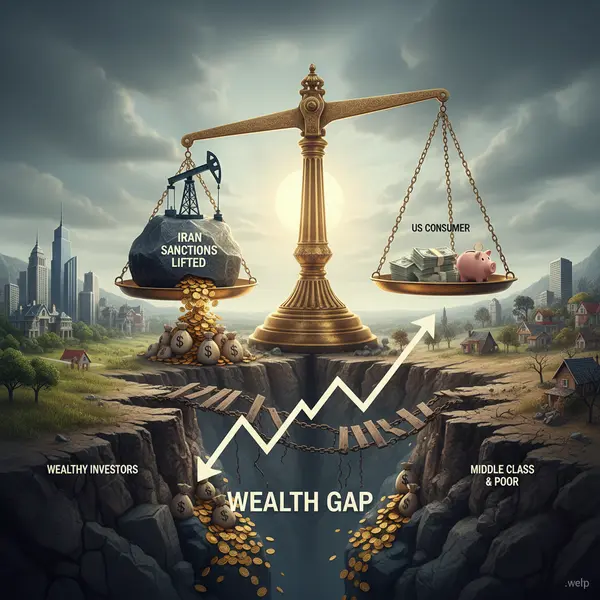
Economists warn a US-Iran peace deal may boost equity markets far more than it helps wage earners, as labor's share of income falls to a 79-year nadir.
- The S&P 500 is up 10.7% year-to-date, with a 19% rally from its March lows, as markets priced in eventual peace.
- Real disposable income fell a combined 0.7 percentage points in March and April; Americans spent an extra $447 on energy since the war began.
- Labor's share of gross domestic income has dropped to 51%, the lowest level in 79 years of records.
Lead
WASHINGTON — A tentative 60-day ceasefire extension between the United States and Iran, awaiting President Donald Trump's final approval, has renewed hope that energy prices will ease heading into summer. But economists and market strategists warn that the underlying divergence in American economic fortunes — sharpened by months of conflict — is unlikely to simply reverse when the fighting stops. The Iran peace deal, far from narrowing the US wealth gap, may accelerate it.
Two Economies, One War
Since US-led strikes on Iran began in late February 2026, the country has split into two distinct economic experiences. Investors watched the S&P 500 absorb an initial 8% drop, then rebound 19% from its March lows. The index is now up 10.7% year-to-date, on pace for a fourth consecutive year of double-digit gains.
Wage earners have endured a fundamentally different war. The national average for regular gasoline has reached $4.56 per gallon, the highest in four years. Bureau of Economic Analysis data show that Americans' real disposable income fell 0.2% in March and another 0.5% in April. Moody's estimates households spent an additional $447.19 on average in energy costs since hostilities began. In the Northeast, households earning less than $40,000 annually cut gasoline purchases by nearly 10%; those earning more than $125,000 barely adjusted.
This is the textbook K-shaped economy — a divergence first named during the pandemic and now re-emerging with sharper edges. Upper-income households, with portfolios weighted toward financial assets, have benefited from the equity rally. Lower-income and middle-class households, more dependent on wages and more exposed to energy as a share of spending, have absorbed the full weight of the oil shock.
Why Peace May Not Close the Gap
The proposed memorandum of understanding calls for the Strait of Hormuz to reopen to unrestricted shipping, Iranian mines to be cleared within 30 days, and further negotiations on nuclear disarmament and sanctions relief to follow. Republicans, including House Speaker Mike Johnson, have framed a deal as the path to lower gas prices and improved midterm prospects. Trump's chief economic adviser Kevin Hassett has predicted that re-opening energy flows could produce "negative inflation."
Analysts are more cautious. An estimated 2,000 ships remain trapped inside the Persian Gulf, and the mandatory 30-day mine clearance timetable means any meaningful reduction in US pump prices will unfold over months rather than weeks. Financial markets reprice in seconds; the physical oil supply chain cannot.
More fundamentally, the wealth gap that the war deepened has structural roots that predate the conflict. Labor's share of gross domestic income stands at 51% — the lowest level in 79 years of recorded data. Corporate profits, bolstered by elevated energy prices and resilient spending among upper-income households, have outpaced wage growth throughout the war. A peace agreement does not renegotiate that divide.
Stock Market Rally: Who Benefits
The anticipated peace dividend is widely expected to push equity markets higher. Trump declared in April that the market "is going to boom" when the war ends. That rally will be felt most acutely by those with the heaviest equity exposure. The wealthiest 10% of Americans own approximately 93% of all stocks; the bottom 50% hold less than 1%.
Brent crude stood at roughly $72 per barrel before hostilities began, surged more than 60% after the Strait of Hormuz closure, and is trading around $97.94 per barrel as of late May 2026 — still about a third above pre-war levels. Energy equities have substantially outperformed through the conflict. A full peace deal is expected to compress energy margins while lifting the broader market, concentrating gains further in diversified portfolios.For lower-income households, the question is whether even a significant fall in gas prices offsets the cumulative losses already absorbed. The $447 in extra energy spending is already gone. Real wages have not recovered. The 51% labor income share represents a structural reallocation — one that a ceasefire agreement leaves entirely untouched.
Geopolitical Dimension
The deal under discussion would ease sanctions and begin the process of unfreezing Iranian assets, with direct consequences for global oil supply and capital flows. A sustained Hormuz reopening would push significant additional crude volume into global markets, exerting downward pressure on prices and easing headline inflation. That outcome is broadly positive across income levels — but the speed of transmission varies sharply. Financial markets re-rate immediately; gas station prices and grocery bills adjust over a longer horizon.
With the midterm elections six months away, Republicans are counting on tangible relief at the pump. But with structural inequality metrics at multi-decade extremes, analysts note that even a successful peace deal may leave a substantial share of the electorate feeling economically exposed — particularly if the stock market rally continues to outpace wage recovery.
Outlook
A US-Iran peace agreement would lower energy prices over time and relieve one of the most acute pressures on lower-income American households. It would do little, however, to close the US wealth gap that the war has deepened. The S&P 500's 10.7% year-to-date advance has already delivered significant gains to financial-asset holders, while real wages and disposable income remain under pressure. Labor's 51% share of gross domestic income stands at a 79-year nadir. The path to a more equitable distribution of the peace dividend runs through labor market policy and the tax structure — territory that a ceasefire agreement does not enter.
Mentioned tickers: SPY, BNO, USO, XOM, CVX`Geopolitics`