Pomegra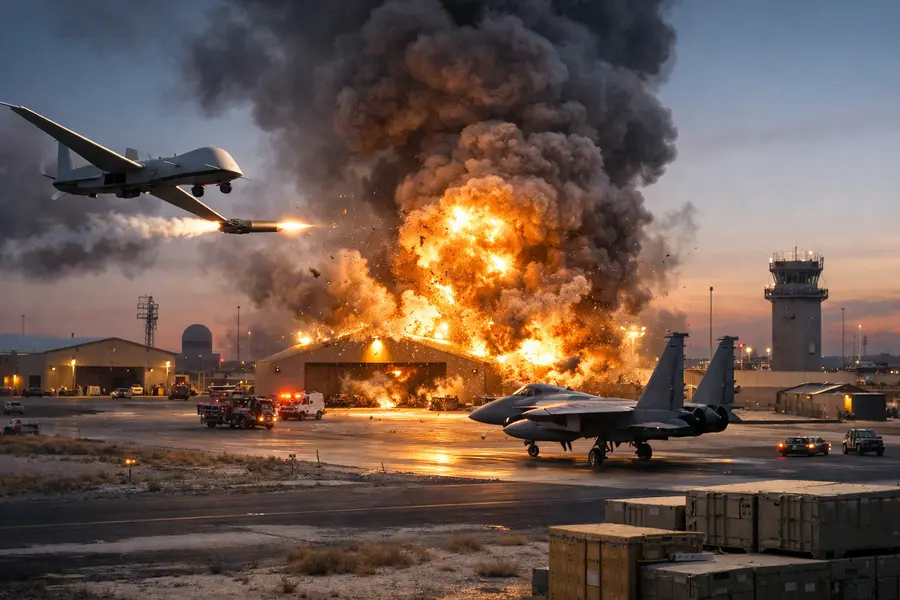
Iran's military says drones struck U.S. assets at Kuwait's Ahmad al-Jaber Air Base on July 31, in the conflict's 27th retaliatory wave; CENTCOM has not responded.
- Iran's Army declared the Ahmad al-Jaber military air base struck in the 27th phase of Operation Sa'eqeh, citing U.S. attacks on Qeshm Island.
- Reported targets include fighter jet shelters, satellite communications systems, and equipment depots at the major U.S. drone and air hub.
- U.S. Central Command has issued no confirmation or denial, and Kuwait has not made an official statement.
Lead
Iran's military announced Thursday that it launched drone strikes against U.S. military assets at the Ahmad al-Jaber Air Base in Kuwait on July 31, 2026, marking the 27th successive wave of retaliatory operations under what Tehran has designated Operation Sa'eqeh — Arabic for Thunderbolt. The strike, carried out with kamikaze-type drones, was described by Iranian military officials as a direct response to a U.S. airstrike on a residential structure on Qeshm Island in southern Iran. The U.S. Central Command (CENTCOM) declined to confirm or deny the claims, and Kuwait's government had not issued a formal response as of publication.
What Happened
Iran's Army stated that precision drone munitions were directed at U.S.-operated infrastructure inside the Ahmad al-Jaber military air base, located approximately 90 kilometers southwest of Kuwait City. Claimed targets included aircraft shelters housing U.S. fighter jets, satellite communications arrays, and logistics equipment depots. Iranian military channels simultaneously asserted that Ali Al Salem Air Base — a separate U.S.-used installation in Kuwait — was also struck in the same operational phase.
Satellite imagery circulated by Iranian state-affiliated media and assessed by open-source analysts appeared to show surface scarring and thermal discoloration consistent with fire damage at a storage compound associated with U.S. forces at Ali Al Salem. Independent verification of damage at Ahmad al-Jaber specifically remained unavailable at time of writing.
CENTCOM — the U.S. military command responsible for the Middle East and Central Asia — offered no comment on the claimed strike, maintaining a pattern of delayed or withheld acknowledgment that has characterized the command's posture throughout the current conflict cycle.Strategic Context
Ahmad al-Jaber Air Base holds considerable significance in the U.S. Gulf force posture. The installation has served as a primary hub for American air and intelligence, surveillance, and reconnaissance (ISR) missions across the Arabian Peninsula and northern Gulf, providing logistical support for combat and airlift operations since the early 1990s. Iranian military statements have consistently framed it as a forward enabler of U.S. strike packages against Iranian territory, making it a high-profile symbolic and operational target.The July 31 strike is the 27th declared wave of Operation Sa'eqeh since the current phase of hostilities began. Prior phases targeted U.S. military facilities in Bahrain, Jordan, and Qatar, as well as Kuwaiti infrastructure. The sustained pace of attacks has tested regional Gulf state diplomacy, as host governments face competing pressures from Washington to maintain basing rights and from Tehran to curtail their military cooperation with American forces.
The Pentagon had already been reassessing its Kuwait footprint in recent weeks, with force protection reviews underway as drone and ballistic missile threats to Gulf-hosted installations intensified. Whether the July 31 claim accelerates any drawdown decision remains unclear.
Geopolitical Dimension
Kuwait occupies a structurally delicate position in the 2026 Iran conflict. A longstanding U.S. security partner, it hosts tens of thousands of American troops and significant pre-positioned equipment, yet shares a border with Iraq — where Iranian-aligned factions hold substantial influence — and maintains historically calibrated ties with Tehran. The repeated targeting of its military air bases by Iranian forces has put Kuwaiti sovereignty and diplomatic neutrality under direct strain.
The absence of a Kuwaiti government statement following Iran's claim reflects that strain acutely. Public acknowledgment of damage would expose Kuwait to domestic political pressure and risk escalatory signaling; denial without evidence risks credibility if satellite damage assessments circulate widely.
For Iran, striking Gulf-hosted U.S. assets serves dual purposes: imposing operational costs on American forward presence and signaling to GCC states that hosting U.S. forces carries tangible sovereign risk. Tehran's explicit identification of Ahmad al-Jaber as a "logistical hub for U.S. air aggression" ties each attack to a stated strategic rationale rather than presenting it as indiscriminate retaliation.
Market and Economic Channels
Oil markets have remained sensitive to each escalation point in the conflict. Brent crude and WTI have tracked the rhythm of Iranian retaliatory waves through 2026, with Gulf shipping insurance premiums elevated across the quarter. Any confirmed major strike on a U.S. military air base in Kuwait — a country that borders the northern end of the Persian Gulf and sits adjacent to key tanker corridors — carries the potential to sharpen risk premia further, particularly if Kuwaiti civilian infrastructure were implicated.Shipping intelligence firms monitoring vessel routing through the Strait of Hormuz and northward Gulf lanes reported no immediate disruption following the Iranian claim, but rerouting contingencies remain active.
Outlook
The 27th declared wave of Operation Sa'eqeh underscores that the operational tempo of Iranian retaliatory strikes has not diminished despite sustained U.S. military pressure. CENTCOM's continued silence on claimed strikes in Kuwait introduces a persistent information gap that complicates both public accountability and real-time threat assessment for regional actors. As long as the Qeshm attack and its claimed response remain without official U.S. acknowledgment, the facts of the July 31 exchange at Ahmad al-Jaber will remain contested — a condition that itself carries strategic utility for both sides. The trajectory of the conflict, and its continued strain on Gulf state basing arrangements, will depend heavily on whether diplomatic back-channels can establish a damage-limitation framework before the next retaliatory cycle.