Pomegra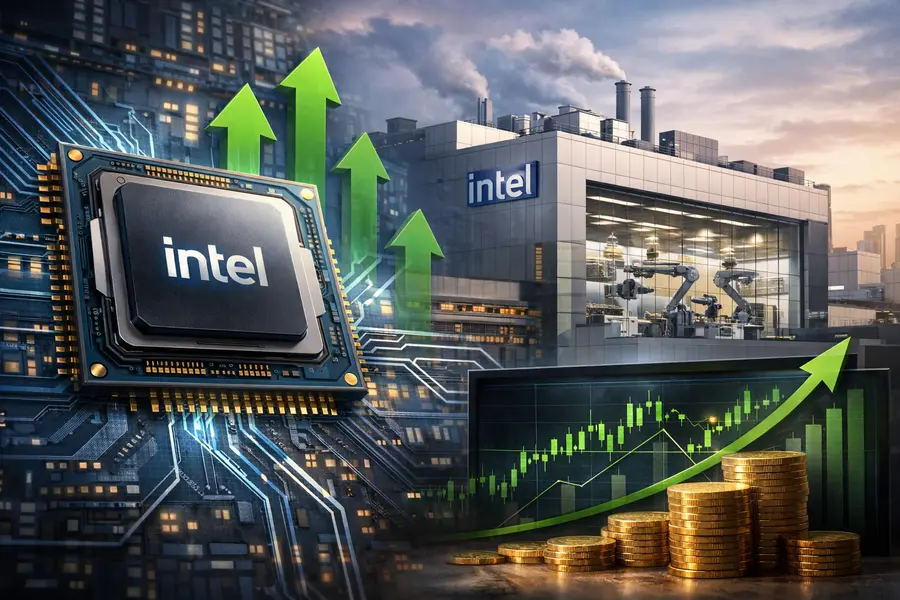
Intel's second-quarter earnings report delivered the company's fastest revenue growth in more than 15 years, propelling the INTC stock to intraday highs before a volatile reversal raised questions about the pace of its foundry transformation.
- Intel Q2 revenue reached $16.1 billion, beating consensus by 12%, while adjusted EPS of $0.42 doubled analyst estimates.
- Intel Foundry revenue rose 31% year-over-year to $5.8 billion as 18A process yields hit 85%, exceeding internal targets.
- INTC stock surged 13% in after-hours trading before reversing to close down 7.9% on July 24 amid elevated capex concerns.
Lead
Intel Corporation posted second-quarter 2026 revenue of $16.1 billion on July 23, a 25% year-over-year increase that surpassed the $14.45 billion Wall Street consensus by roughly $1.65 billion. Non-GAAP earnings per share of $0.42 nearly doubled the $0.21 estimate. Chief Executive Lip-Bu Tan described the quarter as a demonstration that demand is running ahead of supply — a phrase not heard at the company for years.What Happened
The Intel earnings report marked the chipmaker's strongest quarterly revenue growth rate since at least 2011. Non-GAAP gross margin of 41.8% came in 280 basis points above guidance. The breadth of outperformance — spanning revenue, margins, and earnings — drove an immediate after-hours pop in INTC stock of approximately 13%, briefly lifting shares toward $110.
On a GAAP basis, Intel reported a net loss of approximately $11 billion, reflecting ongoing restructuring charges and accelerating capital investment. That figure, alongside a materially higher capital expenditure outlook, shaped the session that followed.
Segment Performance
The primary growth engine was the Data Center and AI segment, where revenue surged 59% year-over-year to $6.26 billion. Accelerating demand for server-class processors, particularly for AI infrastructure buildout, drove the outperformance. The segment's trajectory reinforces a narrative that CPUs remain a relevant compute layer alongside GPUs in large-scale AI deployments.
The Client Computing and Physical AI group — formerly the PC-centric client division — generated $8.9 billion in revenue, up 15% sequentially, benefiting from both a healthy enterprise refresh cycle and initial traction in AI-enabled personal computing.
Intel Foundry Turnaround
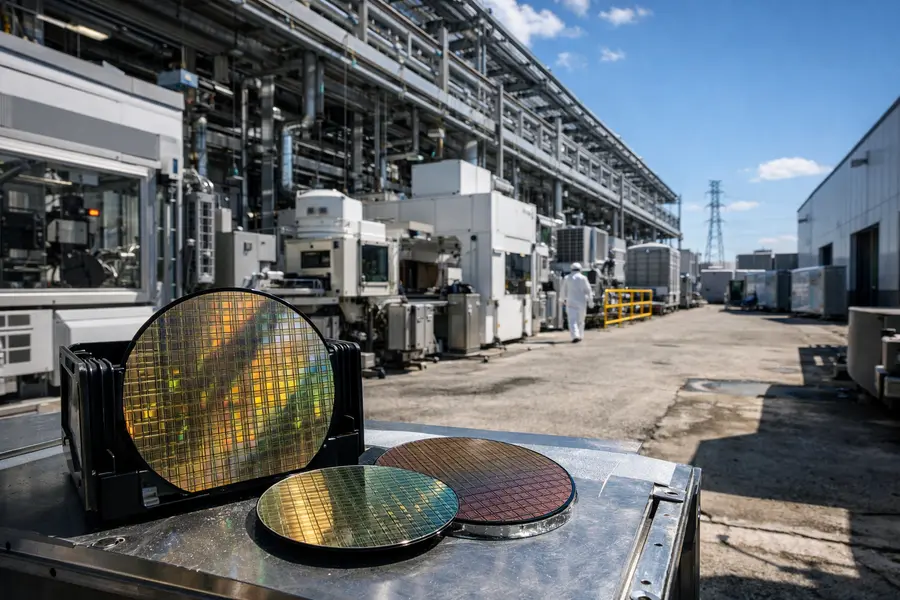
The Intel foundry turnaround was a central theme of the earnings call. Intel Foundry posted revenue of $5.8 billion, up 31% year-over-year, while its operating loss narrowed by $348 million quarter-over-quarter to $2.1 billion. Wafer output on the company's leading 18A process node came in roughly 25% above internal volume targets.
Yields on the 18A node have reached 85%, improving at a rate of 7% to 8% per month — a pace that industry benchmarks consider strong for a maturing advanced process. Intel began production of the 18A-P variant in June 2026, and the company confirmed a manufacturing agreement with a major cloud service provider. ASML separately validated that Intel is among the first to ship chips produced at volume using High NA EUV lithography, a technical milestone that underpins the credibility of its foundry roadmap.
Tan characterized the foundry business as a "national treasure," citing growing inbound interest from external customers and volume production of the Panther Lake processor as proof points. Multiple external customer commitments are expected to materialize in the second half of 2026.
Market Reaction
Despite the strong headline numbers, chip stock recovery enthusiasm proved short-lived for Intel specifically. INTC shares closed July 24 at $92.32, a decline of 7.9% from the prior session, after briefly trading above $104. The iShares Semiconductor ETF was effectively flat on the day, trading near $549.68, suggesting that investors treated Intel's results as a company-specific event rather than a broad sector signal.
The reversal reflected two concerns: the GAAP net loss of approximately $11 billion and a raised capital expenditure target of more than $20 billion for 2026, with a further "meaningful increase" signaled for 2027. Investors questioned the timeline to sustained profitability in the foundry segment, even as the operational metrics pointed in the right direction.
What Comes Next
Intel guided third-quarter 2026 revenue in the range of $15.80 billion to $16.80 billion, with non-GAAP EPS of $0.38. That guidance implies continued sequential revenue stability and positions the company to demonstrate whether its foundry business can convert yield and volume gains into narrowing losses.
The broader context is significant: Intel stock has risen approximately 178% year to date, reflecting a dramatic reassessment of the company's strategic position following U.S. government investment in domestic semiconductor capacity. The magnitude of that rally means the bar for sustained momentum is high.
Outlook
Intel's Q2 2026 results validate the operational thesis behind its foundry pivot — yields are improving, volumes are exceeding internal targets, and external customers are engaging at an accelerating rate. The central question now is whether capital intensity can be managed as revenue scales. With Q3 guidance holding above $15.8 billion and the 18A and 14A roadmaps progressing on schedule, the foundry recovery appears genuine; its financial payoff, however, remains a 2027 story.
Mentioned tickers: INTC