Pomegra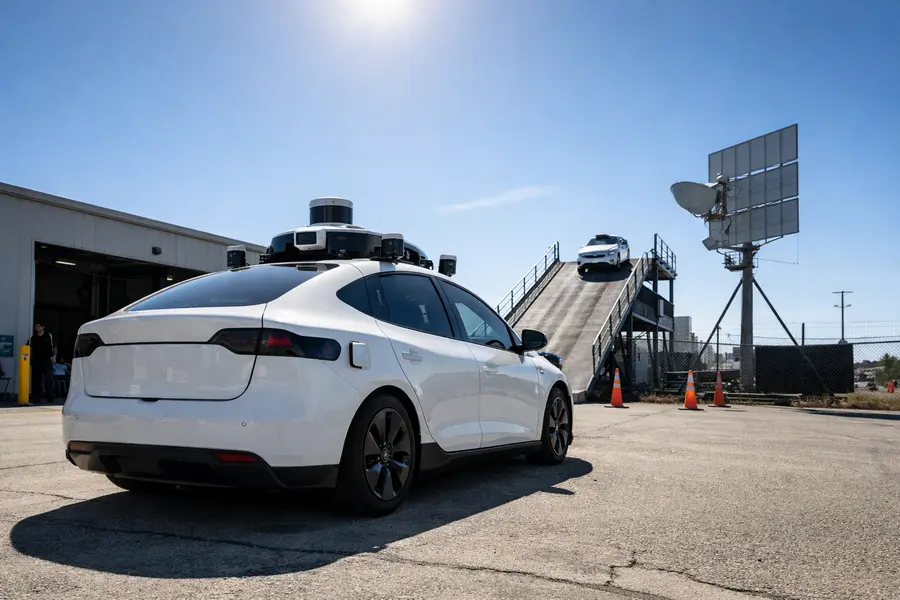
Federal regulators opened a formal investigation into Tesla's 1,000-unit Cybercab deployment in Austin hours after launch, sending TSLA shares down 6% and raising fears of a prolonged regulatory freeze.
- NHTSA launched an audit into roughly 1,000 Tesla Cybercabs in Austin, challenging the company's self-certification of vehicles that lack a steering wheel, brake pedal, and mirrors.
- Tesla bypassed the exemption pathway used by rivals and self-certified compliance directly - a shortcut that now faces formal federal scrutiny.
- TSLA slid 6.4% on the session, hit simultaneously by the federal probe and investor reaction to a Cybercab rollout widely described as underwhelming.
Lead
Tesla (TSLA) shed 6.4% on September 4, 2026, the day after the company deployed roughly 1,000 Cybercab robotaxis on public roads in Austin, Texas - the first commercial rollout of a fully driverless vehicle, lacking a steering wheel, brake pedal, accelerator pedal, and side mirrors, on U.S. streets. Within hours of the fleet going live, the National Highway Traffic Safety Administration opened a formal audit probe questioning whether the vehicles legally meet federal motor vehicle safety standards, casting immediate doubt over Tesla's ambition to scale the autonomous taxi service nationally.Why Did Tesla Stock Fall 6%?
Two forces converged to pressure TSLA on September 4. The NHTSA investigation was the more consequential: the probe directly challenges the legal basis on which the Cybercabs operate, introducing a regulatory overhang capable of freezing fleet expansion pending a resolution that, by historical precedent, takes years. The second pressure was operational. Tesla's Austin launch event was invite-only, was not streamed, and CEO Elon Musk did not appear. Wall Street flagged early execution problems, including user-reported routing errors, missed destinations, and excessive wait times - a performance that fell short of the autonomous-taxi vision Tesla has marketed to investors for years.
What Is NHTSA Investigating?
The agency opened what it designated an Open Audit Query, targeting the process and technical data Tesla used to self-certify the Cybercab as compliant with all applicable Federal Motor Vehicle Safety Standards (FMVSS). The core legal tension is structural: virtually all FMVSS rules were drafted around a human driver and assume the physical presence of a steering wheel, brake pedal, accelerator, and mirrors. Tesla notified NHTSA of its self-certification rather than petitioning for a formal exemption from the standards it concluded were inapplicable - a procedural distinction that now carries significant commercial weight.
The Zoox Precedent: A Four-Year Warning
The regulatory path of Amazon's (AMZN) Zoox unit provides the clearest precedent for what Tesla may face. Zoox, which also operates vehicles without manual controls, chose to petition NHTSA for a formal exemption from FMVSS requirements rather than self-certify compliance. The process took approximately four years. NHTSA granted the exemption in July 2026, allowing Zoox - whose fleet had logged nearly 2 million driverless miles and carried roughly 350,000 passengers in demonstration service - to clear the final federal hurdle toward a paid commercial launch. Tesla's decision to self-certify and deploy at commercial scale before securing an equivalent federal ruling is precisely what the current probe examines. If NHTSA determines the self-certification was improper, the agency holds authority to require Tesla to remove the Cybercabs from roads pending compliance - effectively replicating the same multi-year standstill that delayed Zoox.
Why Did Tesla Skip the Exemption Route?
Tesla's approach reflects a deliberate bet that deployment speed outweighs procedural certainty. The U.S. Department of Transportation proposed in June 2026 to eliminate the federal requirement for manual brake pedals in fully autonomous vehicles - a rule change that, once finalized, would substantially resolve Tesla's compliance exposure. The company's self-certification effectively anticipated that regulatory outcome. Proposed rules, however, carry no legal force until enacted, and NHTSA's probe operates under existing statute. The gap between proposed and finalized regulation is the contested legal ground on which the investigation now stands.
Will the NHTSA Probe Halt Tesla's Robotaxi Rollout?
The investigation does not automatically ground the current Austin fleet - NHTSA must complete its review before any enforcement action. It does, however, place a hard ceiling on near-term expansion. Tesla had signaled plans to extend the Cybercab service beyond Austin to additional U.S. markets in 2026. That timeline is now contingent on the investigation's outcome. An adverse ruling would require Tesla either to seek a retroactive exemption - reproducing the multi-year Zoox process - or retrofit the vehicles with manual controls, altering the fundamental product design. The outcome carries implications beyond Tesla: a ruling against self-certification could establish binding precedent requiring all autonomous vehicle operators, including Alphabet's (GOOGL) Waymo, to follow the formal exemption route before deploying without manual controls at commercial scale.
Outlook
The Cybercab NHTSA federal probe represents the most significant near-term risk to Tesla's autonomous vehicle business model. With roughly 1,000 Cybercabs operating under contested legal status in Austin, the company faces a regulatory timeline it does not control and a federal framework that has not yet caught up with its hardware. The DOT's proposed revision to FMVSS brake-pedal requirements remains the pivotal variable: finalization before the investigation concludes would substantially strengthen Tesla's position; an adverse NHTSA ruling first would trigger a resolution process measured in years rather than months - preserving Tesla's first-mover status in autonomous transport while preventing the company from monetizing it at scale.
Mentioned tickers: TSLA, AMZN, GOOGL