Pomegra
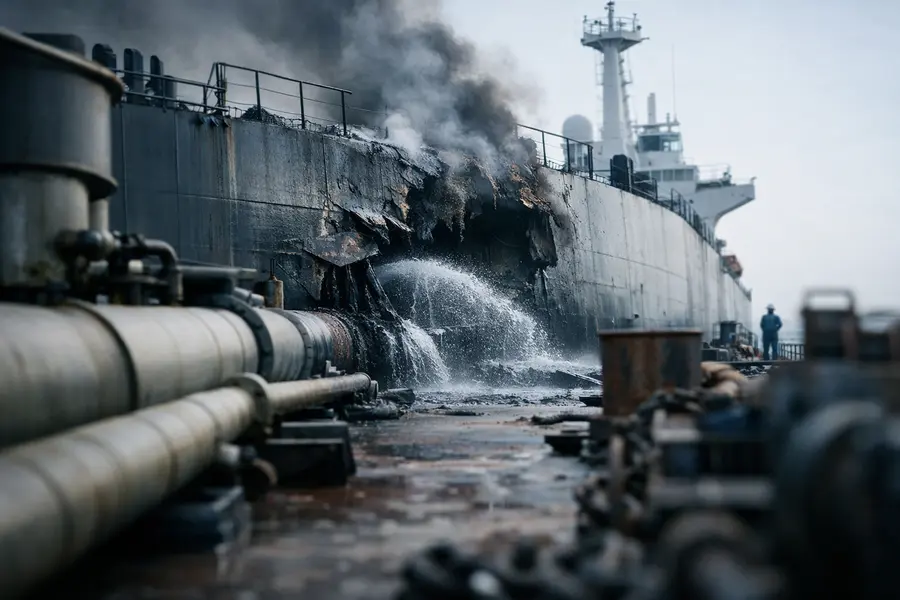
Iran's Revolutionary Guard says four tankers hit mines in the Strait of Hormuz as Trump weighs renewed strikes, pushing Brent crude above $115 a barrel on Friday.
- Iran's Revolutionary Guard says four tankers struck mines within 24 hours; U.S. Central Command calls such claims false.
- A separate tanker was hit by an unidentified projectile, and Brent crude traded above $115 a barrel on October 30.
- Trump was briefed Thursday on options for renewed strikes on Iran, with a Vance letter to Tehran still unanswered.
Lead
Iran's Islamic Revolutionary Guard Corps said on October 29 that four tankers struck sea mines in and near the Strait of Hormuz within 24 hours. A fifth incident, a tanker hit by an unidentified projectile, followed. The reports pushed the crude oil price higher on October 30, with Brent futures near $115 to $116 a barrel and U.S. West Texas Intermediate above $102. Both benchmarks were on course for a fourth straight monthly gain, with Brent up more than 10% in October and WTI up roughly 14%.
What Happened in the Strait of Hormuz?
The Revolutionary Guard Navy said three tankers exploded and caught fire on the southern route of the strait, a passage Tehran treats as off-limits, after crews ignored warnings and switched off navigation systems. The Iranian army reported a fourth vessel damaged by a mine east of the waterway. One tanker was seen burning north of Khasab, Oman.
The UK Maritime Trade Operations center separately reported a tanker hit by explosive devices attached to its hull by a small boat. No party has been identified. A further tanker was struck by a projectile during an outbound transit.
U.S. Central Command rejected the mine claims, saying primary transit routes had been cleared. No maritime authority has independently confirmed the Iranian account of four mine strikes.Why Is the Crude Oil Price Rising?
Crude is rising because the strait carries a large share of seaborne oil and the incidents have deepened the shipping disruption. Daily transits have collapsed from a pre-crisis baseline of about 85 vessels to a handful on some days, with only two recorded on October 25. Roughly 6,000 seafarers remain stranded in the area, and at least 24 have been killed since the conflict began on February 28.
Iranian attacks on shipping have run at about 30 since October 1, the fastest pace of the conflict. Houthi attacks on Saudi Arabia have added to supply concerns. WTI is closing in on a monthly finish above $100 for the first time since April.
The market consensus is that prices stay elevated and volatile through the U.S. midterm elections on November 3. Longer term, forecasts for a post-conflict range of $70 to $90 a barrel rest on restocking demand and a lasting geopolitical risk premium.
What Are Trump's Options on Iran?
Trump was briefed on military options for renewed strikes on Iran at a White House meeting on Thursday with Admiral Brad Cooper, who commands U.S. Central Command. The president has repeatedly signaled that large-scale action could follow the midterms.
Diplomacy is running in parallel. Vice President JD Vance sent a letter to Mohsen Rezaei, secretary of Iran's Supreme National Security Council, to explore a framework for renewed negotiations. Nuclear restrictions are among Washington's principal concerns. Iranian news agencies said Tehran had received the letter but had not responded, and Iran has refused to soften its conditions for talks. Vance said Trump would achieve U.S. objectives but would not allow a prolonged "forever war."
Geopolitical Dimension
The dispute over whether the southern route is mined is also a dispute over who controls passage. Tehran's insistence that ships use an authorized lane, and its claim that violators are punished by mines, turns navigation rules into a lever of coercion. Washington's position is that the waterway is open and that its escorts and clearance work have helped Gulf producers export more than 1.5 billion barrels since the summer.
The gap between the two accounts raises insurance and chartering costs even where no ship is damaged. Owners and underwriters price the risk of an incident, not only confirmed hits.
What Comes Next for Shipping and Oil?
Near-term direction depends on three variables: whether Tehran answers the Vance letter, whether independent confirmation emerges on the mine claims, and whether the U.S. acts on strike options after November 3. A resumption of strikes would likely trigger further attacks on shipping and lift the crude oil price again. A resumption of talks would ease the risk premium, though a full return of transit volumes would take longer.
Outlook
Four claimed mine strikes, an unexplained projectile hit and a stalled diplomatic channel have kept Brent above $115 a barrel. Transit volumes through Hormuz remain a fraction of pre-war levels. The period through the November 3 midterms is the next point at which the balance between strikes and negotiation is likely to be tested.
Mentioned tickers: None