Pomegra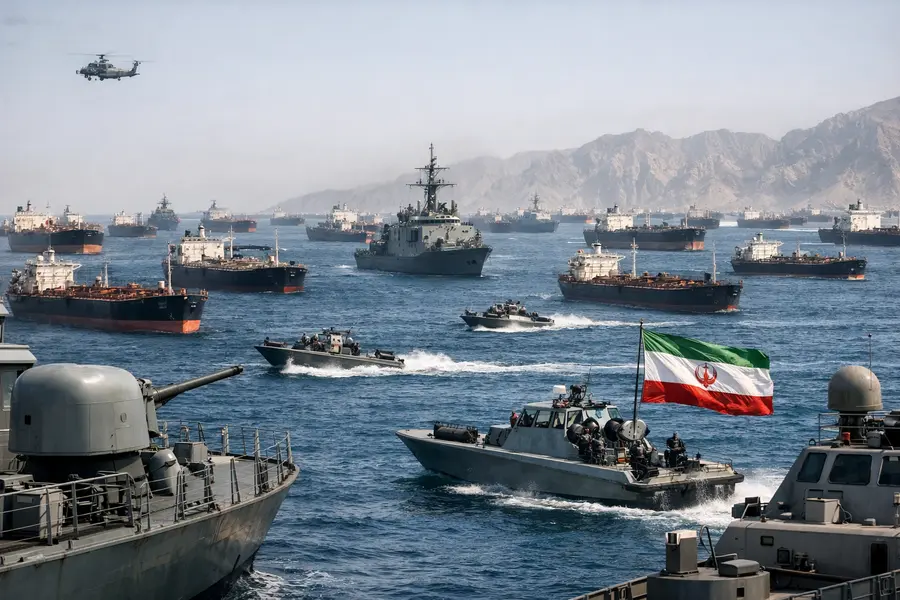
The U.S. Hormuz blockade returns July 14, trapping 230 loaded oil tankers in the Persian Gulf as Brent crude surges 9.59% in its largest single-day gain in six years.
- Brent crude settled at $83.30/barrel on July 14 — up 9.59% — after the U.S. reimposed a naval blockade covering Iran's entire coastline, ports, and oil terminals
- 230-plus loaded oil tankers are stranded inside the Persian Gulf with zero route to market, their cargoes accruing demurrage with no viable delivery path
- The global energy supply disruption, already the largest since the 1970s crisis, now risks repeating the 10.1 mb/d supply crash recorded in March 2026
Lead
The Strait of Hormuz is closed again. The United States reimposed a naval blockade against Iran on Monday, July 14, 2026, effective 4:00 p.m. ET, covering Iran's coastline, all ports, and oil export terminals. Brent crude surged 9.59% to settle at $83.30 per barrel — its largest single-day percentage gain in more than six years — as more than 230 loaded oil tankers sat anchored inside the Persian Gulf with no viable exit. The resumption of hostilities comes six weeks after a ceasefire unraveled on July 8, when Iran allegedly struck multiple commercial vessels transiting the strait.
What Happened
The June 18 memorandum of understanding between Washington and Tehran — which had briefly reopened the Hormuz corridor and pushed Brent crude back below $70 per barrel — held for less than three weeks. Iran's alleged attacks on commercial shipping on July 8 triggered an immediate U.S. military response. By July 11, only six vessels crossed the strait in a 12-hour window, against the normal cadence of 18 to 22 crossings per day. On Sunday, July 13, the U.S. Department of Energy reported that 8.5 million barrels transited the strait under active naval escort, a sharply reduced fraction of pre-conflict throughput.
President Donald Trump announced Monday that the reimposed blockade would apply to Iranian vessels outright and would require all other ships to remit 20% of cargo value as a protection fee before transiting — a novel tariff mechanism layered on top of the existing military standoff.
Oil Price 0: The Stranded Cargo Paradox
While benchmark prices surged for crude that can move freely, the 230-plus tankers anchored inside the Persian Gulf present a different market reality. Their cargoes — millions of barrels of crude oil priced for international delivery — now face an oil price 0 scenario in practical terms: no buyer can take physical delivery, demurrage costs accumulate daily, and storage capacity inside the Gulf is absorbing surplus. The effective realizable value of any barrel that cannot exit the strait approaches nil.
The dynamic closely mirrors the April 2020 WTI futures collapse, when U.S. contracts briefly turned negative as landlocked producers ran out of storage. In the Strait of Hormuz oil blockade context, the constraint is geographic rather than logistical, but the economic consequence for cargo holders is structurally similar — stranded supply with no near-term market.
Regional crude oil flows out of the Middle East Gulf averaged approximately 20 million barrels per day of crude and oil products before the conflict began on February 28. Those flows crashed by 10.1 mb/d in March at the height of the initial blockade, marking the largest supply shock in the history of the global oil market.
Market Reaction
Brent crude posted its highest settlement since June 12, reversing a weeks-long decline. GasBuddy analysts projected U.S. national average gasoline prices would reach $4.00 per gallon within 7 to 10 days. Equity markets in major energy-importing economies fell, with concentrated pressure on airline, shipping, and petrochemical sectors sensitive to sudden fuel cost spikes.The pricing reversal is stark. From a crisis peak of $126 per barrel in mid-March — the highest level in four years — Brent had retreated to below $70 per barrel by July 1, near where prices stood when the conflict originated. Monday's 9.59% surge partially reverses that correction and puts the market back in crisis-premium territory.
Geopolitical Dimension
The 2026 Strait of Hormuz crisis, triggered by the U.S.-Israeli air campaign against Iran on February 28, produced what the International Energy Agency classified as the largest global energy supply disruption in the history of the world oil market. The ceasefire era briefly restored confidence that the corridor could function normally, drawing down the geopolitical risk premium embedded in prices. The breakdown of that truce eliminates the assumption underpinning those lower prices.
The strait remains the sole viable maritime export route for Iraq, Kuwait, the United Arab Emirates, and a significant share of Saudi Arabian crude. No pipeline infrastructure exists at sufficient scale to reroute the volume at risk. Trump's 20% cargo levy introduces a separate layer of friction: even when military conditions permit transit, the economic cost calculation for shipping operators is now materially different.
Crude Oil Price Forecast
Before the truce collapsed, the U.S. Energy Information Administration projected Brent would average $70 per barrel in the fourth quarter of 2026, with rising supply outpacing moderating demand. Those projections are now subject to fundamental revision. Global oil consumption had already contracted by an average of 1.2 million barrels per day in 2026 — partly reflecting demand destruction during the initial blockade phase. A second supply shock layered on a weakened demand base creates non-linear downside risk for global growth, even as headline crude oil price forecast models revise upward.
The path forward for prices hinges on three variables: the pace and credibility of diplomatic re-engagement, the viability of the U.S. naval protection arrangement for commercial shipping, and whether OPEC+ producers outside the Gulf can expand output fast enough to partially offset blocked flows.
Outlook
The reimposition of the Strait of Hormuz oil blockade on July 14, 2026 erases weeks of cautious market recovery and reinstates the global energy supply disruption as the central fact of the oil market. Brent crude at $83.30 remains below the March peak of $126, but the trajectory has reversed sharply. With 230 tankers stranded inside the Gulf, throughput at a fraction of normal capacity, and a new cargo-fee structure adding economic friction to every transit, the market faces a sustained supply constraint rather than a transient spike. Whether diplomacy can reopen the corridor — and how quickly — will determine whether crude oil price volatility deepens or stabilizes through the second half of 2026.