Pomegra
Goldman Sachs warns that global AI compute cluster supply will fall short of demand well into 2027, as JPMorgan raises its Microsoft price target to $625 on surging infrastructure economics.
- Goldman Sachs projects AI compute cluster demand will exceed supply through at least the second half of 2027.
- Hyperscale operators are forecast to spend $527 billion on data center CapEx in 2026, rising to $1.6 trillion annually by 2031.
- JPMorgan lifted its Microsoft price target from $550 to $625, citing Azure's capacity monetization and Copilot revenue potential of $24–$41 billion.
Lead
Goldman Sachs warned on Wednesday that the global artificial intelligence infrastructure build-out faces a structural capacity shortfall lasting years, with demand for AI compute cluster resources expected to outpace supply through at least the second half of 2027. The finding, drawn from the bank's latest infrastructure research, arrives as JPMorgan raised its price target on Microsoft (MSFT) to $625 from $550, underscoring Wall Street's conviction that the winners of the capacity race will command premium valuations for years.What Goldman Sachs Found
Goldman Sachs identified a widening gap between the pace of AI workload growth and the physical infrastructure required to support it. In the bank's baseline scenario, annual AI capital expenditure reaches $765 billion in 2026, climbing to $1.6 trillion by 2031. In a more conservative scenario, hyperscale operators still commit at least $527 billion to data center construction and AI compute cluster build-outs in 2026 alone.
The supply constraint is no longer primarily a semiconductor problem. U.S. data center power demand is on track to rise from 31 gigawatts in 2025 to 41 GW in 2026 and 66 GW in 2027, assuming 70% capacity utilization. By 2027, data centers alone are projected to account for 8.5% of total U.S. electricity demand, a figure that strains grid capacity across the Mid-Atlantic, Mid-Continent, and Northwest regions.
Goldman Sachs described grid infrastructure — transformers, switchgear, and high-voltage interconnection — as the binding constraint that chip manufacturers cannot resolve on their own. Electrical grid expansion is measured in years, not quarters, placing a hard ceiling on how quickly hyperscalers can bring new compute online regardless of GPU availability.
The Semiconductor Layer
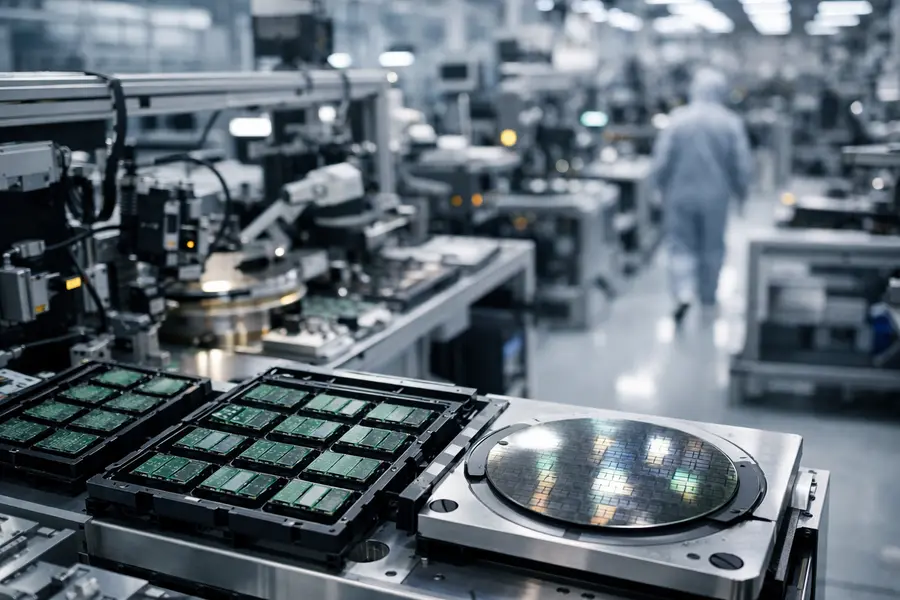
While power has surpassed chips as the near-term bottleneck, the semiconductor supply chain remains under pressure. Lead times for data-center GPUs range from 36 to 52 weeks, and high-bandwidth memory now consumes 23% of total global DRAM wafer capacity, up from single digits just two years ago. The shift reflects the memory intensity of large-scale AI compute cluster deployments, where inference workloads can require 100 to 750 megawatts per facility.
Nvidia (NVDA) stands as the primary beneficiary of sustained GPU scarcity, while companies across the memory supply chain — including SK Hynix, Samsung, and Micron Technology (MU) — are absorbing structural demand increases that show no near-term reversal.JPMorgan Lifts Microsoft Target
Against that backdrop, JPMorgan raised its Microsoft price target to $625, citing the company's positioning to monetize constrained AI infrastructure through multiple layers of the stack. Analyst Samik Chatterjee highlighted Azure's role in selling compute capacity directly to enterprises and AI developers, with Microsoft's own Copilot suite functioning as an internal, high-margin customer for that infrastructure.
Chatterjee estimated that Copilot-related demand alone could add $24 billion to $41 billion in incremental revenue before factoring in potential AI capacity sales to third parties. The implied upside from JPMorgan's revised target stands at approximately 30% from current trading levels.
Microsoft has committed approximately $80 billion in AI infrastructure CapEx in fiscal year 2025, which ended in June, and has outlined roughly $190 billion in capital expenditure for calendar year 2026 — including an estimated $25 billion attributable to rising memory component costs. The scale of that commitment has historically weighed on near-term free cash flow, but JPMorgan's note signals that the market is shifting toward pricing long-duration infrastructure economics rather than near-term margin compression.
Strategic Context
The Goldman Sachs framework positions the current AI infrastructure cycle as structurally different from prior technology build-outs. Earlier waves of data center investment — driven by cloud migration and streaming — were eventually met by supply, leading to cyclical corrections in both capacity utilization and infrastructure valuations. The current cycle is distinguished by the simultaneity of demand: generative AI inference, model training, agentic deployments, and enterprise software integrations are competing for the same constrained pool of AI compute cluster resources simultaneously.
That confluence has led Goldman Sachs to characterize 2026 as a year of entrenched scarcity rather than emerging resolution, even as chipmakers and utilities attempt to coordinate on longer-horizon expansion plans. The bank's bullish scenario extends the supply-demand imbalance through 2030.
For hyperscalers — Microsoft, Alphabet (GOOGL), Amazon (AMZN), and Meta Platforms (META) — the implication is continued justification for elevated CapEx, as the alternative is ceding market position in a capacity-constrained environment where early movers lock in power contracts and GPU allocations years in advance.
Outlook
Goldman Sachs' assessment reinforces a multi-year investment thesis centered on AI infrastructure scarcity, with grid capacity now the defining limit. JPMorgan's upward revision on Microsoft reflects the same logic applied at the company level: operators that control large, contracted AI compute cluster assets are positioned to capture outsized returns as demand continues to outrun supply. The next critical data points — utility interconnection queues, hyperscaler CapEx guidance revisions, and GPU allocation disclosures — will determine whether Goldman's 2027 equilibrium estimate holds or is pushed further into the decade.
Mentioned tickers: MSFT, NVDA, MU, GOOGL, AMZN, META