Pomegra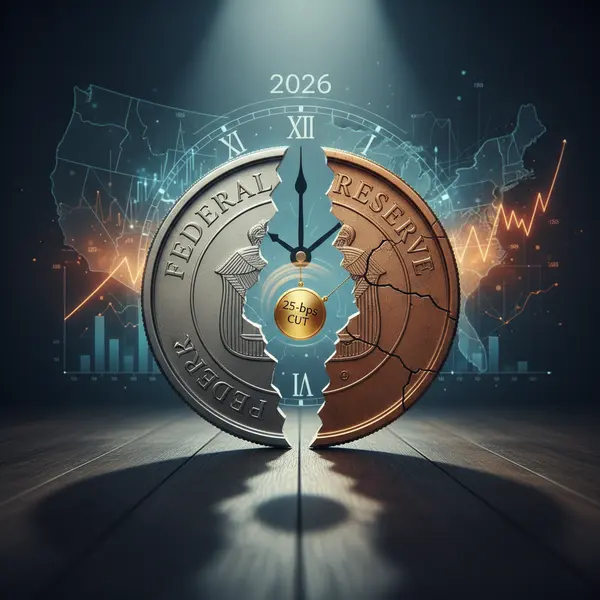
The Federal Reserve cut its benchmark rate 25 basis points to 3.25–3.50% on Wednesday, its first reduction in 2026, amid the sharpest internal division in three decades.
- The FOMC lowered its target range to 3.25–3.50%, consuming the full year's projected easing in a single vote and ending a multi-meeting pause.
- Three hawkish dissenters — Hammack, Kashkari, and Logan — opposed the move while April CPI held at 3.8% year-over-year, highest since 2023.
- Chair Kevin Warsh endorsed the cut, arguing AI-driven productivity gains will eventually pull inflation sustainably toward the 2% target.
Lead
The Federal Open Market Committee voted Wednesday to reduce the federal funds target range by 25 basis points to 3.25–3.50%, executing the first Fed cut of 2026 after a prolonged pause and recording the most fractured vote in over 30 years. The decision, the first presided over by Chair Kevin Warsh, drew dissenters on both flanks of the committee — a structural echo of April's unprecedented 8-4 split, the widest divergence since October 1992.
What Happened
The majority found cover in cooling labor-market data. April nonfarm payrolls added 115,000 jobs — below trend — while the unemployment rate held at 4.3%. The committee's March dot plot had penciled in exactly one 25-basis-point reduction for all of 2026; Wednesday's action exhausts that allocation.
Warsh, who has argued that energy-driven inflation is transitory and that artificial intelligence productivity gains will suppress underlying price pressures over time, provided the intellectual backbone for the narrow majority. The new chair has also spoken against the Fed's dot-plot framework itself, a signal that forward guidance may grow less prescriptive under his tenure.
The Dissents
Hawkish dissenters Beth M. Hammack, Neel Kashkari, and Lorie K. Logan pointed to April's consumer price index reading of 3.8% year-over-year and a 6% annual surge in wholesale inflation — the fastest pace since 2022 — as evidence that the committee should not ease before disinflationary trends are confirmed. All three cited the ongoing Middle East conflict as a structural upside risk to energy costs that makes premature cuts dangerous.
On the other end of the spectrum, Governor Stephen Miran — a persistent advocate for easing who has dissented at consecutive meetings — welcomed the decision.
Market Reaction
Treasury yields fell across the curve. The 2-year yield retreated toward 4.15%; the 10-year settled near 4.50%. S&P 500 futures extended gains following the announcement. The dollar softened modestly against a basket of major currencies, while rate-sensitive sectors — utilities and real estate — outperformed in after-hours trading.
Interest Rate Outlook
The committee's own projections place core PCE inflation at 2.7% by year-end 2026, still well above the 2% goal. With the real rate narrowed by Wednesday's move, seven of 19 policymakers had entered the meeting favoring no cuts at all in 2026, while five projected 50 basis points or more of cumulative easing — a distribution that reflects a genuine strategic fault line rather than a minor technical difference.
Outlook
The June cut leaves the FOMC with limited space to ease further without risking credibility on inflation, particularly if May CPI data — due before the next scheduled meeting — shows another elevated print. Warsh's productivity-led disinflation thesis faces its first empirical test in the weeks ahead, and the July and September meetings will reveal whether the committee's fragile majority holds or fractures further. The interest rate outlook for the remainder of 2026 hinges on incoming data and the duration of the energy shock linked to Middle East tensions.
Mentioned tickers: SPY, TLT, IEF, UUP, TBT