Pomegra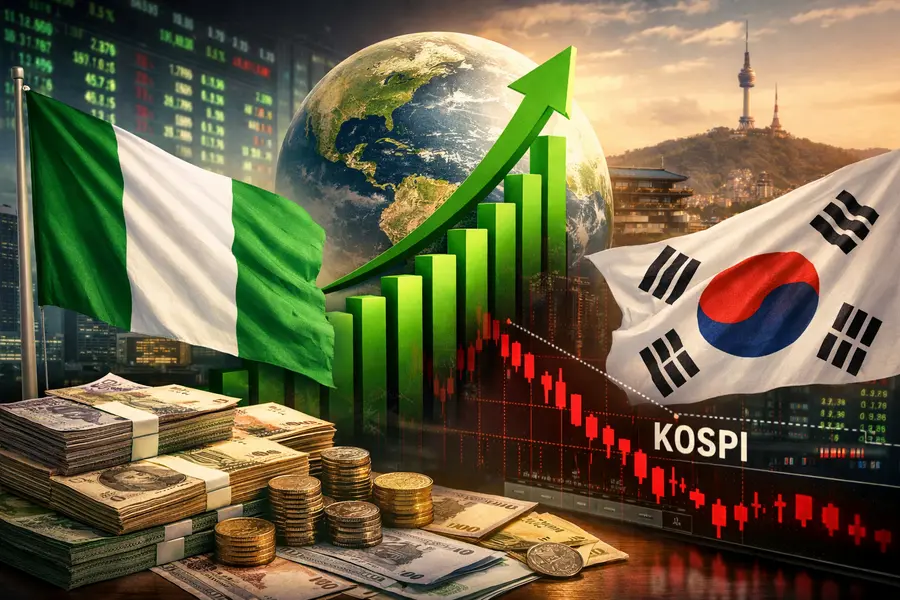
Nigeria's NGX All-Share Index has delivered 68% in dollar returns this year, topping Bloomberg's global ranking of 92 exchanges and surpassing South Korea's Kospi to claim the title of world's best-performing stock market.
- NGX dollar returns of 68% edge past South Korea's Kospi at 66%, placing Nigeria atop Bloomberg's 92-market global ranking.
- The naira's 4% gain against the dollar amplifies Nigeria stock returns for foreign investors, while the Korean won has lost 5%.
- The NGX All-Share Index hit 242,459.98 on July 8, lifting market capitalisation to ₦155.59 trillion.
Lead
Nigeria's equity market vaulted past South Korea's Kospi on July 9 to become the world's top-performing stock market in dollar terms. Bloomberg's ranking of 92 global exchanges places the NGX All-Share Index (ASI) at the summit with approximately 68% in dollar-adjusted returns year-to-date, edging the Kospi's 66% gain. The milestone marks the first time Nigeria has held that position in its market history, cementing a structural shift in global emerging investment appetite toward sub-Saharan Africa's largest economy.
What Happened
Nigeria's benchmark rallied 20.36% in April alone — the single best month in the Exchange's recorded history — before the ASI touched 242,459.98 on July 8, 2026. Market capitalisation climbed ₦3.45 trillion in that session, reaching ₦155.59 trillion. Year-to-date, the index is up approximately 55% in naira terms; in dollar terms, the naira's 4% appreciation against the greenback takes that figure to 68%, making Nigeria stock returns among the most compelling in global finance this year.
The NGX Banking Index closed July 8 at 2,113.54 points, the Insurance Index at 1,118.45, and the Oil and Gas Index at 5,066.24, reflecting broad-based demand across sectors. The insurance sector has been the standout, surging 111% in naira terms through the first half of 2026. Among individual equities, Fortis Global Insurance Plc has returned approximately 1,400% in dollar terms — a figure that underscores the depth of the rally in Nigeria's financial sector.
NGX vs Kospi Performance
NGX vs Kospi performance diverged sharply in the second quarter. South Korea's Kospi had led world top performing stocks through most of H1 2026, propelled by a semiconductor and artificial-intelligence-driven bull run. The index then entered a technical bear market after falling 22% from its June 19 peak, as sentiment on AI-linked equities soured and foreign capital rotated out of Korean equities. The South Korean won compounded losses for dollar-based investors, dropping 5% against the dollar year-to-date — ranking as the fourth worst-performing currency in Asia.Nigeria offered the inverse configuration. The naira has gained 4% against the dollar since January, supported by external reserves that have climbed to above $51 billion — a level not seen in 17 years. That currency strength converts strong naira-term equity gains into superior dollar-denominated returns, an arithmetic advantage that has not gone unnoticed in international portfolio flows.
Strategic Context
The rally sits on a foundation of structural reform. President Bola Tinubu's administration removed Nigeria's long-standing fuel subsidy and unified the foreign exchange market in mid-2023 — two decisions that initially compressed household purchasing power but unlocked significant capital market momentum. A banking sector recapitalization programme launched in 2024 compelled Nigerian lenders to raise new equity, deepening the market and drawing fresh domestic and foreign participation.
Legislative support followed. The Investment and Securities Act of 2025 modernised the regulatory framework, while the Nigerian Exchange's adoption of a T+2 settlement cycle and extended trading hours improved operational credibility. Higher global oil prices in 2026 have reinforced Nigeria's fiscal position as a major crude producer, boosting foreign exchange inflows and stabilizing the naira at approximately ₦1,400 per dollar on the official market.
GDP growth reached 3.89% in the first quarter of 2026, up from 2.54% in Q3 2023, validating the macroeconomic thesis that underpins the emerging investment case for Nigerian equities. Domestic institutional investors — notably pension funds — have provided a steady demand floor, reducing reliance on episodic foreign portfolio inflows.Market Reaction
Investors gained ₦6.3 trillion in market capitalisation over four consecutive sessions in early July, as the index crossed records on successive trading days. The broader market ended H1 2026 as Africa's top performer, with the ASI advancing 45.95% in naira terms between January and June 30, and the listed equity universe expanding from ₦99.94 trillion to ₦146.56 trillion. Foreign portfolio flows dipped in May for the second consecutive month but recovered materially in June as the dollar-return premium over comparable markets widened.
S&P Dow Jones Indices has placed Nigeria on its 2027 watchlist for a potential upgrade from standalone to frontier-market classification — a reclassification that would expand the universe of passive funds eligible to invest in Nigerian equities.
What Comes Next
H2 2026 carries its own risks. Oil price volatility remains the primary macro variable, given crude export receipts underpin the naira's stability. Any deterioration in the global energy market could pressure the currency and reverse a portion of the dollar-return premium that has driven foreign inflows. Domestically, inflation remains elevated, squeezing consumer spending and posing downside risk to earnings in consumption-linked sectors.
The banking recapitalization deadline is also approaching, which may generate secondary equity issuance and short-term price pressure in the financial sector. Still, the structural reform trajectory, near-record reserves, and expanding institutional investor base give the market a firmer platform than at any prior point in its history.
Outlook
Nigeria's equity market has moved from emerging-market afterthought to global headline in fewer than 36 months. The convergence of structural reform, currency strength, sector-specific earnings momentum, and an AI-driven rotation away from Asian tech equities has placed the NGX All-Share Index at the top of the world top performing stocks table. Near-term volatility around oil prices and domestic inflation will test the rally's durability, but the fundamental case for Nigerian equities — underpinned by regulatory modernization, a strengthening naira, and rising foreign exchange reserves — has materially improved since the reform cycle began in 2023.
Mentioned tickers: NGSEINDX, KOSPI