Pomegra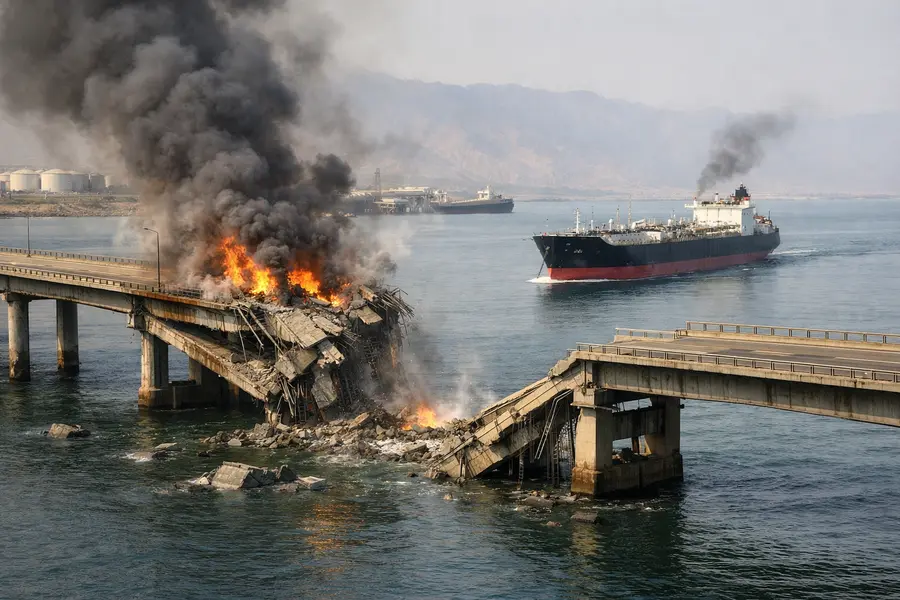
U.S. forces destroyed highway and rail bridges at Bandar Khamir in a seventh consecutive night of Iran infrastructure strikes, physically cutting Bandar Abbas from its overland supply routes to Tehran.
- U.S. airstrikes demolished bridges at Bandar Khamir in Hormozgan province, killing at least seven and wounding twenty, severing a primary artery to Bandar Abbas.
- Iran retaliated by striking Kuwait's water desalination plant and launching missiles at Qatar, Jordan, and U.S. military facilities in Bahrain and Syria.
- Brent crude touched $85.92 a barrel as tanker traffic through the Strait of Hormuz fell to a two-month low of seven vessels per day.
Lead
U.S. Central Command on July 17, 2026, struck bridges at Bandar Khamir—a coastal city in Iran's Hormozgan province overlooking the Strait of Hormuz—demolishing both highway and rail spans in the seventh straight night of the US Iran infrastructure war. Iranian state media reported at least seven killed and twenty wounded. The strike constitutes a deliberate escalation in the Middle East military campaign: by severing Bandar Khamir's road and rail links, Washington has isolated Bandar Abbas, Iran's principal commercial port and the base of its Islamic Revolutionary Guard Corps naval command, from overland resupply routes stretching north to Tehran.
What Happened
Overnight strikes destroyed the highway and rail bridge at Bandar Khamir and collapsed a maritime control tower at Chabahar port on the Gulf of Oman, Iranian state media confirmed. A separate wave of strikes hit energy infrastructure across southern Iran; the country's Energy Ministry—acknowledging power grid damage for the first time since the renewed campaign began—issued an emergency call for residents in southern provinces to reduce electricity consumption.
Earlier in the campaign, U.S. forces had already destroyed the Geriveh Bridge linking Bandar Abbas to the city of Lar, cutting one of the primary logistics arteries. The Bandar Khamir bridge strike compounds that disruption, leaving Bandar Abbas connected to the interior through secondary and tertiary roads that are narrower, slower, and more exposed to further interdiction. While alternative overland routes remain open, the cumulative effect of the US Iran infrastructure war is a measurable degradation of Iran's ability to move military materiel and commercial goods across its most strategically sensitive southern tier.
Strategic Context
The current campaign follows the collapse of an interim ceasefire that the United States and Iran had signed on June 18. The truce unraveled on July 8 when Iranian forces struck multiple commercial vessels transiting the Strait of Hormuz. Washington responded by revoking a temporary sanctions waiver on Iranian oil sales—its 60-day window was set to expire July 17—and resuming kinetic operations.
U.S. strike sequencing reflects a deliberate Iran war latest phase of the conflict: early operations in late June and early July targeted active weapons batteries, underground munitions storage, and maritime surveillance sites. The pivot to transportation infrastructure—bridges, port towers, and energy distribution nodes—signals a strategic shift toward economic and logistical attrition. Bandar Abbas handles a significant share of Iran's non-oil imports and serves as the operational hub of IRGC naval forces responsible for the Strait's interdiction capacity. Cutting its land links from both the west via the Geriveh Bridge and from the west-coastal route through Bandar Khamir tightens the geographic noose around the port without requiring a direct naval confrontation in the Strait itself.
Geopolitical Dimension
Iran's retaliation widened the conflict's geographic footprint on July 16–17. Missile and drone strikes hit Kuwait's power generation and water desalination infrastructure, prompting the government to urge residents to conserve electricity during summer temperatures that regularly exceed 45 degrees Celsius. A missile targeting Qatar—a key mediator in the conflict—wounded a child after partial intercept by Qatari and U.S. air defenses. Tehran also claimed strikes on U.S. military installations in Bahrain and on a base in Syria, representing Iran's first acknowledged direct strike on Syrian soil since the renewed conflict began.
Several Gulf Arab states issued sharp condemnations of Tehran. The attacks on Qatar are diplomatically significant: Doha has served as a back-channel between Washington and Tehran in previous rounds of diplomacy, and strikes on Qatari soil risk closing that avenue at the moment it is most needed. The Middle East military theater now spans the Persian Gulf, the Gulf of Oman, and the Red Sea approaches, with the Strait of Hormuz as the contested center of gravity.
Market Impact
Energy markets responded immediately to the Iran war latest escalation. Brent crude reached $85.92 a barrel, the highest level since mid-June, extending a single-week gain of more than ten percent. Daily tanker transits through the Strait of Hormuz fell to seven vessels—down from thirteen the prior week—as shipping operators rerouted or idled tonnage pending clarity on corridor safety. Roughly one-fifth of global seaborne oil and liquefied natural gas normally transits the Strait, and prolonged disruption at current levels would tighten physical supply balances heading into the northern hemisphere winter. Defense contractors with significant U.S. military logistics and munitions exposure saw elevated volume in afternoon trading.
What Comes Next
The expiration of Washington's 60-day Iranian oil sanctions waiver on July 17 removes a financial cushion that had partially offset Tehran's revenue losses. Iran's Energy Ministry call for power conservation suggests domestic pressure is building. However, the destruction of civilian transportation infrastructure—including the Bandar Khamir bridge—carries risk of hardening Iranian public opinion and complicating any diplomatic off-ramp. Iran has publicly warned that the conflict "will spread," and the strikes on Kuwait and Qatar indicate Tehran is prepared to widen its retaliatory perimeter.
Mediating states, including Oman and Turkey, are reported to be pressing both sides for talks. Whether the infrastructure attrition campaign compels Tehran toward negotiation or entrenches the confrontation will depend substantially on how quickly Iran can restore supply routes and whether Washington signals any ceiling on the escalation ladder.
Outlook
The Bandar Khamir bridge strike marks the sharpest single escalation in the US Iran infrastructure war to date, severing a rail and highway artery that Bandar Abbas—and the IRGC naval command embedded within it—depends upon for resupply. With Brent crude above $85 and tanker transits at multi-month lows, markets are pricing in a prolonged conflict. The path to de-escalation exists through third-party mediation, but the collapse of the June ceasefire and Iran's widening retaliation geography suggest that window is narrowing.
Mentioned tickers: XOM, CVX, OXY, HAL, LMT, RTX, NOC, GD