Pomegra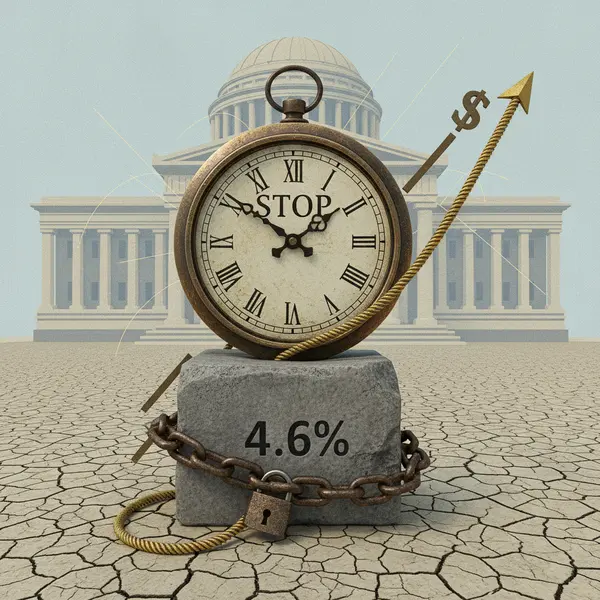
The Federal Reserve's six-month rate-cut freeze has driven the ten-year Treasury yield to 4.56% as sticky inflation and a divided FOMC extinguish market hopes for 2026 easing.
- The Fed has held its federal funds rate at 3.5%–3.75% since its December 2025 cut, the end of a 75-basis-point easing cycle.
- The ten-year Treasury yield climbed to 4.56%, just below the 2026 peak of 4.67% hit on May 19.
- Core PCE inflation at 3.3% annually has prompted markets to price out all rate cuts through year-end.
Lead
The Federal Reserve closed its April 28–29 meeting with an 8–4 vote to keep the federal funds target range at 3.50%–3.75%, extending what has become a six-month Fed pause and reshaping the monetary policy calculus across global fixed-income markets. With the June 16–17 meeting now priced at a 99.4% probability of no change, the bond market has absorbed the signal: the easing cycle that began in September 2025 is, for now, over.
What Happened
The April decision arrived with unusual internal friction. Three dissenters — Beth Hammack, Neel Kashkari, and Lorie Logan — supported holding rates but pushed to strip the statement's easing bias, arguing the language no longer reflected economic reality. A fourth dissent came from Governor Stephen Miran, who favored a 25-basis-point cut. The resulting split underscored how divergent views within the FOMC have become as data refuse to cooperate with the rate-cut narrative that dominated early-year forecasts.
Chair Jerome Powell, speaking at the post-meeting press conference, acknowledged that inflation remains elevated "in part reflecting the recent increase in global energy prices," a reference to supply disruptions tied to the ongoing Iran conflict. Powell also addressed mounting institutional pressure directly, warning that political attacks on the Fed are "battering this institution and putting at risk the things that really matter to the public" — namely, the capacity to conduct monetary policy free from political interference.
Kevin Warsh's nomination as Fed Chair meanwhile cleared the Senate Banking Committee along party lines, setting up a full Senate confirmation vote and adding an additional layer of uncertainty around future policy direction.
Treasury Yield Reaction
Treasury yields have tracked the Fed's posture higher in near-lockstep. The benchmark ten-year yield, which traded near 4.0% in late February, jumped further on April 29 as oil prices surged alongside the policy decision. A second leg higher followed on May 13, when stronger-than-expected PPI data pushed the ten-year to its highest level since July 2025. The yield has since settled at 4.56% — at the top of the 4.00%–4.50% range most institutional forecasters had assigned as a year-end anchor.The two-year yield, more sensitive to near-term Fed expectations, also moved higher over the intermeeting period alongside near-term inflation compensation, reflecting a market that has repriced both the timing and probability of cuts. Options-market pricing now reflects a modal path consistent with zero rate changes in 2026, a sharp reversal from the two-cut consensus that prevailed in January.
Inflation: The Binding Constraint
Inflation is the fulcrum of the entire debate. Core PCE, the Fed's preferred gauge, stood at 3.3% annually as of the latest reading — nearly 130 basis points above the 2% target. Headline PCE ran hotter at 3.8%. Month-over-month, the March print came in at 0.7%, placing it in the 90.9th percentile of its trailing 12-month range.Energy is a meaningful contributor. The Iran conflict has kept global supply under pressure and gasoline prices elevated, complicating an inflation picture that was already sticky across shelter and services categories. The Fed has made clear that it will not move until it has "greater confidence" that inflation is durably retreating — language that has functioned in practice as a high bar against premature easing.
The mathematical threshold that analysts identify for reopening the rate-cut door: sustained core PCE running below 0.2% month-over-month. A return to that pace could make a Q3 cut viable and, in theory, pull the ten-year back toward 4.0%. The prevailing consensus, however, holds that such deceleration is unlikely before late in the year at the earliest.
Strategic Context
The extended Fed pause carries broad consequences across asset classes. Higher-for-longer Treasury yields raise the discount rate applied to equities, compress refinancing windows for leveraged borrowers, and increase the cost of carrying the federal deficit — a concern that has itself contributed to a modest term premium re-emergence in longer maturities. For corporations with floating-rate debt, every month of pause translates directly into earnings pressure.
For fixed-income investors, the current environment places Treasury bonds at an inflection point. If inflation cools, duration exposure becomes attractive at current levels. If energy prices or services inflation re-accelerate, the 4.67% May peak becomes a floor rather than a ceiling.
Outlook
The Fed pause is no longer a short-term contingency — it is the base case. With the June meeting all but certain to produce another hold and markets pricing out cuts through December, the burden of proof now rests on the inflation data. Core PCE and the monthly CPI releases scheduled through the summer will determine whether the FOMC can begin to soften its tone at the September or November meetings. Until then, Treasury yields near 4.5% reflect a bond market that has accepted the reality of persistent inflation and a central bank with limited room to move.
Mentioned tickers: TLT, IEF, SHY, TBT, TMF