Pomegra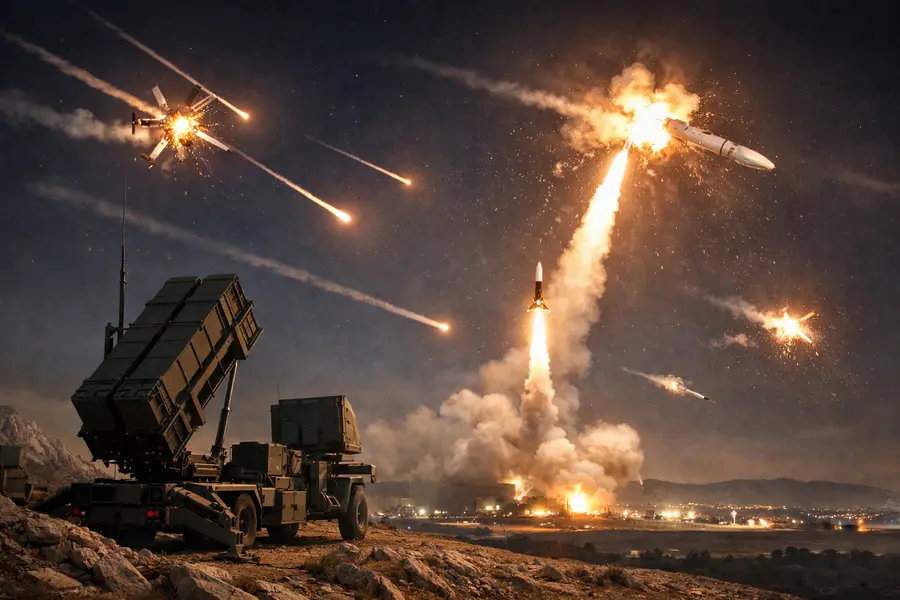
Jordan's air defense forces intercepted eight Iranian missiles before dawn on July 16, extending a weeks-long pattern of aerial attacks that has made the kingdom a front line in the widening US-Iran war.
- Jordan has shot down 222 of 240 Iranian missiles and drones fired since hostilities began in late February 2026.
- Iran's targeting of Muwaffaq Salti Air Base is assessed as a strategic "shaping" campaign to degrade Jordan's air defense ahead of potential strikes on Israel.
- The barrage is part of a simultaneous Iranian wave hitting Kuwait, Bahrain, Qatar, the UAE, and Oman, deepening the Middle East regional spillover.
Lead
Amman, July 16, 2026 — Jordanian air defense units destroyed eight Iranian ballistic missiles over the kingdom's eastern desert before dawn on Thursday, the Royal Jordanian Armed Forces announced, the latest volley in a campaign that has subjected the kingdom to 240 projectiles since the US-Israeli military operation against Iran began on February 28. No casualties or material damage were reported. The interceptions, conducted in accordance with established defensive procedures, took place near Muwaffaq Salti Air Base in Zarqa Governorate — a joint Royal Jordanian Air Force and US Air Force installation that has emerged as Iran's single most frequently targeted facility in Jordan.What Happened
The July 16 engagement followed three Iranian missiles intercepted the previous day. In the broadest wave of the conflict, launched in early March, Iran fired 240 missiles and drones at the kingdom within three weeks; Jordan's Jordan air defense drones and missile interceptor network neutralized 222 of them. The remaining 18 produced 414 debris incidents across the country, injuring 24 civilians — all of whom have since recovered, according to the Public Security Directorate.
Royal Jordanian Air Force F-16A/B fighters armed with AIM-120C AMRAAM and AIM-9M Sidewinder air-to-air missiles have scrambled repeatedly to engage Iranian UAVs crossing from the east. Ground-based Patriot and SHORAD batteries handle ballistic threats at shorter ranges, with US forces co-located at Muwaffaq Salti providing additional layered coverage.
Thursday's attack is part of a widened Iranian barrage tied to American strikes on Iranian targets around the Strait of Hormuz. Iran's Revolutionary Guard launched simultaneous missile and drone salvos against US facilities in Kuwait, hitting Ali Al Salem Air Base and a logistics depot, and against Bahrain, Qatar, the UAE, and Oman. The scale of targeting — six nations in a single operational sequence — marks the most extensive Middle East regional spillover of the conflict to date.
Strategic Context
Western security analysts characterize Iran's persistent strikes on Muwaffaq Salti as a shaping operation rather than a purely retaliatory gesture. By systematically stressing Jordan air defense stocks and radar assets, Tehran seeks to degrade the kingdom's ability to protect its own airspace — and, by extension, to intercept Iranian projectiles on their trajectory toward Israeli territory. Jordan and Israel have been coordinating air defense postures since the conflict's early weeks, a partnership Amman has not publicly confirmed but has not denied.
Jordan national security planners face a structural tension: the kingdom depends on US treaty commitments and military infrastructure — Muwaffaq Salti hosts American logistics and aerial refueling operations critical to regional force projection — yet its population is deeply sympathetic to Palestinian and Iranian narratives. King Abdullah II has consistently framed Jordan's defensive actions as the protection of national sovereignty rather than alignment with any belligerent, and has called publicly for a ceasefire and diplomatic resolution.The kingdom's geography places it on the most direct flight path from western Iran to Israel and the occupied West Bank. In that sense, Jordan national security has become structurally inseparable from the wider US-Iran confrontation, regardless of Amman's stated neutrality.
Geopolitical Dimension
The US Iran war impact on regional architecture has been substantial. Washington and Tehran signed a memorandum of understanding on June 17 intended to limit hostilities, but the agreement collapsed within weeks as renewed US strikes on Iranian targets around the Strait of Hormuz — itself declared a "red line" by the Revolutionary Guard — triggered successive Iranian retaliatory waves beginning July 8 and 9.
The Strait of Hormuz closure threat has been the single most consequential economic dimension of the conflict. Brent crude prices surged 39% from pre-war levels in the conflict's first two weeks, and remain elevated as tanker traffic through the strait operates at reduced volumes under Iranian interdiction threats. Bahrain has suffered particularly severe export losses; oil and aluminum shipments, which underpin more than two-thirds of government revenue, have been disrupted by a combination of missile strikes and maritime risk premiums. Gulf airline traffic has been rerouted northward, adding hours and fuel costs to long-haul services.
Beyond the Gulf, the US Iran war impact has filtered into global food systems, industrial supply chains, and financial conditions. The World Economic Forum and Oxford Economics have both revised down 2026 global growth forecasts, citing compounding inflation from energy and shipping disruptions.
What Comes Next
Jordan's immediate military priority is inventory management: intercepting 222 projectiles in less than five months has placed measurable strain on interceptor missile stocks, and replenishment logistics from the United States are subject to the same logistical constraints affecting all US forces in the region. Requests for expedited deliveries of Patriot PAC-3 interceptors are understood to be under active discussion between Amman and Washington.
Diplomatically, Jordan has joined Saudi Arabia and other Arab League states in condemning Iran's attacks, while stopping short of endorsing offensive US or Israeli operations on Iranian soil. The kingdom's ability to maintain that balance will be tested further if Iran escalates to targeting Jordanian civilian infrastructure, or if the shaping campaign against air defense sites succeeds in opening a corridor toward Israel.
The broader regional trajectory depends heavily on whether the collapsed June memorandum can be revived. US and Qatari mediators were reported to be in contact with Iranian interlocutors as of mid-July, but no new talks have been announced. Until a durable ceasefire framework is in place, Jordan and the Gulf states face the prospect of indefinite aerial attrition — a contingency for which none was fully prepared when the conflict began in late February.
Outlook
Jordan's air defense forces have demonstrated exceptional operational performance, maintaining an intercept rate above 90% over four months of sustained attack. That record has conferred strategic value on the kingdom but also made it a persistent target. As the US Iran war impact continues to ripple across the Middle East, Jordan's capacity to defend its airspace — and the stability of its balancing act between Washington and its own public — will remain a critical variable in the region's trajectory. The next 90 days, and whether US-Iranian diplomacy produces a renewed framework, will determine whether Amman's position remains tenable or buckles under compounding pressure.
Mentioned tickers: