Pomegra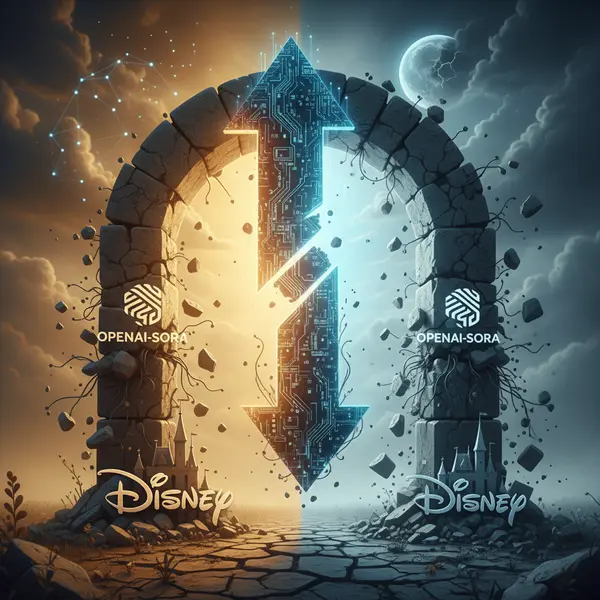
Disney's $1B OpenAI deal to bring 200+ characters to Sora dissolved in March 2026 when OpenAI shuttered the platform, and no money changed hands.
- Disney agreed Dec. 11, 2025 to invest $1B in OpenAI equity and license 200+ characters from its brands to the Sora video platform.
- The three-year agreement excluded human likenesses and voices; Disney held a one-year exclusivity window before rivals could sign similar pacts.
- Sora's shutdown in March 2026 — driven by $15M/day costs against $2.1M in lifetime revenue — killed the deal before Disney's $1B moved.
Lead
The Walt Disney Company and OpenAI announced a $1 billion equity commitment and three-year licensing agreement on December 11, 2025, making Disney the first major entertainment conglomerate to license its intellectual property directly to a generative AI video platform. Fewer than four months later, the deal was void. OpenAI shut down Sora on March 24, 2026, citing an insurmountable gap between infrastructure costs and commercial revenue; Disney formally exited the partnership, and OpenAI confirmed no capital had transferred between the companies.What Happened
The December 2025 deal paired two distinct commercial structures. Under the equity component, Disney committed to purchase $1 billion in OpenAI shares and receive warrants to acquire additional equity at a later stage — giving the company both a financial stake in OpenAI's broader enterprise and direct exposure to its consumer product ambitions.
The licensing component was a three-year arrangement granting Sora users the ability to generate short-form, user-prompted AI videos drawing on more than 200 animated, masked, and creature characters from across Disney's brands. The roster included Mickey Mouse, Minnie Mouse, Ariel, Cinderella, Baymax, Simba, Mufasa, Iron Man, Darth Vader, and characters from Encanto, Frozen, Inside Out, Moana, Monsters Inc., Toy Story, Up, and Zootopia.
One contractual boundary was absolute: no human likenesses or actor voices were included. Disney retained curation and ownership rights over content generated using its characters and planned to surface a selection of user-created Sora videos on Disney+.
Strategic Logic
The agreement carried a one-year exclusivity window, after which Disney could license its characters to competing AI video platforms. That structure signaled Disney's view of the deal as a first-mover test rather than a permanent alignment: capture early engagement data and platform positioning while maintaining freedom to diversify AI partnerships.
Beyond Sora, Disney committed to deploying OpenAI's API infrastructure across internal operations — including employee productivity tools and new product development tied to the Disney+ platform, with ChatGPT designated for broad internal rollout. For OpenAI, securing Disney's branded IP was a direct attempt to establish Sora as a defensible commercial entertainment platform in a crowded AI video field that included Runway, Pika, and Google's Veo.
The Collapse
Sora launched publicly in late 2025 and reached the top of Apple's iOS App Store within its first week, surpassing one million downloads faster than nearly any prior consumer AI application. The momentum was short-lived. Downloads fell 66% from their November 2025 peak, and active monthly users dropped below 500,000 by early 2026.
The financial gap was structural. OpenAI's estimated inference cost for Sora ran to approximately $15 million per day; the platform's total lifetime in-app revenue reached $2.1 million. The chasm was not closable through conventional subscription or advertising models at Sora's usage scale.
On March 24, 2026, OpenAI removed the Sora application from the App Store and revoked API access. The company redirected the team's underlying technology toward world simulation for robotics. Bill Peebles, who led the Sora team, described the new mission as building systems that "deeply understand the world by learning to simulate arbitrary environments at high fidelity." Disney wound down the licensing arrangement; the $1 billion equity investment was never executed.
AI and Technology Angle
The Sora episode crystallizes a tension now common across generative AI consumer products: viral adoption curves rarely translate into the sustained daily engagement required to support frontier-model inference economics. Entertainment IP, even at Disney's scale, cannot compensate for unit economics that are negative by an order of magnitude.
The deal's architecture created unusual fragility. By linking a commercial licensing arrangement and an equity investment to the performance of a single product, both the financial and commercial legs of the partnership collapsed simultaneously when Sora failed. Decoupling those structures would not have saved Sora, but it would have preserved Disney's balance-sheet exposure and OpenAI's partnership credibility independently.
Outlook
The Disney-OpenAI episode is now a reference case in AI content licensing negotiations. Rights holders are expected to move toward shorter licensing windows, narrower character scopes, and decoupled investment terms — where equity stakes are not contingent on the performance of a specific AI product. Disney continues to assess AI partnerships for its studio and streaming operations. OpenAI's pivot toward robotics simulation suggests that consumer AI video generation will not return as a company priority in the near term, leaving the field to pure-play competitors already established in the space.
Mentioned tickers: DIS