Pomegra
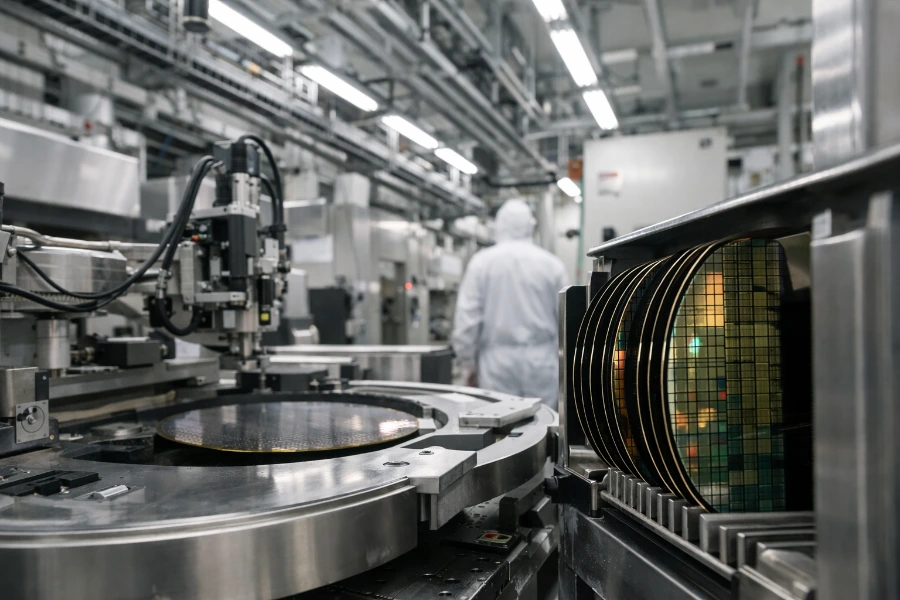
China's CSI Semiconductor index jumped a record 17.6% on Friday after the State Council pledged expanded national team support, lifting the CSI 300 4%.
- The CSI Semiconductor index rose 17.6% on Nov. 27, its largest one-day gain on record.
- The State Council explicitly named the "national team" of state-backed funds for the first time in a meeting document.
- The CSI 300 gained 4%, its biggest jump since October 2024, on turnover 52% above the prior session.
Lead
Chinese chip stocks posted their biggest one-day gain on record on Friday, Nov. 27, 2026. The CSI Semiconductor index of 40 stocks climbed 17.6%, surpassing the previous record of nearly 17% set in late 2024. The move followed a State Council meeting chaired by Premier Li Qiang, which pledged a bigger role for the "national team," the state-backed funds that buy equities to steady the market. The rally put AI stocks and chipmakers at the center of the strongest session for mainland equities in more than a year.
What Happened to China's Chip Stocks?
China's chip stocks rallied sharply across the board, with a semiconductor sub-index gaining 19%, also a record. The STAR Market index rose 14%, led by chipmakers including Semiconductor Manufacturing International Corp (SMIC, 688981.SS) and Cambricon Technologies (688256.SS). The broader CSI 300 index climbed 4%, its largest single-day advance since October 2024.
Trading volume surged. Full-day turnover across the Shanghai, Shenzhen and Beijing exchanges was 52% higher than in the previous session. In Hong Kong, the Hang Seng index gained 2%.
Why Did Beijing's National Team Pledge Move Markets?
The pledge moved markets because it was the first time the State Council explicitly referenced the "national team" in a public meeting document. Officials committed to strengthen the role of state-backed funds in stabilizing markets and ensuring ample liquidity. The national team, led by entities such as Central Huijin Investment, has historically stepped in during selloffs to buy index-linked assets.
The announcement gave no figure for how much capital would be deployed. State media said only that Huijin has "plenty of firepower." Even so, an explicit signal from the cabinet-level body was enough to reset risk appetite, particularly in the high-valuation, high-volatility chip segment where retail participation is heavy.
Strategic Context
Semiconductors sit at the core of China's technology self-reliance push. U.S. export restrictions on advanced AI chips limit sales of products from companies such as Nvidia (NVDA) into the Chinese market. That has directed domestic demand toward local designers and foundries and made the sector a policy priority.
The rally also reflects Beijing's effort to support domestic equity valuations in a sector that funds the country's AI ambitions. Higher share prices lower the cost of capital for chip firms raising money on the STAR Market. Foreign-listed chip exposures, including the VanEck Semiconductor ETF (SMH) and leveraged products such as the Direxion Daily Semiconductor Bull 3x Shares (SOXL), are weighted toward U.S. names and were not the focus of the move.
What Comes Next for Chinese AI Stocks?
The next test for Chinese AI stocks is whether state support turns from a signal into measurable buying. A one-day gain of this size leaves the sector vulnerable to profit-taking if the national team does not appear in the market, or if the pledge is not followed by specifics on funding or on the pace of intervention.
Three variables will shape the next 3 to 12 months:
- Scale and visibility of state buying. Exchange-traded fund flows and Huijin disclosures will indicate whether the pledge is backed by capital.
- Export controls. Any change in U.S. rules on advanced AI chips would alter demand for domestic substitutes.
- Earnings delivery. Revenue and margin results from firms such as SMIC and Cambricon will determine whether valuations hold once the policy impulse fades.
Past national team episodes, including the market stabilization in 2015 and the support steps in early 2024, produced sharp initial rebounds followed by uneven follow-through, depending on the strength of the underlying economic data.
Outlook
The CSI Semiconductor index recorded its largest daily gain on record, 17.6%, as Beijing put state-backed funds at the center of its market stabilization approach. Broader indices followed, with the CSI 300 up 4% on heavy volume. The size of the national team's actual deployment, the direction of U.S. chip export policy and corporate earnings will decide whether Friday's move marks a durable rerating or a policy-driven spike.
Mentioned tickers: 688981.SS, 688256.SS, NVDA, SMH, SOXL