Pomegra
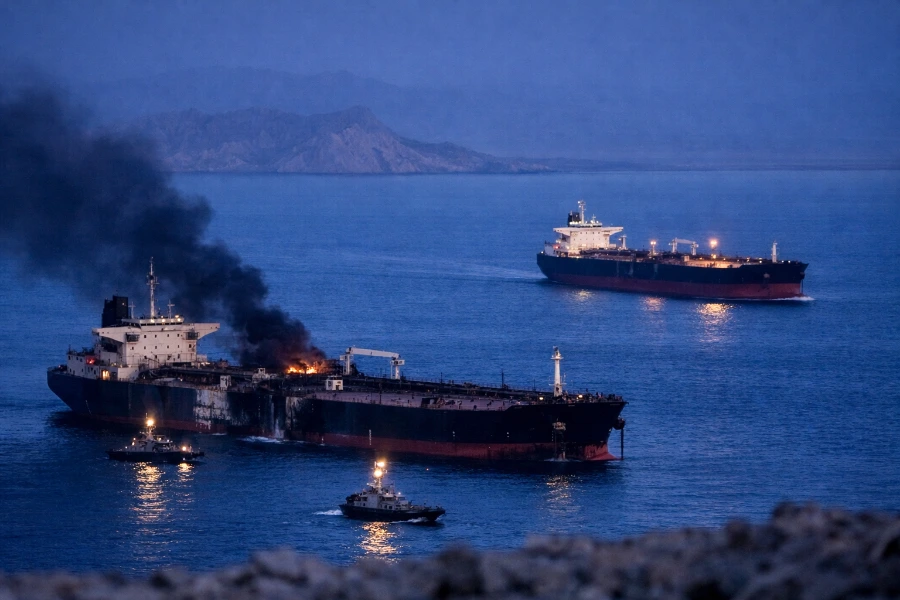
Iran's Revolutionary Guards say two tankers struck naval mines in the Strait of Hormuz, pushing the crude oil price to $96.57 as ships avoid the route.
- Iran's Revolutionary Guards said two tankers hit mines and caught fire north of Oman's Khasab port on November 26.
- Brent settled at $96.57 a barrel, up $1.96, its third straight daily gain.
- Ship traffic through Hormuz was running at about 9% of its pre-war rate as of November 24.
Lead
The Islamic Revolutionary Guard Corps said on Thursday, November 26, that two oil tankers exploded and caught fire after hitting naval mines north of Oman's Khasab port. The ships were attempting to cross the Strait of Hormuz on a route Tehran had not authorized. One was a supertanker carrying more than 2 million barrels of crude. The Guards described the incident as proof of their control over the waterway. The vessels have not been named, and Iran's account has not been independently confirmed. Brent crude settled at $96.57 a barrel.
What Did Iran's Revolutionary Guards Say Happened?
The Guards said both tankers suffered explosions and fires after striking mines in the narrow channel off Oman's northern coast. They said the ships had chosen an unauthorized transit path rather than coordinating passage with Iranian forces.
The claim follows a similar one earlier in the week. On November 24, the Guards said three tankers hit mines while moving under a U.S. military escort, which they said failed to prevent the damage. Washington widened Treasury sanctions on Iran the same day. A further two-tanker claim came on November 25. The Guards have framed each episode as a demonstration that passage depends on Iranian coordination.
Why Are Ships Avoiding the Strait of Hormuz?
Shipowners and insurers are avoiding the strait because the mine risk cannot be priced or ruled out, and because transiting with Iranian coordination carries its own political and sanctions exposure. As of November 24, AIS-visible traffic was running at roughly 9% of its pre-war rate. Oil flows were about half of normal.
The strait links Gulf producers to Asian and European buyers and has historically carried about a fifth of global oil consumption. Few alternative routes exist. Saudi and Emirati pipelines to the Red Sea and the Gulf of Oman can bypass part of the volume, but not all of it. Tankers that wait or reroute add days to voyage times and raise freight and war-risk insurance costs. Those costs feed through to delivered fuel prices even when the physical barrels eventually arrive.
How Are Oil Prices Reacting?
Oil prices are rising steadily rather than spiking. Brent futures settled at $96.57 a barrel on Thursday, a gain of $1.96 and the third consecutive daily advance. Trading earlier in the week ranged through the low-to-mid $90s before the latest claims lifted the benchmark toward $97.
A separate Houthi claim of an attack on Saudi Arabia's Ras Tanura energy complex added to supply concerns. Together, the mine reports and the Houthi claim have layered a Red Sea and Gulf risk premium onto a market that was already pricing reduced Hormuz throughput.
Traders are watching three variables. The first is whether the mine claims are verified by satellite imagery or ship operators. The second is whether the U.S. escort model continues after the reported failure on November 24. The third is whether Iran's transit-permit approach becomes a standing regime. The permit approach would give Tehran a way to meter flows and press buyers without a full closure.
Geopolitical Dimension
The Guards' mine claims serve a strategic purpose beyond the tanker incidents themselves. By tying losses to unauthorized routing, Tehran is asserting that safe passage is a function of its consent. That challenges the U.S. position that the strait is an international waterway open to all commercial traffic.
Washington's response so far combines naval escorts with financial pressure. The new sanctions target Iran's revenue channels, while the escorts aim to restore confidence among shipowners. If mine strikes continue under escort, the credibility of the escort model weakens, and operators may default to waiting at anchor.
Iran's own exports also depend on the strait, which limits how far Tehran can push before harming itself. That constraint explains why the Guards stress coordination and permits rather than outright prohibition.
What Comes Next for the Crude Oil Price?
The crude oil price is likely to track verified shipping data over the next three to twelve months more closely than any single incident. If traffic stays near 9% of pre-war levels and flows hold at about half of normal, inventories and strategic reserves become the main buffer. Prices would face upward pressure toward and above $100.
A credible verification of mine clearance, or a negotiated transit arrangement, would ease the premium. A confirmed mass-casualty or environmental event from a burning supertanker would raise it sharply. Structurally, the episode strengthens the case for pipeline bypass capacity and wider tanker insurance schemes across the Gulf.
Outlook
Iran says two more tankers have been lost to mines in Hormuz, adding to claims earlier in the week. Brent has risen for three sessions to $96.57, while shipping through the strait remains a fraction of normal. The next price move depends on independent confirmation of the incidents, the fate of U.S. escorts, and whether Tehran's permit regime hardens into policy.
Mentioned tickers: None