Pomegra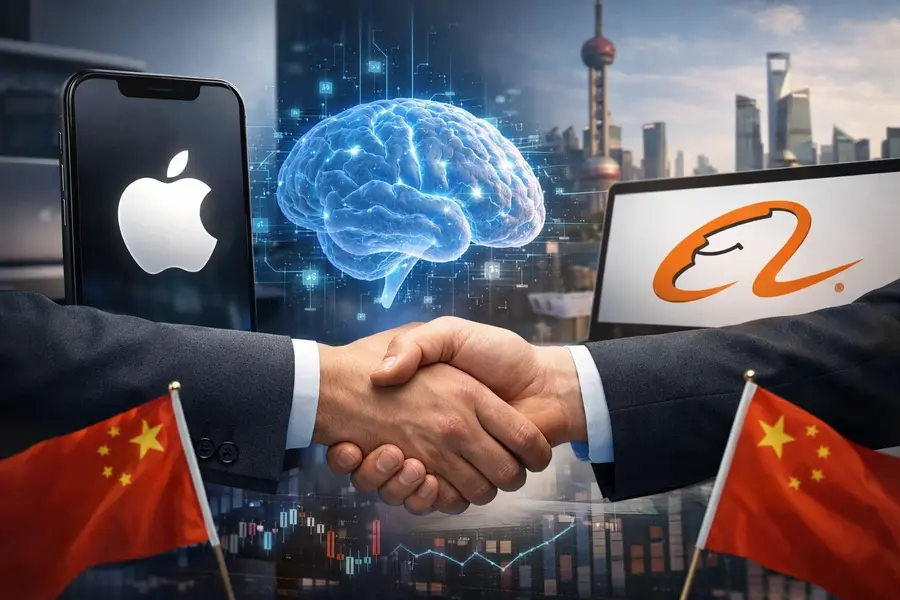
China's Cyberspace Administration cleared Apple Intelligence on July 15, 2026, with Alibaba's Qwen AI model set to power the service across iOS, iPadOS, macOS, and visionOS for mainland users.
- China's CAC added Apple to its approved generative AI registry on July 15, 2026, removing a key barrier to a mainland Apple Intelligence launch.
- Alibaba's Qwen AI model will be the primary engine powering Apple Intelligence in China; Baidu contributes on a secondary scale.
- Alibaba's U.S.-listed shares gained more than 4% on the announcement; a commercial rollout is expected alongside Apple's fall 2026 OS updates.
Lead
China's top internet regulator granted Apple regulatory clearance for its artificial intelligence platform on Wednesday, July 15, 2026, listing the company's generative AI service among newly approved providers under the Cyberspace Administration of China. The approval confirms the Apple Alibaba partnership as the structural foundation of the rollout, with Alibaba's Qwen AI model set to serve mainland users across iOS, iPadOS, macOS, and visionOS. Baidu holds a smaller supporting role in the arrangement. The decision opens the door to the world's largest smartphone market for a suite of AI features that have been available in most other major markets for the better part of a year.
What Happened
China requires any company offering large language models or generative AI services to the public to register with the CAC before launch. Apple's listing on the regulator's approved-provider registry on Wednesday fulfills that prerequisite. Alibaba confirmed that its Qwen large-language model — the Alibaba Qwen AI model that underpins much of the group's domestic AI strategy — will be integrated directly into Apple Intelligence, enabling text generation, image processing, and related features from within Apple's native interface, without requiring users to open a separate application.
The regulatory filing does not carry an automatic launch date. A public rollout is expected in conjunction with Apple's fall 2026 operating system updates, after the company completes security reviews, engineering adaptation, and localization work required under Chinese rules.
Market Reaction
Alibaba's American depositary receipts rose more than 4% in pre-market trading on the news and extended gains to above 6% as markets opened. The move reflects investor confidence that the AAPL China AI arrangement deepens Alibaba's position in the domestic AI ecosystem at a moment when the company is competing intensely with domestic rivals including ByteDance and Baidu. Apple (AAPL) shares also moved higher in early trading, building on a backdrop of improving China revenue. Greater China sales grew 28% to $20.5 billion in the most recent quarter, a recovery that management attributed in part to the anticipation of AI-enabled product upgrades. The Apple Intelligence China approval reinforces that demand thesis heading into the upgrade cycle.Strategic Context
The Apple Alibaba partnership resolves a structural problem that has constrained Apple's AI roadmap in China since Apple Intelligence launched elsewhere. Chinese regulations prohibit foreign AI models from operating on-device or via cloud for domestic consumers without CAC registration. By embedding Alibaba's Qwen AI model — itself already a registered, domestically compliant system — Apple sidesteps the regulatory barrier while preserving the integrated user experience central to its AI strategy.
The arrangement mirrors Apple's approach in other markets, where it partnered with OpenAI to power certain Apple Intelligence features without displacing its own on-device model layer. In China, Qwen fills the role OpenAI occupies elsewhere, granting Apple regulatory standing while giving Alibaba deep distribution into hundreds of millions of active Apple devices.
Geopolitical Dimension
The clearance arrives as technology competition between the United States and China has sharpened materially. Alibaba recently restricted staff access to tools from U.S. AI developers, and members of the U.S. Congress are weighing legislation that would limit American companies' reliance on Chinese AI technology. The AAPL China AI deal illustrates the commercial calculus at work: both sides accept strategic entanglement because the market opportunity outweighs the political friction.
For Apple, China remains a critical revenue and manufacturing anchor. For Beijing, approving Apple Intelligence with a domestic AI backbone — Qwen rather than OpenAI — preserves data sovereignty while allowing a globally recognizable platform to showcase Chinese AI capabilities to hundreds of millions of consumers.
What Comes Next
The CAC listing is a prerequisite, not a launch. Apple must still complete software engineering work, satisfy any additional security review requirements, and align the rollout with an iOS or macOS update cycle. The fall 2026 software release window is the most likely vehicle. If the timeline holds, Chinese iPhone users could access Apple Intelligence features powered by the Alibaba Qwen AI model before year-end.
Outlook
The Apple Intelligence China approval resolves one of the most consequential regulatory overhangs on Apple's global AI rollout. With the Apple Alibaba partnership now formalized, Apple can advance its upgrade narrative in Greater China while Alibaba gains a high-visibility deployment for the Qwen platform. Near-term market attention will focus on the exact launch date, the scope of features cleared for release, and any hardware limitations tied to on-device model requirements.
Mentioned tickers: AAPL, BABA, BIDU