Pomegra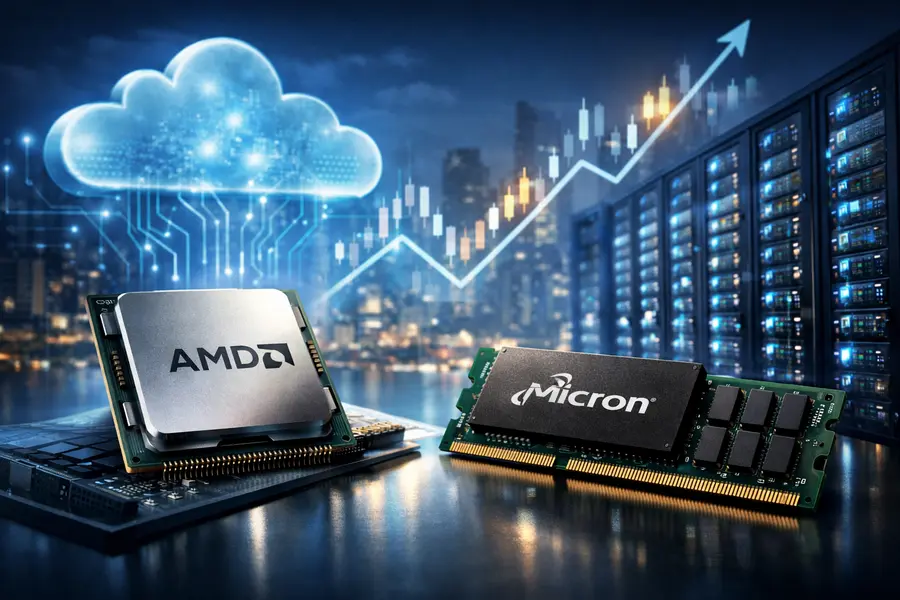
Advanced Micro Devices and Micron Technology are driving the broader chip stock recovery as Microsoft's $190 billion Azure AI infrastructure build fuels unprecedented semiconductor demand in 2026.
- AMD stock surged 5–6% after Microsoft announced deployment of the Helios Rackscale AI system on Azure, scheduled for H2 2026.
- Micron's Q3 2026 revenue hit $41.5 billion — more than four times year-ago levels — with high-bandwidth memory sold out through year-end.
- The global semiconductor industry is on track to surpass $975 billion in 2026, with AI chips accounting for more than half of total revenue.
Lead
Advanced Micro Devices (AMD) shares jumped as much as 6% on July 20 after Microsoft confirmed it would deploy AMD's Helios Rackscale Solution — a full-rack AI inference system combining Instinct MI455X GPUs, sixth-generation EPYC "Venice" CPUs, Pensando networking, and ROCm software — across its Azure cloud platform beginning in the second half of 2026. The deal validated AMD's challenge to NVIDIA's data center dominance and sent a broad wave of optimism through semiconductor industry equities, lifting Micron Technology (MU) alongside AMD as institutional investors repositioned ahead of a wave of AI infrastructure spend that Microsoft has now pegged at $190 billion for calendar 2026.What Happened
Microsoft's decision to standardize on AMD's Helios system for Azure AI inference represents the most significant hyperscaler commitment to an AMD-built data center platform to date. The agreement covers two new Azure virtual machine series: HDv2, targeting agentic AI workloads, and HXv2, designed for semiconductor design and electronic design automation — a pairing that underscores the breadth of compute use cases AMD is now addressing. Deliveries are scheduled to begin in H2 2026, with capacity additions phased across Microsoft's expanding global footprint.
AMD stock has gained 160% year-to-date in 2026, outpacing nearly every major index, though it remains roughly 17% below its June 30 intraday peak of $584.73. The Azure deal supplied fresh momentum, with Goldman Sachs raising its price target on AMD to $640 from $450, citing accelerating demand for high-performance processors across agentic AI workflows.Market Reaction
The chip stock recovery broadened well beyond AMD on the session. Micron, whose high-bandwidth memory is an integral component of AI accelerator systems including those paired with AMD GPUs, extended a remarkable 2026 run. Micron's fiscal third-quarter revenue of $41.5 billion — against $9.3 billion in the year-ago period — had already set the tone heading into the week, making it one of the fastest companies in history to cross the $1 trillion market capitalization threshold.
Micron's HBM inventory is completely sold out through the end of 2026, with supply constraints expected to persist well into 2027. The company has secured $22 billion in multi-year take-or-pay supply commitments from major customers and is projecting fiscal 2026 capital expenditure of $27 billion, nearly double the prior year. A supply agreement with Anthropic covering HBM, DRAM, and enterprise SSDs, announced separately, reinforced the view that the memory market has moved from cyclical recovery to structurally constrained environment.
Strategic Context
The Microsoft-AMD deal reflects a deliberate diversification strategy among hyperscalers seeking to reduce single-vendor exposure in AI silicon. Microsoft Azure AI reached a $37 billion annual revenue run rate in its most recent reported quarter — up 123% year-over-year — adding urgency to securing alternative compute capacity at scale. Azure's commercial remaining performance obligations stand at $627 billion, up 99% year-on-year, making supply assurance a board-level concern.
Microsoft has committed to doubling AI infrastructure capacity within two years and added one gigawatt of additional compute capacity in the March 2026 quarter alone. The $190 billion capital expenditure figure for 2026, which includes $25 billion earmarked to offset cost increases in DRAM, flash, wafers, and substrates, signals that the cloud giant is treating semiconductor access as a core strategic input rather than a procurement line item.
Semiconductor Industry Dynamics
Semiconductor industry news in 2026 has been dominated by the divergence between AI-driven segments and the rest of the market. IDC forecasts global semiconductor revenues of between $975 billion and $1.29 trillion for the year, implying growth of 26% to more than 50% depending on the scenario. AI-supporting chips — GPUs, HBM, advanced logic, and custom ASICs — are projected to account for roughly $500 billion, or more than half of total industry revenue, despite representing less than 0.2% of total unit volume.The memory segment is at the sharpest inflection. IDC forecasts DRAM revenues of $418.6 billion for 2026, a 177% year-on-year increase. This contrasts with a more muted recovery across automotive, industrial, and legacy consumer segments, where inventory normalization is proceeding at a slower pace and pricing power remains limited.
For AMD, the Helios system represents the convergence of its CPU and GPU roadmaps into a single, integrated rack-scale architecture — a format NVIDIA pioneered with NVL72 configurations and one that cloud customers increasingly prefer for its power density, operational simplicity, and software stack coherence. AMD's ROCm software ecosystem has been cited by Microsoft engineers as a factor in the platform's readiness for enterprise AI deployment.
Outlook
The Microsoft-AMD Helios deal positions AMD stock as a direct beneficiary of hyperscaler diversification away from NVIDIA, with Azure deployments scheduled to scale through the end of 2026. Micron remains a critical enabler across the AI chip ecosystem — its sold-out HBM position and long-term supply agreements insulate revenue visibility well into 2027. For the broader semiconductor industry, the structural shift toward AI-centric demand shows no sign of reversal: Microsoft's $190 billion commitment and Azure's triple-digit revenue growth rates indicate that the infrastructure buildout is deepening, not plateauing. The chip stock recovery of 2026 is increasingly less a recovery and more a repricing of what semiconductor capacity is worth in an AI-driven economy.